Ch. 7 - Structure and Synthesis of Alkenes; Elimination
Wade - Organic Chemistry 9th Edition
Wade9th EditionOrganic ChemistryISBN: 9780135213728Not the one you use?Change textbook
Chapter 7, Problem 8i

Some of the following examples can show geometric isomerism, and some cannot. For the ones that can, draw all the geometric isomers, and assign complete names using the E-Z system.
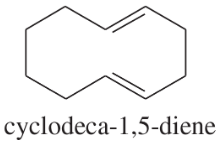
(i)

Verified step by step guidance
1
Identify the structure of cyclodeca-1,5-diene. It is a 10-membered carbon ring with two double bonds located at the 1st and 5th positions.
Determine if the compound can exhibit geometric isomerism. Geometric isomerism occurs in alkenes when there are different substituents on the carbon atoms involved in the double bond, allowing for cis-trans or E-Z isomerism.
For cyclodeca-1,5-diene, examine the double bonds. Each double bond in a ring can potentially show geometric isomerism if the ring is large enough to allow for different spatial arrangements.
Draw the possible geometric isomers. For each double bond, consider the spatial arrangement of the substituents around the double bond. In a ring, this can be more complex due to the ring's constraints.
Assign the E-Z configuration to each double bond. Use the Cahn-Ingold-Prelog priority rules to determine the priority of the substituents attached to the double-bonded carbons. Assign 'E' if the higher priority groups are on opposite sides and 'Z' if they are on the same side.

Verified video answer for a similar problem:

This video solution was recommended by our tutors as helpful for the problem above.
Video duration:
4m
Was this helpful?

Key Concepts

Here are the essential concepts you must grasp in order to answer the question correctly.

Geometric Isomerism

Geometric isomerism, also known as cis-trans isomerism, occurs in compounds with restricted rotation around a bond, typically a double bond or within a ring structure. This results in different spatial arrangements of substituents, leading to distinct isomers. Understanding geometric isomerism is crucial for identifying and drawing all possible isomers of a compound.
Recommended video:
Guided course
06:47
Monosaccharides - D and L Isomerism

E-Z Nomenclature

The E-Z system is a method of naming geometric isomers based on the priority of substituents attached to the double-bonded carbons. 'E' (from the German 'entgegen') indicates that the higher priority groups are on opposite sides, while 'Z' (from 'zusammen') means they are on the same side. This system provides a clear and systematic way to name and differentiate isomers.
Recommended video:
Guided course
03:48
E/Z Diastereoisomerism

Cycloalkenes

Cycloalkenes are cyclic hydrocarbons containing one or more carbon-carbon double bonds. The presence of a ring structure can restrict rotation, making geometric isomerism possible. In cycloalkenes like cyclodeca-1,5-diene, the size of the ring and the position of the double bonds are critical factors in determining the possibility and number of geometric isomers.
Recommended video:
Guided course
01:11
How to find the root name for cycloalkanes
Related Practice
Textbook Question

How many stereogenic double bonds are in octa-1,3,5-triene? How many stereocenters are there? Draw and name the four stereoisomers of octa-1,3,5-triene.

1473
views

Textbook Question

Draw the six stereoisomers of octa-2,4,6-triene. Explain why there are only six stereoisomers, rather than the eight we might expect for a compound with three stereogenic double bonds.

2227
views
Textbook Question

Teflon-coated frying pans routinely endure temperatures that would cause polyethylene or polypropylene to oxidize and decompose. Decomposition of polyethylene is initiated by free-radical abstraction of a hydrogen atom by O2. Bond-dissociation energies of C—H bonds are about 400 kJ/mol, and C—F bonds are about 460 kJ/mol. The BDE of the H—OO bond is about 192 kJ/mol, and the F—OO bond is about 63 kJ/mol. Show why Teflon (Figure 7-5) is much more resistant to oxidation than polyethylene is.

1208
views
Textbook Question

Some of the following examples can show geometric isomerism, and some cannot. For the ones that can, draw all the geometric isomers, and assign complete names using the E-Z system.

c. 3-bromo-2-methylhex-3-ene

d. penta-1,3-diene

1535
views
Textbook Question

Some of the following examples can show geometric isomerism, and some cannot. For the ones that can, draw all the geometric isomers, and assign complete names using the E-Z system.

e. 3-ethyl-5-methyloct-3-ene

f. 3,7-dichloroocta-2,5-diene

1164
views
Textbook Question

Some of the following examples can show geometric isomerism, and some cannot. For the ones that can, draw all the geometric isomers, and assign complete names using the E-Z system.

(g)

(h)

1137
views