Ch. 7 - Structure and Synthesis of Alkenes; Elimination
Wade - Organic Chemistry 9th Edition
Wade9th EditionOrganic ChemistryISBN: 9780135213728Not the one you use?Change textbook
Chapter 7, Problem 36a

The dehydrogenation of butane to trans-but-2-ene has ΔH° = +116 kJ/mol (+27.6 kcal/mol) and ΔS° = +117J/kelvin-mol (+28.0 cal/kelvin-mol).
a. Compute the value of ΔG° for dehydrogenation at room temperature (25 °C or 298 °K). Is dehydrogenation favored or disfavored?
HINT: When you are doing synthesis problems, avoid using these high-temperature industrial methods. They require specialized equipment, and they produce variable mixtures of products.

Verified step by step guidance
1
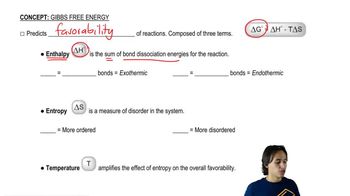
Step 1: Recall the Gibbs free energy equation: ΔG° = ΔH° - TΔS°. This equation relates the change in enthalpy (ΔH°), the change in entropy (ΔS°), and the temperature (T) to determine the spontaneity of a reaction.
Step 2: Convert all units to be consistent. Ensure ΔH° is in joules (J) and ΔS° is in joules per kelvin (J/K). For ΔH° = +116 kJ/mol, convert to joules: 116 kJ/mol × 1000 J/kJ = 116,000 J/mol.
Step 3: Use the given temperature, T = 298 K (room temperature), and substitute the values into the Gibbs free energy equation: ΔG° = ΔH° - TΔS°. Substituting, ΔG° = 116,000 J/mol - (298 K × 117 J/K·mol).
Step 4: Perform the multiplication for the TΔS° term: TΔS° = 298 K × 117 J/K·mol. Subtract this value from ΔH° to calculate ΔG°.
Step 5: Analyze the sign of ΔG°. If ΔG° is negative, the reaction is thermodynamically favored (spontaneous). If ΔG° is positive, the reaction is thermodynamically disfavored (non-spontaneous).

Verified video answer for a similar problem:

This video solution was recommended by our tutors as helpful for the problem above.
Video duration:
6m
Was this helpful?

Key Concepts

Here are the essential concepts you must grasp in order to answer the question correctly.

Gibbs Free Energy (ΔG°)

Gibbs Free Energy (ΔG°) is a thermodynamic potential that indicates the spontaneity of a reaction at constant temperature and pressure. It is calculated using the equation ΔG° = ΔH° - TΔS°, where ΔH° is the change in enthalpy, T is the temperature in Kelvin, and ΔS° is the change in entropy. A negative ΔG° value suggests that the reaction is spontaneous, while a positive value indicates non-spontaneity.
Recommended video:
Guided course
05:02
Breaking down the different terms of the Gibbs Free Energy equation.

Enthalpy (ΔH°)

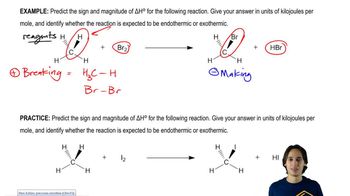
Enthalpy (ΔH°) is a measure of the total heat content of a system and reflects the energy required to break and form bonds during a chemical reaction. In the context of the dehydrogenation of butane, a positive ΔH° value (+116 kJ/mol) indicates that the reaction is endothermic, meaning it absorbs heat from the surroundings. This factor can influence the spontaneity of the reaction when combined with entropy changes.
Recommended video:
Guided course
04:38
Calculating Enthalpies

Entropy (ΔS°)

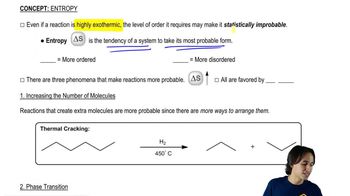
Entropy (ΔS°) is a measure of the disorder or randomness in a system. A positive ΔS° value (+117 J/K·mol) suggests that the products of the reaction have greater disorder compared to the reactants. In chemical reactions, an increase in entropy often favors spontaneity, as systems tend to evolve towards states of higher disorder. The interplay between ΔH° and ΔS° is crucial for determining the overall spontaneity of a reaction.
Recommended video:
Guided course
02:46
Explaining what entropy is.
Related Practice
Textbook Question

Show the product(s) you expect from dehydration of the following alcohols when they are heated in sulfuric or phosphoric acid. In each case, use a mechanism to show how the products are formed.

(b)

977
views

Textbook Question

Show the product(s) you expect from dehydration of the following alcohols when they are heated in sulfuric or phosphoric acid. In each case, use a mechanism to show how the products are formed.

(c)

697
views
Textbook Question

For practice in recognizing mechanisms, classify each reaction according to the type of mechanism you expect:

1. Free-radical chain reaction

2. Reaction involving strong bases and strong nucleophiles

3. Reaction involving strong acids and strong electrophiles

(b)

1518
views
Textbook Question

For practice in recognizing mechanisms, classify each reaction according to the type of mechanism you expect:

1. Free-radical chain reaction

2. Reaction involving strong bases and strong nucleophiles

3. Reaction involving strong acids and strong electrophiles

(c)

1526
views
Textbook Question

For practice in recognizing mechanisms, classify each reaction according to the type of mechanism you expect:

1. Free-radical chain reaction

2. Reaction involving strong bases and strong nucleophiles

3. Reaction involving strong acids and strong electrophiles

(a)

1539
views
Textbook Question

Show the product(s) you expect from dehydration of the following alcohols when they are heated in sulfuric or phosphoric acid. In each case, use a mechanism to show how the products are formed.

(a)

2172
views