Ch. 7 - Structure and Synthesis of Alkenes; Elimination
Wade - Organic Chemistry 9th Edition
Wade9th EditionOrganic ChemistryISBN: 9780135213728Not the one you use?Change textbook
Chapter 7, Problem 68a

When (±)−2,3−dibromobutane reacts with potassium hydroxide, some of the products are (2S,3R)-3-bromobutan-2-ol and its enantiomer and trans-2-bromobut-2-ene. Give mechanisms to account for these products.
Structural representations of (2S,3R)-3-bromobutan-2-ol, its enantiomer, and trans-2-bromobut-2-ene.

Verified step by step guidance
1
Step 1: Analyze the reactant (±)-2,3-dibromobutane. This molecule is a racemic mixture containing two stereocenters. The bromine atoms are located on carbons 2 and 3, and the molecule can undergo substitution and elimination reactions when treated with potassium hydroxide (KOH).
Step 2: For the formation of (2S,3R)-3-bromobutan-2-ol and its enantiomer (2R,3S)-3-bromobutan-2-ol, consider a nucleophilic substitution (SN2) mechanism. The hydroxide ion (OH⁻) from KOH acts as a nucleophile and attacks one of the carbon atoms bearing a bromine atom, leading to the replacement of the bromine atom with a hydroxyl group (-OH). This reaction proceeds with inversion of configuration at the carbon center due to the backside attack characteristic of SN2 reactions.
Step 3: For the formation of trans-2-bromobut-2-ene, consider an elimination (E2) mechanism. The hydroxide ion (OH⁻) acts as a base and abstracts a proton from a β-carbon (a carbon adjacent to the carbon bearing the bromine atom). This leads to the formation of a double bond between the α-carbon and β-carbon, with the bromine atom leaving as a bromide ion (Br⁻). The trans configuration is favored due to steric considerations.
Step 4: Recognize that the reaction conditions (presence of KOH) allow both substitution and elimination mechanisms to occur simultaneously. The stereochemistry of the products depends on the specific pathway (SN2 or E2) and the stereochemical configuration of the starting material.
Step 5: Summarize the mechanisms: The substitution reaction produces (2S,3R)-3-bromobutan-2-ol and its enantiomer (2R,3S)-3-bromobutan-2-ol via SN2 inversion. The elimination reaction produces trans-2-bromobut-2-ene via an E2 mechanism. Both mechanisms are consistent with the observed products.

Verified video answer for a similar problem:

This video solution was recommended by our tutors as helpful for the problem above.
Video duration:
6m
Was this helpful?

Key Concepts

Here are the essential concepts you must grasp in order to answer the question correctly.

Nucleophilic Substitution Reactions

Nucleophilic substitution reactions involve the replacement of a leaving group in a molecule by a nucleophile. In the context of the reaction with potassium hydroxide, the hydroxide ion acts as a nucleophile, attacking the carbon atom bonded to the bromine atom, leading to the formation of alcohols. Understanding the mechanism, whether it follows an SN1 or SN2 pathway, is crucial for predicting the stereochemistry and products formed.
Recommended video:
Guided course
01:47
Nucleophiles and Electrophiles can react in Substitution Reactions.

Elimination Reactions

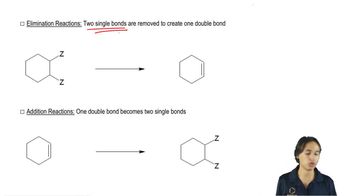
Elimination reactions involve the removal of a small molecule, such as HBr, from a larger molecule, resulting in the formation of a double bond. In this case, potassium hydroxide can facilitate the elimination of bromine and a hydrogen atom, leading to the formation of alkenes like trans-2-bromobut-2-ene. Recognizing the conditions that favor elimination over substitution is essential for understanding the product distribution.
Recommended video:
Guided course
00:40
Recognizing Elimination Reactions.

Stereochemistry and Enantiomers

Stereochemistry refers to the spatial arrangement of atoms in molecules and how this affects their chemical behavior. Enantiomers are pairs of molecules that are mirror images of each other and have different optical activities. In the reaction described, the formation of (2S,3R)-3-bromobutan-2-ol and its enantiomer highlights the importance of stereochemistry in organic reactions, particularly in determining the specific products formed from chiral substrates.
Recommended video:
1:38
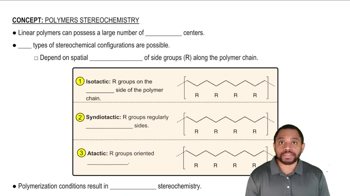
Polymer Stereochemistry Concept 1
Related Practice
Textbook Question

When 2-bromo-3-phenylbutane is treated with sodium methoxide, two alkenes result (by E2 elimination). The Zaitsev product predominates.

a. Draw the reaction, showing the major and minor products.

1666
views

Textbook Question

When (±)−2,3−dibromobutane reacts with potassium hydroxide, some of the products are (2S,3R)-3-bromobutan-2-ol and its enantiomer and trans-2-bromobut-2-ene. Why is no cis-2-bromobut-2-ene formed?

972
views
Textbook Question

A chemist allows some pure (2S,3R)-3-bromo-2,3-diphenylpentane to react with a solution of sodium ethoxide (NaOCH2CH3) in ethanol. The products are two alkenes: A (cis-trans mixture) and B, a single pure isomer. Under the same conditions, the reaction of (2S,3S)-3-bromo-2,3-diphenylpentane gives two alkenes, A (cis-trans mixture) and C. Upon catalytic hydrogenation, all three of these alkenes (A, B, and C) give 2,3-diphenylpentane. Determine the structures of A, B, and C; give equations for their formation; and explain the stereospecificity of these reactions.

1654
views
Textbook Question

Pure (S)-2-bromo-2-fluorobutane reacts with methoxide ion in methanol to give a mixture of (S)-2-fluoro-2-methoxybutane and three fluoroalkenes.

a. Use mechanisms to show which three fluoroalkenes are formed.

2163
views
Textbook Question

When 2-bromo-3-phenylbutane is treated with sodium methoxide, two alkenes result (by E2 elimination). The Zaitsev product predominates.

b. When one pure stereoisomer of 2-bromo-3-phenylbutane reacts, one pure stereoisomer of the major product results. For example, when (2R,3R)-2-bromo-3-phenylbutane reacts, the product is the stereoisomer with the methyl groups cis. Use your models to draw a Newman projection of the transition state to show why this stereospecificity is observed.

c. Use a Newman projection of the transition state to predict the major product of elimination of (2S,3R)-2-bromo-3-phenylbutane.

d. Predict the major product from elimination of (2S,3S)-2-bromo-3-phenylbutane. This prediction can be made without drawing any structures, by considering the results in part (b).

2590
views
1
comments
Textbook Question

Pure (S)-2-bromo-2-fluorobutane reacts with methoxide ion in methanol to give a mixture of (S)-2-fluoro-2-methoxybutane and three fluoroalkenes.

b. Propose a mechanism to show how (S)-2-bromo-2-fluorobutane reacts to give (S)-2-fluoro-2-methoxybutane. Has this reaction gone with retention or inversion of configuration?

1669
views