
Textbook Question
Propose a mechanism for reaction of the first three propylene units in the polymerization of propylene in the presence of a peroxide.
1694
views

 Verified step by step guidance
 02:39
02:39
 05:39
05:39 01:44
01:44Propose a mechanism for reaction of the first three propylene units in the polymerization of propylene in the presence of a peroxide.
When styrene (vinylbenzene) is commercially polymerized, about 1–3% of 1,4-divinylbenzene is often added to the styrene. The incorporation of some divinylbenzene gives a polymer with more strength and better resistance to organic solvents. Explain how a very small amount of divinylbenzene has a marked effect on the properties of the polymer.
An unknown compound decolorizes bromine in carbon tetrachloride, and it undergoes catalytic reduction to give decalin. When treated with warm, concentrated potassium permanganate, this compound gives cis-cyclohexane-1,2-dicarboxylic acid and oxalic acid. Propose a structure for the unknown compound.
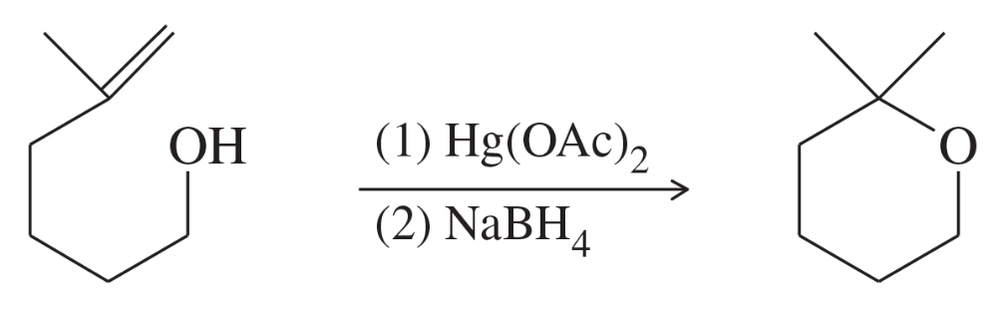
The following cyclization has been observed in the oxymercuration-demercuration of this unsaturated alcohol. Propose a mechanism for this reaction.
The two butenedioic acids are called fumaric acid (trans) and maleic acid (cis). 2,3-Dihydroxybutanedioic acid is called tartaric acid.
Show how you would convert
c. maleic acid to (±)-tartaric acid.
A graduate student attempted to form the iodohydrin of the alkene shown below. Her analysis of the products showed a good yield of an unexpected product. Propose a mechanism to explain the formation of this product.