


Ch.8 - Reactions of Alkenes
Wade - Organic Chemistry 9th Edition
Wade9th EditionOrganic ChemistryISBN: 9780135213728Not the one you use?Change textbook
Chapter 8, Problem 55a

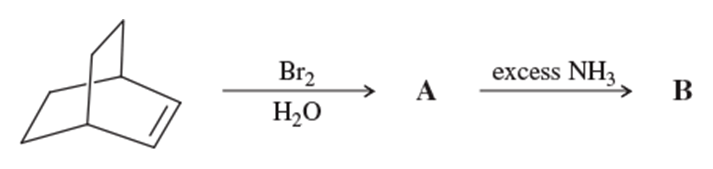
Complete each synthesis by providing the structure of the major product at each step, including any important stereochemistry.
a.

Verified step by step guidance
1
Step 1: Analyze the first reaction. The starting material is an alkene, and the reagents are Br2 and H2O. This indicates a halohydrin formation reaction. The alkene undergoes electrophilic addition, where Br2 adds across the double bond. Water acts as the nucleophile, attacking the more substituted carbon, leading to the formation of a bromohydrin. The stereochemistry is anti-addition, meaning the bromine and hydroxyl group will be added on opposite faces of the ring.
Step 2: Draw the structure of intermediate A. The bromine atom will attach to the less substituted carbon of the double bond, and the hydroxyl group will attach to the more substituted carbon. Ensure the anti stereochemistry is represented in the structure.
Step 3: Analyze the second reaction. Intermediate A reacts with excess NH3 under SN2 conditions. In an SN2 reaction, the nucleophile (NH3) attacks the carbon bonded to the bromine atom, displacing the bromine in a single step. This results in the formation of a new C-N bond.
Step 4: Consider the stereochemistry of the SN2 reaction. Since SN2 reactions proceed via a backside attack, the stereochemistry at the carbon center where substitution occurs will invert. Represent this inversion in the structure of product B.
Step 5: Draw the structure of product B. Replace the bromine atom in intermediate A with an amine group (-NH2), ensuring the stereochemical inversion is correctly depicted. The hydroxyl group remains unchanged from intermediate A.

Verified video answer for a similar problem:

This video solution was recommended by our tutors as helpful for the problem above.
Video duration:
12m
Was this helpful?

Key Concepts

Here are the essential concepts you must grasp in order to answer the question correctly.

Electrophilic Addition Reactions

Electrophilic addition reactions involve the addition of an electrophile to a nucleophile, typically across a double bond. In this case, bromine (Br2) acts as the electrophile, and the alkene undergoes addition in the presence of water, leading to the formation of a bromohydrin. Understanding this mechanism is crucial for predicting the structure of product A.
Recommended video:
Guided course
05:39
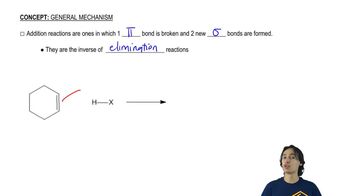
Features of Addition Mechanisms.

Stereochemistry

Stereochemistry refers to the spatial arrangement of atoms in molecules and how this affects their chemical behavior. In the context of the reaction, the stereochemistry of the bromohydrin product A is important, as it can lead to different stereoisomers. Recognizing the stereochemical outcomes is essential for accurately depicting the major product and its configuration.
Recommended video:
1:38
Polymer Stereochemistry Concept 1

Nucleophilic Substitution Reactions

Nucleophilic substitution reactions involve the replacement of a leaving group by a nucleophile. In this synthesis, excess ammonia (NH3) acts as a nucleophile that attacks the electrophilic carbon in product A, leading to the formation of product B. Understanding the mechanism of this substitution is key to predicting the final structure of the product.
Recommended video:
Guided course
01:47
Nucleophiles and Electrophiles can react in Substitution Reactions.
Related Practice
Textbook Question

Professor Patrick Dussault (University of Nebraska at Lincoln) has developed an alternative to the standard two-step ozonolysis procedure requiring reduction of the ozonide in a second step. He uses 2 to 3 equivalents of pyridine, a mildly basic organic solvent, in a one-step process (Organic Letters, 2012, 14, 2242). Show the products you expect from the following examples.

(c)

(d)

628
views
Textbook Question

Complete each synthesis by providing the structure of the major product at each step, including any important stereochemistry.

b.

c.

d.

1034
views
Textbook Question

Show how you might use olefin metathesis to assemble the following alkenes from smaller units:

(a)

(b)

918
views
Textbook Question

Following the instructions for drawing the energy levels of the molecular orbitals for the compounds shown in [Figure 8.17], draw the energy levels of the molecular orbitals for the cycloheptatrienyl cation. For each compound, show the distribution of the π\(\pi\) electrons. Which of the compounds are aromatic?

645
views
Textbook Question

Professor Patrick Dussault (University of Nebraska at Lincoln) has developed an alternative to the standard two-step ozonolysis procedure requiring reduction of the ozonide in a second step. He uses 2 to 3 equivalents of pyridine, a mildly basic organic solvent, in a one-step process (Organic Letters, 2012, 14, 2242). Show the products you expect from the following examples.

(a)

(b)

937
views
Textbook Question

Propose mechanisms consistent with the following reactions.

(a)

1360
views