Ch.8 - Reactions of Alkenes
Wade - Organic Chemistry 9th Edition
Wade9th EditionOrganic ChemistryISBN: 9780135213728Not the one you use?Change textbook
Chapter 8, Problem 17

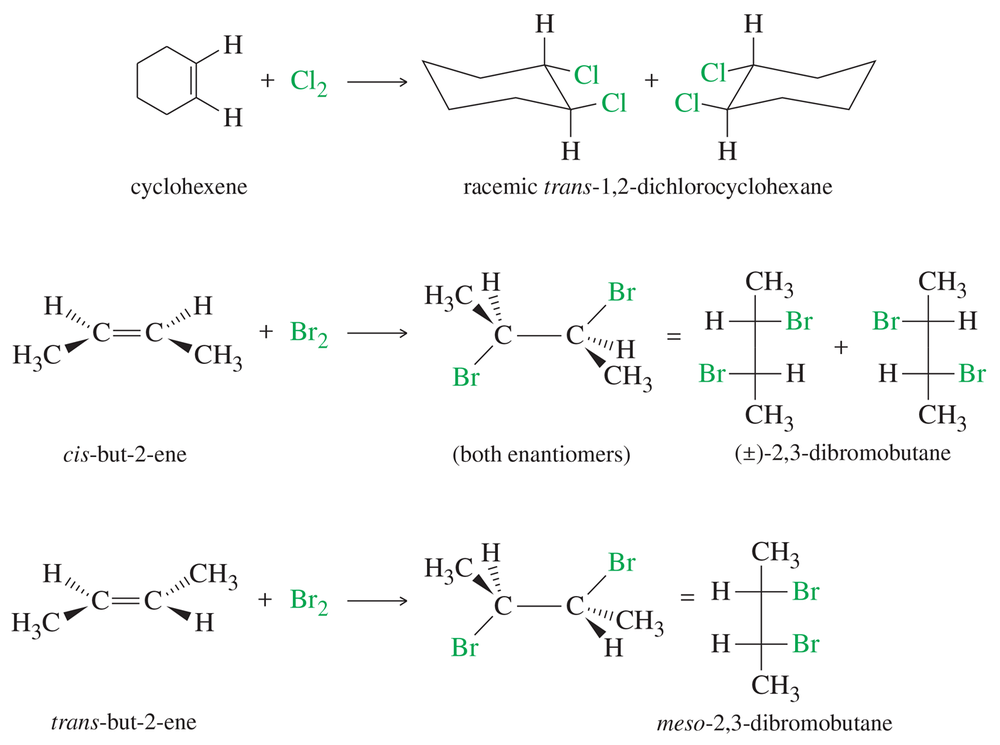
Give mechanisms to account for the stereochemistry of the products observed from the addition of bromine to cis- and trans-but-2-ene (Figure 8-5). Why are two products formed from the cis isomer but only one from the trans? (Making models will be ­helpful.)

Verified step by step guidance
1
Step 1: Begin by understanding the reaction mechanism for the addition of bromine (Br₂) to alkenes. Bromine adds to the double bond in a two-step process: (1) formation of a bromonium ion intermediate and (2) nucleophilic attack by bromide ion on the bromonium ion.
Step 2: For cis-but-2-ene, the double bond is planar, and the bromonium ion forms with bromine bridging the two carbons of the double bond. The attack by the bromide ion occurs from the opposite side of the bromonium ion due to steric hindrance, leading to anti-addition. This results in two enantiomers because the substituents on the double bond are arranged asymmetrically.
Step 3: For trans-but-2-ene, the double bond is also planar, and the bromonium ion forms similarly. However, due to the symmetry of the trans configuration, the anti-addition of bromide results in a single meso compound. This is because the product has an internal plane of symmetry, making it achiral.
Step 4: The stereochemistry of the products is determined by the anti-addition mechanism, which ensures that the bromine atoms are added to opposite sides of the double bond. In the cis isomer, the asymmetry leads to two enantiomers, while in the trans isomer, the symmetry leads to a meso compound.
Step 5: To visualize this, use molecular models to represent the cis- and trans-but-2-ene structures. Observe how the bromonium ion forms and how the bromide ion attacks from the opposite side. This will help clarify why the cis isomer produces two enantiomers and the trans isomer produces a single meso compound.

Verified video answer for a similar problem:

This video solution was recommended by our tutors as helpful for the problem above.
Video duration:
14m
Was this helpful?

Key Concepts

Here are the essential concepts you must grasp in order to answer the question correctly.

Stereochemistry

Stereochemistry is the study of the spatial arrangement of atoms in molecules and how this affects their chemical behavior. In the context of alkenes, stereochemistry is crucial for understanding how different isomers (cis and trans) can lead to different products during reactions, such as the addition of bromine. The arrangement of substituents around the double bond influences the formation of stereoisomers, which can result in distinct products.
Recommended video:
1:38
Polymer Stereochemistry Concept 1

Electrophilic Addition Mechanism

The electrophilic addition mechanism describes how alkenes react with electrophiles, such as bromine, to form addition products. In this process, the double bond acts as a nucleophile, attacking the electrophile and leading to the formation of a cyclic bromonium ion intermediate. This intermediate can then open up to yield different products depending on the stereochemistry of the starting alkene, explaining why cis-but-2-ene produces two products while trans-but-2-ene yields only one.
Recommended video:
Guided course
05:39
Features of Addition Mechanisms.

Formation of Stereoisomers

The formation of stereoisomers occurs when a reaction leads to products that differ in the spatial arrangement of atoms. In the case of cis-but-2-ene, the addition of bromine can lead to both enantiomers due to the possibility of attack from either side of the bromonium ion, resulting in two distinct products. Conversely, trans-but-2-ene leads to a meso compound, which is achiral and has a plane of symmetry, resulting in only one unique product.
Recommended video:
Guided course
01:58
Determining when molecules are stereoisomers.