Ch.8 - Reactions of Alkenes
Wade - Organic Chemistry 9th Edition
Wade9th EditionOrganic ChemistryISBN: 9780135213728Not the one you use?Change textbook
Chapter 8, Problem 75

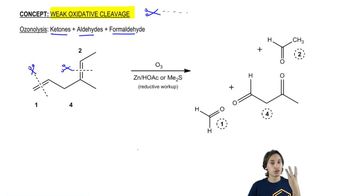
Ozonolysis can be applied selectively to different types of carbon–carbon double bonds. The compound shown below contains two vinyl ether double bonds, which are electron-rich because of the electron-donating alkoxy groups. Ozone reacts more quickly with electron-rich double bonds and more slowly with hindered double bonds. At −78 °C, this compound quickly adds two equivalents of ozone. Immediate reduction of the ozonide gives a good yield of a single product. Show the expected ozonolyis product, and label the functional groups produced, some of which are not typical from ozonolysis of simple alkenes.
Chemical structure of a compound with two vinyl ether double bonds, showing ozonolysis reaction conditions and expected product.

Verified step by step guidance
1
Step 1: Analyze the structure of the compound provided. The molecule contains two vinyl ether double bonds, which are electron-rich due to the electron-donating alkoxy groups (-OCH3). These double bonds are more reactive toward ozone compared to hindered or less electron-rich double bonds.
Step 2: Understand the reaction conditions. Ozonolysis involves the addition of ozone (O3) to the double bonds at low temperatures (-78 °C). The reaction proceeds by forming an ozonide intermediate, which is then reduced using dimethyl sulfide ((CH3)2S) to yield the final products.
Step 3: Predict the cleavage of the double bonds. Ozone cleaves the carbon-carbon double bonds, resulting in the formation of carbonyl-containing products. For vinyl ethers, ozonolysis typically produces aldehydes or ketones, along with other functional groups depending on the substituents.
Step 4: Identify the products formed. Each double bond in the molecule will be cleaved, and the electron-donating alkoxy groups will influence the type of carbonyl compounds formed. The expected products will include aldehydes and/or ketones, and the functional groups should be labeled accordingly.
Step 5: Summarize the functional groups in the product. After ozonolysis and reduction, the molecule will yield a single product containing multiple carbonyl groups (aldehydes and/or ketones). These functional groups are characteristic of ozonolysis reactions, but the presence of alkoxy groups may lead to atypical products compared to simple alkenes.

Verified video answer for a similar problem:

This video solution was recommended by our tutors as helpful for the problem above.
Video duration:
4m
Was this helpful?

Key Concepts

Here are the essential concepts you must grasp in order to answer the question correctly.

Ozonolysis

Ozonolysis is a reaction involving the cleavage of carbon-carbon double bonds (alkenes) using ozone (O3). This reaction typically results in the formation of ozonides, which can be further reduced to yield carbonyl compounds such as aldehydes or ketones. The reaction is particularly useful for transforming alkenes into more functionalized products, and the selectivity of ozonolysis can vary based on the electronic and steric properties of the double bonds involved.
Recommended video:
Guided course
06:30
General properties of ozonolysis.

Electron-Rich Double Bonds

Electron-rich double bonds, such as those found in vinyl ethers, are more reactive towards ozone due to the presence of electron-donating groups. These groups enhance the nucleophilicity of the double bond, facilitating a faster reaction with ozone compared to electron-poor or hindered double bonds. Understanding the reactivity of different double bonds is crucial for predicting the products of ozonolysis and the overall reaction mechanism.
Recommended video:
Guided course
06:00
Single bonds, double bonds, and triple bonds.

Functional Group Transformation

Ozonolysis often leads to the formation of functional groups that are not typically associated with simple alkenes. In this reaction, the cleavage of the double bond can produce carbonyl compounds, such as aldehydes and ketones, as well as other functional groups depending on the substituents present. Recognizing these transformations is essential for accurately predicting the final products of ozonolysis and understanding the implications for further chemical reactivity.
Recommended video:
Guided course
02:36
Identifying Functional Groups
Related Practice
Textbook Question

Propose a mechanism for reaction of the first three propylene units in the polymerization of propylene in the presence of a peroxide.

1694
views

Textbook Question

When styrene (vinylbenzene) is commercially polymerized, about 1–3% of 1,4-divinylbenzene is often added to the styrene. The incorporation of some divinylbenzene gives a polymer with more strength and better resistance to organic solvents. Explain how a very small amount of divinylbenzene has a marked effect on the properties of the polymer.

1427
views
Textbook Question

The cationic polymerization of isobutylene (2-methylpropene) is shown in Section 8-16A. Isobutylene is often polymerized under free-radical conditions. Propose a mechanism for the free-radical polymerization of isobutylene.

1342
views
Textbook Question

We have seen many examples where halogens add to alkenes with anti stereochemistry via the halonium ion mechanism. However, when 1-phenylcyclohexene reacts with chlorine in carbon tetrachloride, a mixture of the cis and trans isomers of the product is recovered. Propose a mechanism, and explain this lack of stereospecificity.

1254
views
Textbook Question

An inexperienced graduate student treated dec-5-ene with borane in THF, placed the flask in a refrigerator, and left for a party. When he returned from the party, he discovered that the refrigerator was broken and that it had gotten quite warm inside. Although all the THF had evaporated from the flask, he treated the residue with basic hydrogen peroxide. To his surprise, he recovered a fair yield of decan-1-ol. Use a mechanism to show how this reaction might have occurred. (Hint: The addition of BH3 is reversible.)

1066
views
Textbook Question

Propose mechanisms to explain the opposite regiochemistry observed in the following two reactions.

907
views