The chiral BINAP ligand shown in Figure 8-8 contains no asymmetric carbon atoms. Explain how this ligand is chiral.
Ch.8 - Reactions of Alkenes
Chapter 8, Problem 27a
Predict the carbenoid addition products of the following reactions.
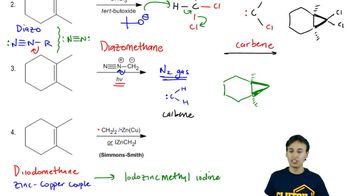
(a) cyclohexene + CHCl3, 50% NaOH/H2O
Verified step by step guidance1
Identify the reaction type: This is a carbenoid addition reaction, where a carbene or carbenoid intermediate is generated and reacts with the alkene to form a cyclopropane ring.
Understand the reagents: CHCl₃ (chloroform) in the presence of a strong base like NaOH generates a dichlorocarbene (:CCl₂) intermediate. This occurs via deprotonation of CHCl₃ by NaOH, followed by elimination of a chloride ion.
Generate the dichlorocarbene intermediate: The reaction mechanism involves the following steps: (1) NaOH deprotonates CHCl₃ to form the trichloromethyl anion (CCl₃⁻), and (2) CCl₃⁻ eliminates a chloride ion (Cl⁻) to form the neutral dichlorocarbene (:CCl₂).
React the dichlorocarbene with cyclohexene: The alkene (cyclohexene) reacts with the dichlorocarbene (:CCl₂) in a concerted mechanism to form a cyclopropane ring. The two π-electrons of the alkene bond with the carbene carbon, resulting in a three-membered ring structure.
Draw the product: The final product is a cyclopropane ring fused to the cyclohexane ring, with two chlorine atoms attached to the cyclopropane carbon. The product can be represented as 7,7-dichlorobicyclo[4.1.0]heptane.

Verified video answer for a similar problem:
This video solution was recommended by our tutors as helpful for the problem above.
Video duration:
4mWas this helpful?
Key Concepts
Here are the essential concepts you must grasp in order to answer the question correctly.
Carbenoids
Carbenoids are reactive intermediates that resemble carbenes but are stabilized by adjacent groups. They can participate in various reactions, including additions to alkenes. In the context of the given reaction, the carbenoid generated from CHCl3 in the presence of a strong base like NaOH can add to the double bond of cyclohexene, leading to the formation of a halogenated product.
Recommended video:
Guided course
The Simmons-Smith reaction.
Electrophilic Addition Reactions
Electrophilic addition reactions involve the addition of an electrophile to a nucleophilic site, typically a double bond in alkenes. In this case, the carbenoid acts as an electrophile that adds to the cyclohexene, resulting in the formation of a more stable product. Understanding the mechanism of electrophilic addition is crucial for predicting the outcome of the reaction.
Recommended video:
Guided course
Features of Addition Mechanisms.
Regioselectivity
Regioselectivity refers to the preference of a chemical reaction to yield one structural isomer over others when multiple possibilities exist. In the reaction of cyclohexene with the carbenoid, the regioselectivity will determine which carbon atom of the double bond the electrophile adds to, influencing the final product's structure. Analyzing the stability of potential products helps predict the major outcome.
Recommended video:
Guided course
Heck Reaction
Related Practice
Textbook Question
1305
views
Textbook Question
One of the principal components of lemongrass oil is limonene, C10H16. When limonene is treated with excess hydrogen and a platinum catalyst, the product is an alkane of formula C10H20. What can you conclude about the structure of limonene?
1291
views
Textbook Question
What are the products of the following reactions, assuming that one equivalent of each reagent is used in each reaction?
a.
656
views
Textbook Question
Predict the carbenoid addition products of the following reactions.
(c)
1706
views
1
rank
Textbook Question
Predict the carbenoid addition products of the following reactions.
(b)
2047
views
Textbook Question
Predict the carbenoid addition products of the following reactions.
a. trans-hex-3-ene + CH2I2, Zn(Cu)
b. cis-hex-3-ene + CH2I2, Zn(Cu)
1628
views