Ch.8 - Reactions of Alkenes
Wade - Organic Chemistry 9th Edition
Wade9th EditionOrganic ChemistryISBN: 9780135213728Not the one you use?Change textbook
Chapter 8, Problem 32a

Predict the major products of the following reactions.
a. cis-hex-2-ene + mCPBA in chloroform

Verified step by step guidance
1
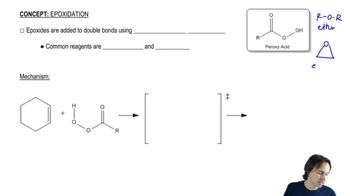
Step 1: Recognize the type of reaction. The reagent mCPBA (meta-chloroperoxybenzoic acid) is a peracid commonly used for epoxidation reactions. It reacts with alkenes to form epoxides.
Step 2: Analyze the structure of the starting material. Cis-hex-2-ene is an alkene with a double bond between carbons 2 and 3, and the substituents on the double bond are on the same side (cis configuration).
Step 3: Understand the stereochemical outcome of the reaction. Epoxidation with mCPBA is stereospecific, meaning the stereochemistry of the starting alkene is preserved in the product. Since the alkene is cis, the resulting epoxide will also have substituents on the same side of the ring.
Step 4: Draw the product structure. The double bond in cis-hex-2-ene will be converted into a three-membered epoxide ring, with the oxygen atom bridging carbons 2 and 3. The substituents on carbons 2 and 3 will remain cis to each other.
Step 5: Confirm the reaction conditions. The solvent chloroform is inert and does not interfere with the reaction, ensuring that the epoxidation proceeds smoothly to yield the major product.

Verified video answer for a similar problem:

This video solution was recommended by our tutors as helpful for the problem above.
Video duration:
3m
Was this helpful?

Key Concepts

Here are the essential concepts you must grasp in order to answer the question correctly.

Electrophilic Addition Reactions

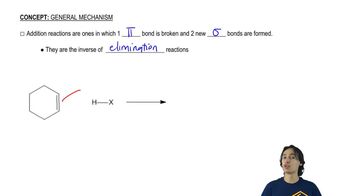
Electrophilic addition reactions involve the addition of an electrophile to a nucleophile, typically across a double bond. In the case of alkenes like cis-hex-2-ene, the double bond acts as a nucleophile, reacting with electrophiles to form more saturated products. Understanding this mechanism is crucial for predicting the products of reactions involving alkenes.
Recommended video:
Guided course
05:39
Features of Addition Mechanisms.

Epoxidation

Epoxidation is a specific type of electrophilic addition where an alkene reacts with a peracid, such as mCPBA (meta-chloroperbenzoic acid), to form an epoxide. This three-membered cyclic ether is formed by the addition of an oxygen atom across the double bond. Recognizing the formation of epoxides is essential for predicting the products of the given reaction.
Recommended video:
Guided course
02:19
General properties of epoxidation.

Stereochemistry

Stereochemistry refers to the spatial arrangement of atoms in molecules and how this affects their chemical behavior. In the case of cis-hex-2-ene, the stereochemistry of the starting material influences the stereochemical outcome of the epoxidation reaction. Understanding how stereochemistry impacts product formation is vital for accurately predicting the major products.
Recommended video:
1:38
Polymer Stereochemistry Concept 1
Related Practice
Textbook Question

Predict the products, including stereochemistry where appropriate, for the m-chloroperoxybenzoic acid epoxidations of the following alkenes.

c. cis-cyclodecene

d. trans-cyclodecene

1366
views

Textbook Question

Magnesium monoperoxyphthalate (MMPP) epoxidizes alkenes much like mCPBA. MMPP is more stable, however, and it may be safer to use for large-scale and industrial reactions. Propose a mechanism for the reaction of trans-2-methylhept-3-ene with MMPP, and predict the structure of the product(s).

1604
views
Textbook Question

When 1,2-epoxycyclohexane (cyclohexene oxide) is treated with anhydrous HCl in methanol, the principal product is trans-2-methoxycyclohexanol. Propose a mechanism to account for the formation of this product.

1926
views
1
rank
Textbook Question

Predict the major products of the following reactions.

b. trans-hex-3-ene + peroxyacetic acid (CH3CO3H) in water

c. 1-methylcyclohexene + MMPP in ethanol

2229
views
Textbook Question

Predict the major products of the following reactions.

d. trans-cyclodecene + peroxyacetic acid in acidic water

e. cis-cyclodecene + mCPBA in CH2Cl2, then dilute aqueous acid

1826
views
Textbook Question

a. Propose a mechanism for the conversion of cis-hex-3-ene to the epoxide (3,4-­epoxyhexane) and the ring-opening reaction to give the glycol, hexane-3,4-diol. In your mechanism, pay particular attention to the stereochemistry of the intermediates and products.

b. Repeat part (a) for trans-hex-3-ene. Compare the products obtained from cis- and trans-hex-3-ene. Is this reaction sequence stereospecific?

1355
views