Ch.8 - Reactions of Alkenes
Wade - Organic Chemistry 9th Edition
Wade9th EditionOrganic ChemistryISBN: 9780135213728Not the one you use?Change textbook
Chapter 8, Problem 8

Show how you would accomplish the following conversions.d. trans-hex-3-ene to (d,l)-hexane-3,4-diol

Verified step by step guidance
1
Step 1: Begin with the trans-hex-3-ene molecule. Recognize that you need to add hydroxyl groups (OH) to the 3rd and 4th carbon atoms to form a diol.
Step 2: Perform an epoxidation reaction on trans-hex-3-ene. Use a peroxyacid, such as mCPBA (meta-chloroperoxybenzoic acid), to convert the alkene into an epoxide. This will form an epoxide ring between the 3rd and 4th carbon atoms.
Step 3: Open the epoxide ring to form the diol. Use an acidic or basic hydrolysis method. For example, you can use aqueous acid (H3O+) or a base like NaOH followed by water to open the epoxide ring, resulting in the formation of (d,l)-hexane-3,4-diol.
Step 4: Ensure that the reaction conditions are controlled to favor the formation of the (d,l) mixture, which indicates the formation of both enantiomers (diastereomers) of the diol.
Step 5: Verify the stereochemistry of the product to confirm that you have obtained the (d,l)-hexane-3,4-diol, which is a racemic mixture of the two enantiomers.

Verified video answer for a similar problem:

This video solution was recommended by our tutors as helpful for the problem above.
Video duration:
2m
Was this helpful?

Key Concepts

Here are the essential concepts you must grasp in order to answer the question correctly.

Alkenes and Their Reactions

Alkenes are hydrocarbons that contain at least one carbon-carbon double bond. They are reactive compounds that can undergo various reactions, such as hydrogenation, hydrohalogenation, and hydration. Understanding the reactivity of alkenes is crucial for converting trans-hex-3-ene into other functional groups, as these reactions will dictate the pathway to the desired product.
Recommended video:
2:09
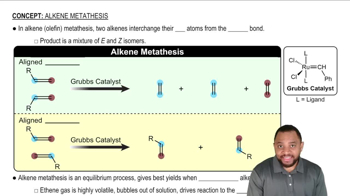
Alkene Metathesis Concept 1

Stereochemistry

Stereochemistry is the study of the spatial arrangement of atoms in molecules and how this affects their chemical behavior. In the conversion of trans-hex-3-ene to (d,l)-hexane-3,4-diol, it is important to consider the stereochemical configuration of the reactants and products. The presence of chiral centers in the diol product means that understanding stereoisomerism is essential for predicting the outcome of the reaction.
Recommended video:
1:38
Polymer Stereochemistry Concept 1

Diol Formation

Diols, or glycols, are compounds containing two hydroxyl (-OH) groups. The conversion of alkenes to diols typically involves syn or anti-dihydroxylation reactions, where water or other nucleophiles add across the double bond. In this case, the transformation of trans-hex-3-ene to (d,l)-hexane-3,4-diol will require specific reagents and conditions to ensure the correct addition of hydroxyl groups to achieve the desired product.
Recommended video:
Guided course
02:26
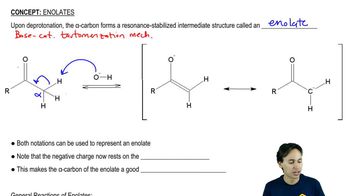
Formation of Enolates