
Ch.8 - Reactions of Alkenes
Wade - Organic Chemistry 9th Edition
Wade9th EditionOrganic ChemistryISBN: 9780135213728Not the one you use?Change textbook
Chapter 8, Problem 22c

Show how you would accomplish the following synthetic conversions.
c. 1-methylcyclopentanol → 2-chloro-1-methylcyclopentanol
Problem-Solving Hint: The opening of a halonium ion is driven by its electrophilic nature. The weak nucleophile attacks the carbon bearing more positive charge.

Verified step by step guidance
1
Step 1: Begin by understanding the target transformation. The goal is to convert 1-methylcyclopentanol into 2-chloro-1-methylcyclopentanol. This involves introducing a chlorine atom at the 2-position while retaining the hydroxyl group at the 1-position.
Step 2: Recognize that the reaction likely involves the formation of a halonium ion intermediate. To achieve this, treat the starting alcohol (1-methylcyclopentanol) with a halogen source, such as Cl₂, in the presence of a nucleophilic solvent like water. This will facilitate the formation of a halonium ion.
Step 3: The halonium ion intermediate forms when the double bond (if present) or the alcohol reacts with the halogen. The halonium ion is electrophilic, meaning it has a partial positive charge on the carbons involved in the ring structure. The nucleophile (water or hydroxyl group) will attack the more positively charged carbon in the halonium ion.
Step 4: After the nucleophilic attack, the halonium ion opens up, resulting in the addition of a chlorine atom to the 2-position and retention of the hydroxyl group at the 1-position. This regioselectivity is driven by the stability of the carbocation formed during the process.
Step 5: Finally, isolate and purify the product, 2-chloro-1-methylcyclopentanol, using standard organic chemistry techniques such as distillation or chromatography to ensure the desired compound is obtained.

Verified video answer for a similar problem:

This video solution was recommended by our tutors as helpful for the problem above.
Video duration:
1m
Was this helpful?

Key Concepts

Here are the essential concepts you must grasp in order to answer the question correctly.

Halonium Ion Mechanism

A halonium ion is a cyclic intermediate formed during the electrophilic addition of halogens to alkenes. This species is characterized by a three-membered ring structure where a halogen atom carries a positive charge. The electrophilic nature of the halonium ion makes it susceptible to nucleophilic attack, typically at the more substituted carbon, leading to the formation of products like 2-chloro-1-methylcyclopentanol.
Recommended video:
3:39
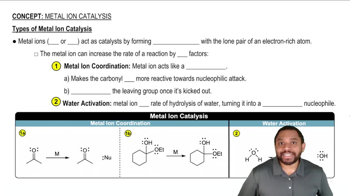
Metal Ion Catalysis Concept 1

Nucleophilic Attack

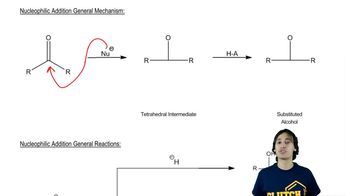
Nucleophilic attack refers to the process where a nucleophile, which is an electron-rich species, donates a pair of electrons to an electrophile, forming a new bond. In the context of the conversion from 1-methylcyclopentanol to 2-chloro-1-methylcyclopentanol, the weak nucleophile attacks the carbon of the halonium ion that bears a greater positive charge, facilitating the substitution reaction.
Recommended video:
Guided course
08:27
Nucleophilic Addition

Electrophilicity and Reactivity

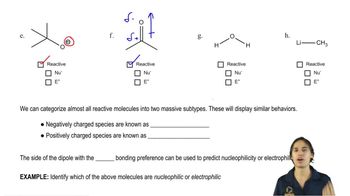
Electrophilicity is a measure of how readily a species can accept electrons, making it a key factor in chemical reactivity. In this synthetic conversion, the halonium ion's strong electrophilic character drives the reaction, as it attracts nucleophiles. Understanding the relative electrophilicity of different species helps predict the outcome of reactions, such as the formation of 2-chloro-1-methylcyclopentanol from 1-methylcyclopentanol.
Recommended video:
Guided course
01:17
Reactivity of Molecules