

Ch.8 - Reactions of Alkenes
Wade - Organic Chemistry 9th Edition
Wade9th EditionOrganic ChemistryISBN: 9780135213728Not the one you use?Change textbook
Chapter 8, Problem 51a

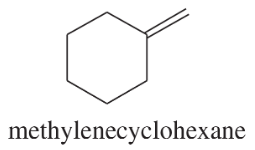
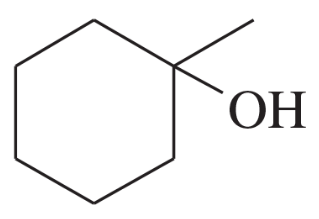
Show how you would synthesize each compound using methylenecyclohexane as your starting material.

(a)

Verified step by step guidance
1
Step 1: Analyze the starting material, methylenecyclohexane, which contains a double bond. This double bond can undergo reactions such as hydroboration-oxidation or acid-catalyzed hydration to introduce an -OH group.
Step 2: Choose hydroboration-oxidation as the method to synthesize the target compound. This reaction is regioselective and adds the -OH group to the less substituted carbon of the double bond, following anti-Markovnikov addition.
Step 3: Perform hydroboration by reacting methylenecyclohexane with BH₃·THF (borane in tetrahydrofuran). This step forms an organoborane intermediate.
Step 4: Oxidize the organoborane intermediate using hydrogen peroxide (H₂O₂) in the presence of a base, such as NaOH. This converts the boron group into an -OH group, yielding the alcohol.
Step 5: Verify the product structure to ensure the -OH group is attached to the less substituted carbon of the original double bond, resulting in the desired compound.

Verified video answer for a similar problem:

This video solution was recommended by our tutors as helpful for the problem above.
Video duration:
1m
Was this helpful?

Key Concepts

Here are the essential concepts you must grasp in order to answer the question correctly.

Synthesis in Organic Chemistry

Synthesis in organic chemistry refers to the process of constructing complex organic compounds from simpler ones. This often involves a series of chemical reactions that transform the starting material into the desired product. Understanding the mechanisms and pathways of these reactions is crucial for predicting the outcomes and yields of the synthesis.
Recommended video:
Guided course
00:56
What is an organic molecule?

Functional Groups

Functional groups are specific groups of atoms within molecules that are responsible for the characteristic chemical reactions of those molecules. In the context of the question, the hydroxyl (OH) group is a functional group that can significantly alter the properties and reactivity of methylenecyclohexane, making it essential to consider when planning a synthesis.
Recommended video:
Guided course
02:36
Identifying Functional Groups

Reaction Mechanisms

Reaction mechanisms describe the step-by-step sequence of elementary reactions by which overall chemical change occurs. Understanding these mechanisms is vital for predicting how methylenecyclohexane can be transformed into other compounds, including those with functional groups like hydroxyls. This knowledge helps chemists design efficient synthetic routes.
Recommended video:
Guided course
02:16
Heck Reaction Mechanism