Ch.9 - Alkynes
Wade - Organic Chemistry 9th Edition
Wade9th EditionOrganic ChemistryISBN: 9780135213728Not the one you use?Change textbook
Chapter 9, Problem 28d,e,f

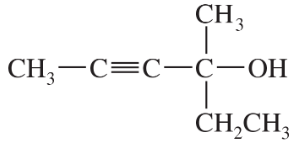
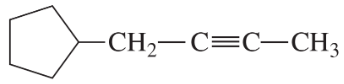
Give IUPAC names for the following compounds.
(d)
(e)
(f)

Verified step by step guidance
1
Identify the longest carbon chain in the compound that contains the highest priority functional group. For compound (d), the longest chain is a four-carbon chain with a bromo substituent and a triple bond.
Number the carbon chain starting from the end nearest to the highest priority functional group. In compound (d), start numbering from the end closest to the triple bond.
Identify and name the substituents. In compound (d), there is a dibromo group on the second carbon.
Combine the names of the substituents with the base name of the compound, using appropriate locants. For compound (d), the name will include '2,2-dibromo' and 'butyne'.
Repeat the process for compounds (e) and (f), ensuring to identify the longest chain, number it correctly, and name the substituents and functional groups. For compound (e), consider the alcohol group and for compound (f), consider the cyclopentyl group.

Verified video answer for a similar problem:

This video solution was recommended by our tutors as helpful for the problem above.
Video duration:
4m
Was this helpful?

Key Concepts

Here are the essential concepts you must grasp in order to answer the question correctly.

IUPAC Nomenclature

IUPAC nomenclature is a systematic method for naming organic chemical compounds. It provides rules for identifying the structure of a compound based on its molecular formula and functional groups. Understanding the hierarchy of functional groups, the longest carbon chain, and the correct use of prefixes and suffixes is essential for accurately naming compounds.
Recommended video:
Guided course
03:43
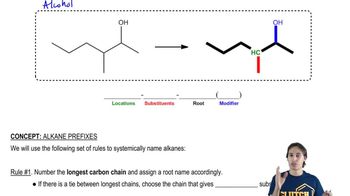
The different parts of an IUPAC name

Functional Groups

Functional groups are specific groups of atoms within molecules that are responsible for the characteristic chemical reactions of those molecules. Common functional groups include alkenes, alkynes, alcohols, and halides. Recognizing these groups is crucial for determining the reactivity and properties of organic compounds, as well as for their correct nomenclature.
Recommended video:
Guided course
02:36
Identifying Functional Groups

Stereochemistry

Stereochemistry involves the study of the spatial arrangement of atoms in molecules and how this affects their chemical behavior. In organic compounds, stereoisomers can exist due to the presence of double or triple bonds, which restrict rotation. Understanding stereochemistry is important for naming compounds accurately, especially when dealing with chiral centers or geometric isomerism.
Recommended video:
1:38
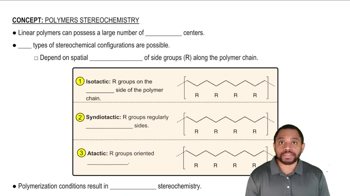
Polymer Stereochemistry Concept 1