Ch.9 - Alkynes
Wade - Organic Chemistry 9th Edition
Wade9th EditionOrganic ChemistryISBN: 9780135213728Not the one you use?Change textbook
Chapter 9, Problem 34c

Show how you would accomplish the following synthetic transformations. Show all intermediates.
c. but-1-yne → oct-3-yne

Verified step by step guidance
1
Step 1: Deprotonate but-1-yne using a strong base such as sodium amide (NaNH₂) to generate the acetylide anion. This step is crucial because the acetylide anion is a strong nucleophile and can undergo alkylation reactions.
Step 2: Perform an alkylation reaction by reacting the acetylide anion with an appropriate alkyl halide, such as 1-bromopropane. This will extend the carbon chain by three carbons, forming pent-1-yne as the intermediate.
Step 3: Repeat the deprotonation step on pent-1-yne using sodium amide (NaNH₂) to generate the acetylide anion of pent-1-yne.
Step 4: Perform a second alkylation reaction by reacting the acetylide anion of pent-1-yne with another alkyl halide, such as 1-bromopropane. This will extend the carbon chain further, forming oct-3-yne as the final product.
Step 5: Verify the structure of the final product, oct-3-yne, ensuring that the triple bond is located between the third and fourth carbons in the chain.

Verified video answer for a similar problem:

This video solution was recommended by our tutors as helpful for the problem above.
Video duration:
5m
Was this helpful?

Key Concepts

Here are the essential concepts you must grasp in order to answer the question correctly.

Alkyne Synthesis

Alkynes are hydrocarbons containing at least one carbon-carbon triple bond. The synthesis of alkynes often involves the elimination of hydrogen halides from dihaloalkanes or the deprotonation of terminal alkynes. Understanding the mechanisms of these reactions is crucial for planning synthetic pathways, as they dictate the formation of desired products and intermediates.
Recommended video:
Guided course
09:11
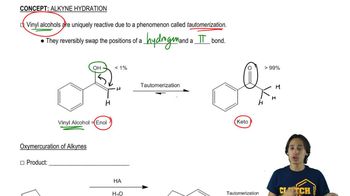
Alkyne Hydration

Reagents and Reaction Conditions

Different reagents and reaction conditions can significantly influence the outcome of organic transformations. For the conversion of but-1-yne to oct-3-yne, specific reagents such as strong bases (e.g., sodium amide) for deprotonation and coupling agents (e.g., alkyl halides) for alkylation are essential. Recognizing the role of these reagents helps in predicting the formation of intermediates and final products.
Recommended video:

Reaction Mechanisms

Understanding reaction mechanisms is vital for predicting the steps involved in a synthetic transformation. For the transformation of but-1-yne to oct-3-yne, one must consider the mechanisms of nucleophilic substitution and elimination reactions. This knowledge allows chemists to visualize the formation of intermediates and the overall pathway, ensuring a comprehensive approach to the synthesis.
Recommended video:
Guided course
02:16
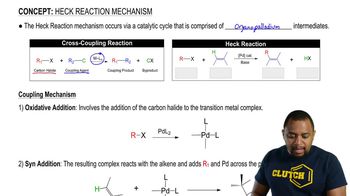
Heck Reaction Mechanism