
Ch.9 - Alkynes
Wade - Organic Chemistry 9th Edition
Wade9th EditionOrganic ChemistryISBN: 9780135213728Not the one you use?Change textbook
Chapter 9, Problem 31

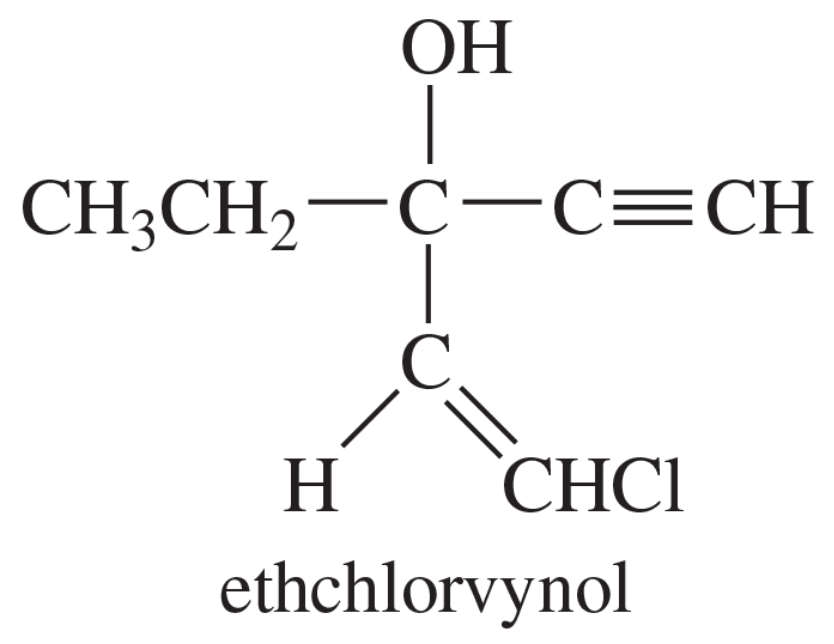
The application box in the margin of states, “The addition of an acetylide ion to a carbonyl group is used in the synthesis of ethchlorvynol, a drug used to cause drowsiness and induce sleep.” Show how you would accomplish this synthesis from acetylene and a carbonyl compound.

Verified step by step guidance
1
Step 1: Begin by generating the acetylide ion from acetylene. This is accomplished by treating acetylene (C≡CH) with a strong base, such as sodium amide (NaNH₂), to deprotonate the terminal alkyne and form the acetylide ion (C≡C⁻).
Step 2: Identify the carbonyl compound required for the synthesis. Based on the structure of ethchlorvynol, the carbonyl compound should be 2-chloro-3-pentanone (CH₃CH₂C(=O)CHClCH₃). This compound contains the necessary functional groups to form the final product.
Step 3: Perform the nucleophilic addition reaction. The acetylide ion (C≡C⁻) acts as a nucleophile and attacks the electrophilic carbonyl carbon of 2-chloro-3-pentanone. This results in the formation of a new C-C bond and generates an alkoxide intermediate.
Step 4: Protonate the alkoxide intermediate. Treat the reaction mixture with a mild acid, such as water or dilute HCl, to protonate the alkoxide and form the alcohol functional group (-OH) in the final product.
Step 5: Verify the structure of the product. The resulting compound should match the structure of ethchlorvynol, which includes a hydroxyl group (-OH), a terminal alkyne (C≡CH), and the chloro-substituted carbon chain (CH₃CH₂C(OH)C≡CHCHCl).

Verified video answer for a similar problem:

This video solution was recommended by our tutors as helpful for the problem above.
Video duration:
3m
Was this helpful?

Key Concepts

Here are the essential concepts you must grasp in order to answer the question correctly.

Acetylide Ion

An acetylide ion is a negatively charged species formed by deprotonating a terminal alkyne, such as acetylene. It acts as a strong nucleophile in organic reactions, particularly in nucleophilic addition to electrophilic carbonyl groups. This reaction is crucial in forming carbon-carbon bonds, which is a fundamental step in many organic syntheses, including the synthesis of complex molecules.
Recommended video:
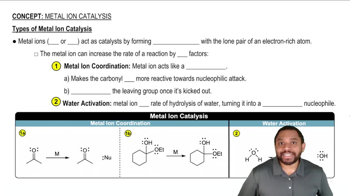
3:39
Metal Ion Catalysis Concept 1

Carbonyl Compounds

Carbonyl compounds, characterized by the presence of a carbon-oxygen double bond (C=O), include aldehydes and ketones. They are key intermediates in organic synthesis due to their electrophilic nature, making them susceptible to nucleophilic attack. Understanding the reactivity of carbonyl compounds is essential for predicting the outcomes of reactions involving acetylide ions and for designing synthetic pathways.
Recommended video:
Guided course
01:40
Defining meso compounds.

Nucleophilic Addition Reaction

Nucleophilic addition reactions involve the attack of a nucleophile, such as an acetylide ion, on an electrophilic carbon atom of a carbonyl compound. This reaction typically results in the formation of an alcohol after subsequent protonation. Mastery of this reaction type is vital for constructing larger organic molecules and is a common strategy in organic synthesis, including the synthesis of pharmaceuticals like ethchlorvynol.
Recommended video:
Guided course
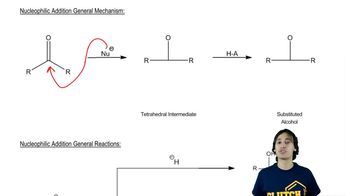
08:27
Nucleophilic Addition