Ch.6 - Alkyl Halides; Nucleophilic Substitution
Wade - Organic Chemistry 9th Edition
Wade9th EditionOrganic ChemistryISBN: 9780135213728Not the one you use?Change textbook
Chapter 6, Problem 29b

A reluctant first-order substrate can be forced to ionize by adding some silver nitrate (one of the few soluble silver salts) to the reaction. Silver ion reacts with the halogen to form a silver halide (a highly exothermic reaction), generating the cation of the alkyl group.

Give mechanisms for the following silver-promoted rearrangements.
(b) Chemical reaction showing a substrate with iodine converting to an alcohol using silver nitrate and solvents.

Verified step by step guidance
1
Step 1: Analyze the reaction conditions. The substrate contains a CH2I group attached to a bicyclic structure. The reaction involves silver nitrate (AgNO3) in a mixture of water and ethanol (H2O/CH3CH2OH). Silver nitrate promotes the ionization of the alkyl halide by forming a silver halide precipitate (AgI), which drives the reaction forward.
Step 2: Initiate the mechanism by ionization of the alkyl halide. The silver ion (Ag+) reacts with the iodine atom in the CH2I group, forming AgI (a precipitate) and generating a carbocation (R+). The carbocation is formed at the CH2 position, which is adjacent to the bicyclic structure.
Step 3: Consider the stability of the carbocation. The initially formed carbocation undergoes rearrangement to form a more stable carbocation. In this case, a hydride shift or ring expansion may occur to stabilize the carbocation by delocalizing the positive charge within the bicyclic system.
Step 4: Nucleophilic attack by water. Once the rearranged carbocation is formed, water (H2O) acts as a nucleophile and attacks the positively charged carbon atom, leading to the formation of an alcohol group (-OH) at the site of the carbocation.
Step 5: Final product formation. The reaction concludes with the formation of the alcohol product, where the OH group is attached to the bicyclic structure. The silver halide precipitate (AgI) is removed from the reaction mixture, and the solvent (ethanol/water) facilitates the reaction.

Verified video answer for a similar problem:

This video solution was recommended by our tutors as helpful for the problem above.
Video duration:
10m
Was this helpful?

Key Concepts

Here are the essential concepts you must grasp in order to answer the question correctly.

Nucleophilic Substitution Reactions

Nucleophilic substitution reactions involve the replacement of a leaving group (like a halide) by a nucleophile. In this context, the silver ion (Ag+) acts as a catalyst that facilitates the ionization of the alkyl halide, allowing the formation of a carbocation. This process is crucial for understanding how the substrate can be transformed into an alcohol through subsequent reactions.
Recommended video:
Guided course
01:47
Nucleophiles and Electrophiles can react in Substitution Reactions.

Carbocation Stability and Rearrangement

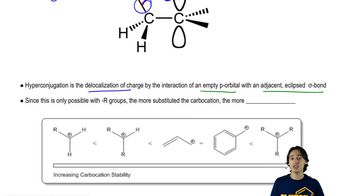
Carbocations are positively charged carbon species that can undergo rearrangements to form more stable structures. In the given reaction, the formation of a carbocation from the alkyl halide is a key step, and the stability of this intermediate can influence the reaction pathway. Understanding the factors that stabilize carbocations, such as hyperconjugation and inductive effects, is essential for predicting the outcome of the reaction.
Recommended video:
Guided course
05:58
Determining Carbocation Stability

Silver Nitrate as a Reactant

Silver nitrate (AgNO3) is used in this reaction to promote the ionization of the alkyl halide. The silver ion reacts with the halogen to form a silver halide precipitate, which drives the reaction forward. This concept highlights the role of specific reagents in organic reactions and how they can influence the mechanism and products formed, particularly in nucleophilic substitution scenarios.
Recommended video:
Guided course
06:09
EAS Nitration
Related Practice
Textbook Question

Show how you would convert (in one or two steps) 1-phenylpropane to the three products shown below. In each case, explain what unwanted reactions might produce undesirable impurities in the product.

744
views

Textbook Question

Under certain conditions, when (R)-2-bromobutane is heated with water, the SN1 substitution proceeds twice as fast as the SN2. Calculate the e.e. and the specific rotation expected for the product. The specific rotation of (R)-butan-2-ol is −13.5°. Assume that the SN1 gives equal amounts of the two enantiomers.

1242
views
Textbook Question

Draw the structures of the following compounds.

a. sec-butyl chloride

b. isobutyl bromide

864
views
Textbook Question

For each reaction, give the expected substitution product, and predict whether the ­mechanism will be predominantly first order (SN1) or second order (SN2).

d. cyclohexylbromide + methanol

e. cyclohexylbromide + sodium ethoxide

1574
views
Textbook Question

Show how you would convert (in one or two steps) 1-phenylpropane to the three products shown below. In each case, explain what unwanted reactions might produce undesirable impurities in the product.

1009
views
Textbook Question

A reluctant first-order substrate can be forced to ionize by adding some silver nitrate (one of the few soluble silver salts) to the reaction. Silver ion reacts with the halogen to form a silver halide (a highly exothermic reaction), generating the cation of the alkyl group.

Give mechanisms for the following silver-promoted rearrangements.

(a)

1853
views