Ch.6 - Alkyl Halides; Nucleophilic Substitution
Wade - Organic Chemistry 9th Edition
Wade9th EditionOrganic ChemistryISBN: 9780135213728Not the one you use?Change textbook
Chapter 6, Problem 3c,d

For each of the following compounds,
1. give the IUPAC name.
2. give the common name (if possible).
3. classify the compound as a methyl, primary, secondary, or tertiary halide.
c. Structural formula of an alkyl halide showing a chlorine atom attached to a carbon chain with methyl and ethyl groups.
d. Cyclohexane structure with a fluorine atom and two methyl groups attached, illustrating alkyl halide classification.

Verified step by step guidance
1
Step 1: Analyze the first compound (image 1). Identify the longest carbon chain containing the halogen (chlorine) atom. This chain has 4 carbons, so the parent name is 'butane'.
Step 2: Number the carbon chain such that the halogen (chlorine) gets the lowest possible number. The chlorine is attached to the first carbon, so the base name becomes '1-chlorobutane'.
Step 3: Identify and name the substituents. There is an ethyl group (-CH2CH3) attached to the second carbon. Combine this with the parent name to get '2-ethyl-1-chlorobutane' as the IUPAC name.
Step 4: For the common name, this compound can be referred to as 'sec-butyl chloride' because the chlorine is attached to a secondary carbon in a butyl group.
Step 5: Classify the compound. Since the carbon bonded to the chlorine is attached to two other carbons, this is a secondary (2°) halide.

Verified video answer for a similar problem:

This video solution was recommended by our tutors as helpful for the problem above.
Video duration:
9m
Was this helpful?

Key Concepts

Here are the essential concepts you must grasp in order to answer the question correctly.

IUPAC Nomenclature

IUPAC nomenclature is a systematic method for naming organic chemical compounds. It involves identifying the longest carbon chain, determining the functional groups, and assigning locants to indicate the position of substituents. For halides, the name includes the halogen as a substituent, with prefixes indicating the number of halogen atoms present.
Recommended video:
Guided course
03:43
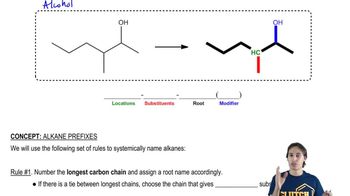
The different parts of an IUPAC name

Classification of Halides

Halides are classified based on the carbon atom to which the halogen is attached. A methyl halide has the halogen on a carbon with three hydrogens, a primary halide on a carbon with two hydrogens, a secondary halide on a carbon with one hydrogen, and a tertiary halide on a carbon with no hydrogens. This classification affects the reactivity and properties of the compounds.
Recommended video:
Guided course
01:52
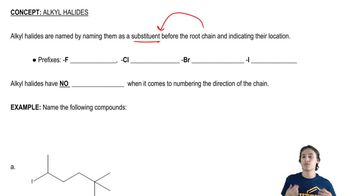
How to name alkyl halides

Common Names of Organic Compounds

Common names are traditional names used for organic compounds that may not follow IUPAC rules. They often reflect the structure or origin of the compound. For example, 'ethyl chloride' is a common name for chloroethane. Understanding common names is essential for recognizing and communicating about compounds in organic chemistry.
Recommended video:
Guided course
02:43
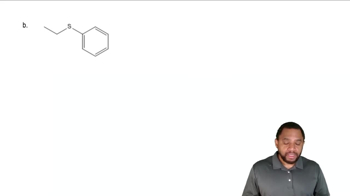
Provide the IUPAC name and common name for the following compound.