Ch.6 - Alkyl Halides; Nucleophilic Substitution
Wade - Organic Chemistry 9th Edition
Wade9th EditionOrganic ChemistryISBN: 9780135213728Not the one you use?Change textbook
Chapter 6, Problem 35e,f

Show how each compound might be synthesized by the SN2 displacement of an alkyl halide.
e. H2C=CH—CH2CN
f. H—C≡C—CH2CH2CH3

Verified step by step guidance
1
Step 1: Identify the target compound and the nucleophile required for the SN2 reaction. For compound (e) H2C=CH—CH2CN, the nucleophile is cyanide ion (CN⁻), and for compound (f) H—C≡C—CH2CH2CH3, the nucleophile is acetylide ion (C≡C⁻).
Step 2: Select an appropriate alkyl halide that can undergo SN2 displacement. For compound (e), the alkyl halide should be H2C=CH—CH2X (where X is a good leaving group, such as Br or I). For compound (f), the alkyl halide should be CH3CH2CH2X.
Step 3: Ensure the reaction conditions favor SN2. Use a polar aprotic solvent like acetone or DMSO to stabilize the nucleophile and avoid steric hindrance. The reaction should proceed with a backside attack of the nucleophile on the carbon attached to the leaving group.
Step 4: Write the reaction mechanism. For compound (e), CN⁻ attacks the carbon in H2C=CH—CH2X, displacing X and forming H2C=CH—CH2CN. For compound (f), C≡C⁻ attacks the carbon in CH3CH2CH2X, displacing X and forming H—C≡C—CH2CH2CH3.
Step 5: Verify the stereochemistry and product formation. SN2 reactions proceed with inversion of configuration at the carbon center if it is chiral. Ensure the final product matches the target compound.

Verified video answer for a similar problem:

This video solution was recommended by our tutors as helpful for the problem above.
Video duration:
6m
Was this helpful?

Key Concepts

Here are the essential concepts you must grasp in order to answer the question correctly.

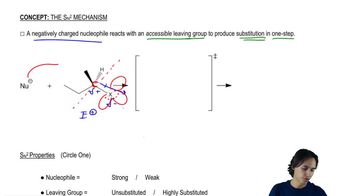
SN2 Mechanism

The SN2 (substitution nucleophilic bimolecular) mechanism involves a nucleophile attacking an electrophilic carbon atom, leading to the simultaneous displacement of a leaving group. This reaction is characterized by a single concerted step, where the nucleophile approaches the carbon from the opposite side of the leaving group, resulting in an inversion of configuration. The rate of the reaction depends on the concentration of both the nucleophile and the substrate.
Recommended video:
Guided course
08:33
Drawing the SN2 Mechanism

Alkyl Halides

Alkyl halides are organic compounds containing a carbon atom bonded to a halogen atom (F, Cl, Br, or I). They serve as key substrates in SN2 reactions due to the polar nature of the carbon-halogen bond, which makes the carbon susceptible to nucleophilic attack. The structure of the alkyl halide, including steric hindrance and the type of halogen, significantly influences the reactivity and outcome of the SN2 reaction.
Recommended video:
Guided course
01:52
How to name alkyl halides

Nucleophiles

Nucleophiles are species that donate an electron pair to form a chemical bond in a reaction. In the context of SN2 reactions, strong nucleophiles are essential for effectively displacing the leaving group from the alkyl halide. Common nucleophiles include anions like CN⁻ or neutral molecules with lone pairs, such as amines. The strength and sterics of the nucleophile can greatly affect the reaction rate and product formation.
Recommended video:
Guided course
08:27
Nucleophilic Addition