
Ch.6 - Alkyl Halides; Nucleophilic Substitution
Wade - Organic Chemistry 9th Edition
Wade9th EditionOrganic ChemistryISBN: 9780135213728Not the one you use?Change textbook
Chapter 6, Problem 6-15a

Show how you might use SN2 reactions to convert 1-chlorobutane into the following compounds.
a. butan-1-ol

Verified step by step guidance
1
Step 1: Understand the SN2 reaction mechanism. SN2 reactions involve a single-step nucleophilic substitution where the nucleophile attacks the electrophilic carbon and simultaneously displaces the leaving group. This reaction is favored in primary alkyl halides like 1-chlorobutane.
Step 2: Identify the nucleophile and solvent required for the reaction. To convert 1-chlorobutane into butan-1-ol, the nucleophile should be hydroxide ion (OH⁻), which can be provided by a strong base like NaOH or KOH. The solvent should be polar aprotic, such as acetone or DMSO, to favor the SN2 mechanism.
Step 3: Write the chemical equation for the reaction. The hydroxide ion will attack the carbon bonded to the chlorine atom in 1-chlorobutane, displacing the chlorine atom as Cl⁻ and forming butan-1-ol. The reaction can be represented as: CH3CH2CH2CH2(Cl)+OHCH3CH2CH2CH2(OH)+Cl
Step 4: Consider reaction conditions. Ensure the reaction is carried out under conditions that favor SN2, such as using a polar aprotic solvent and maintaining a low temperature to avoid competing elimination reactions.
Step 5: Verify the product. After the reaction, confirm the formation of butan-1-ol by analyzing the product using techniques like IR spectroscopy (look for the O-H stretch around 3200-3600 cm⁻¹) or NMR spectroscopy (look for the characteristic signals of the hydroxyl group and the alkyl chain).

Verified video answer for a similar problem:

This video solution was recommended by our tutors as helpful for the problem above.
Video duration:
1m
Was this helpful?

Key Concepts

Here are the essential concepts you must grasp in order to answer the question correctly.

SN2 Reactions

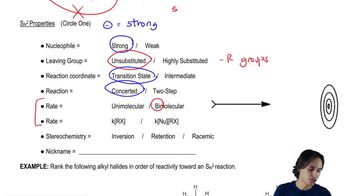
SN2 (Substitution Nucleophilic Bimolecular) reactions involve a nucleophile attacking an electrophilic carbon atom, resulting in the simultaneous displacement of a leaving group. This mechanism is characterized by a single concerted step, where the nucleophile approaches the carbon from the opposite side of the leaving group, leading to inversion of configuration. Understanding this mechanism is crucial for predicting the outcome of reactions involving primary alkyl halides like 1-chlorobutane.
Recommended video:
Guided course
11:57
Understanding the properties of SN2.

Nucleophiles

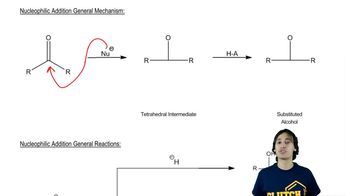
Nucleophiles are species that donate an electron pair to form a chemical bond in a reaction. In the context of SN2 reactions, a strong nucleophile is essential for effectively displacing the leaving group. Common nucleophiles include hydroxide ions (OH-) and alkoxide ions (RO-), which can be used to convert 1-chlorobutane into butan-1-ol by attacking the carbon atom bonded to the chlorine.
Recommended video:
Guided course
08:27
Nucleophilic Addition

Leaving Groups

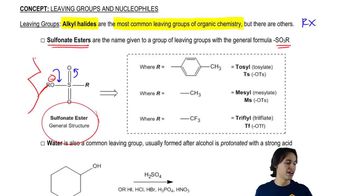
A leaving group is an atom or group that can depart with a pair of electrons in a substitution or elimination reaction. The effectiveness of a leaving group significantly influences the rate and feasibility of SN2 reactions. In the case of 1-chlorobutane, the chloride ion (Cl-) is a good leaving group, allowing for the successful conversion to butan-1-ol when a suitable nucleophile is introduced.
Recommended video:
Guided course
07:22
The 3 important leaving groups to know.
Related Practice
Textbook Question

a. Propose a mechanism for the following reaction:

b. Use the bond-dissociation enthalpies given in Table 4-2 (page 167) to calculate the value of ΔH° for each step shown in your mechanism. (The BDE for CH2=CHCH2―Br is about 280 kJ/mol, or 67 kcal/mol.) Calculate the overall value of ΔH° for the reaction. Are these values consistent with a rapid free-radical chain reaction?

2163
views
Textbook Question

For each pair of compounds, predict which compound has the higher boiling point. Check [TABLE 6-2] to see if your prediction was right; then explain why that compound has the higher boiling point.

c. 1-bromobutane and 1-chlorobutane

1371
views
Textbook Question

For each pair of compounds, predict which compound has the higher boiling point. Check [TABLE 6-2] to see if your prediction was right; then explain why that compound has the higher boiling point.

b. isopropyl chloride and tert-butyl bromide

1270
views
Textbook Question

Show how you might use SN2 reactions to convert 1-chlorobutane into the following compounds.

b. 1-fluorobutane

675
views
Textbook Question

For each pair of compounds, predict which compound has the higher boiling point. Check [TABLE 6-2] to see if your prediction was right; then explain why that compound has the higher boiling point.

a. isopropyl bromide and n-butyl bromide

1435
views
Textbook Question

Under appropriate conditions, (S)-1-bromo-1-fluoroethane reacts with sodium methoxide to give pure (S)-1-fluoro-1-methoxyethane.

a. Why is bromide rather than fluoride replaced?

b. Draw perspective structures (as shown on the previous page for 2-bromobutane) for the starting material, the transition state, and the product.

c. Does the product show retention or inversion of configuration? d. Is this result consistent with reaction by the SN2 mechanism?

2378
views