Ch.6 - Alkyl Halides; Nucleophilic Substitution
Wade - Organic Chemistry 9th Edition
Wade9th EditionOrganic ChemistryISBN: 9780135213728Not the one you use?Change textbook
Chapter 6, Problem 13c

Under certain conditions, the reaction of 0.5 M 1-bromobutane with 1.0 M sodium methoxide forms 1-methoxybutane at a rate of 0.05 mol/L per second.
c. Show another SN2 reaction using a different combination of an alkoxide and an alkyl bromide that also produces 1-methoxybutane.

Verified step by step guidance
1
Step 1: Understand the SN2 reaction mechanism. SN2 reactions involve a single-step bimolecular nucleophilic substitution where the nucleophile attacks the electrophilic carbon, displacing the leaving group. The reaction rate depends on both the concentration of the nucleophile and the substrate.
Step 2: Identify the target product, 1-methoxybutane. This compound has a butane backbone with a methoxy (-OCH3) group attached to the first carbon. The goal is to produce this compound using a different alkoxide and alkyl bromide combination.
Step 3: Choose an alternative alkoxide nucleophile. Sodium ethoxide (NaOCH2CH3) can be used as the nucleophile, as it is a strong base and can participate in SN2 reactions. However, to ensure the formation of 1-methoxybutane, the alkoxide must be modified to match the desired methoxy group. Use sodium methoxide (NaOCH3) as the nucleophile.
Step 4: Select a different alkyl bromide substrate. Instead of 1-bromobutane, you can use methyl bromide (CH3Br) as the substrate. Methyl bromide is a good candidate for SN2 reactions due to its small size and lack of steric hindrance.
Step 5: Combine the chosen reactants. React sodium methoxide (NaOCH3) with methyl bromide (CH3Br) under appropriate conditions (e.g., polar aprotic solvent like acetone). The methoxide ion will attack the methyl carbon, displacing the bromide ion and forming 1-methoxybutane as the product.

Verified video answer for a similar problem:

This video solution was recommended by our tutors as helpful for the problem above.
Video duration:
7m
Was this helpful?

Key Concepts

Here are the essential concepts you must grasp in order to answer the question correctly.

SN2 Reaction Mechanism

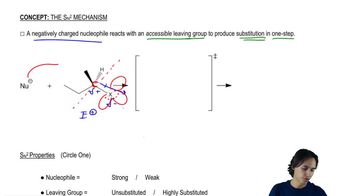
The SN2 (substitution nucleophilic bimolecular) reaction is a type of nucleophilic substitution where a nucleophile attacks an electrophile, resulting in the simultaneous displacement of a leaving group. This mechanism involves a single concerted step, where the bond formation and bond breaking occur simultaneously, leading to an inversion of configuration at the carbon center. Understanding this mechanism is crucial for predicting the outcomes of reactions involving alkyl halides and nucleophiles.
Recommended video:
Guided course
08:33
Drawing the SN2 Mechanism

Alkoxides as Nucleophiles

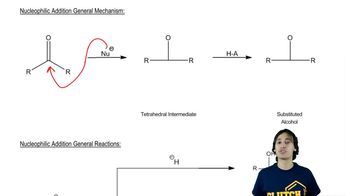
Alkoxides are strong nucleophiles derived from alcohols by deprotonation. They are characterized by the presence of an alkyl group attached to an oxygen atom with a negative charge. In SN2 reactions, alkoxides can effectively attack alkyl halides, such as 1-bromobutane, to form ethers like 1-methoxybutane. Recognizing the reactivity of different alkoxides is essential for designing alternative reactions that yield the same product.
Recommended video:
Guided course
08:27
Nucleophilic Addition

Reactivity of Alkyl Halides

The reactivity of alkyl halides in nucleophilic substitution reactions is influenced by their structure, particularly the degree of substitution at the carbon atom bonded to the halide. Primary alkyl halides, like 1-bromobutane, are more reactive in SN2 reactions due to less steric hindrance, allowing easier access for the nucleophile. Understanding the reactivity patterns of various alkyl halides helps in selecting appropriate substrates for synthesizing desired products, such as 1-methoxybutane.
Recommended video:
Guided course
01:52
How to name alkyl halides