Solve each equation in x over the interval [0, 2π) and each equation in θ over the interval [0°, 360°). Give exact solutions. cos 2x + cos x = 0
Verified step by step guidance
1
Start with the given equation: \(\cos 2x + \cos x = 0\).
Use the double-angle identity for cosine: \(\cos 2x = 2\cos^2 x - 1\). Substitute this into the equation to get \(2\cos^2 x - 1 + \cos x = 0\).
Rewrite the equation as a quadratic in terms of \(\cos x\): \(2\cos^2 x + \cos x - 1 = 0\).
Solve the quadratic equation \$2y^2 + y - 1 = 0\( where \(y = \cos x\). Use the quadratic formula \(y = \frac{-b \pm \sqrt{b^2 - 4ac}}{2a}\) with \)a=2\(, \)b=1\(, and \)c=-1$.
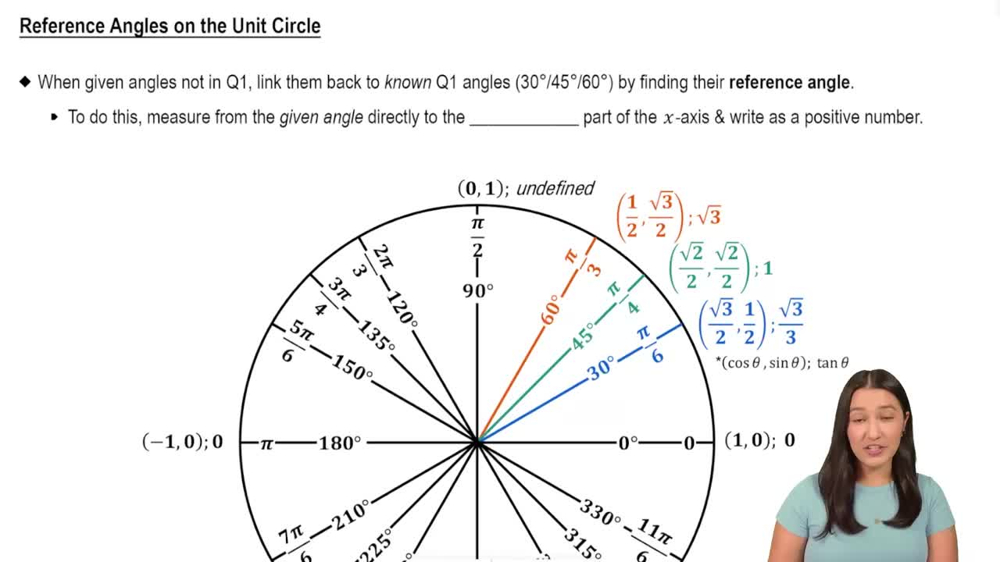
Find the values of \(x\) in the interval \([0, 2\pi)\) (or \(\theta\) in \([0^\circ, 360^\circ)\)) by solving \(\cos x = y\) for each root \(y\) obtained, using inverse cosine and considering all solutions within the given interval.
Verified video answer for a similar problem:
This video solution was recommended by our tutors as helpful for the problem above
Play a video:
0 Comments
Key Concepts
Here are the essential concepts you must grasp in order to answer the question correctly.
Double-Angle Identity for Cosine
The double-angle identity expresses cos(2x) in terms of cos(x) and sin(x), commonly as cos(2x) = 2cos²(x) - 1. This identity helps rewrite the equation cos(2x) + cos(x) = 0 into a single trigonometric function, simplifying the solving process.
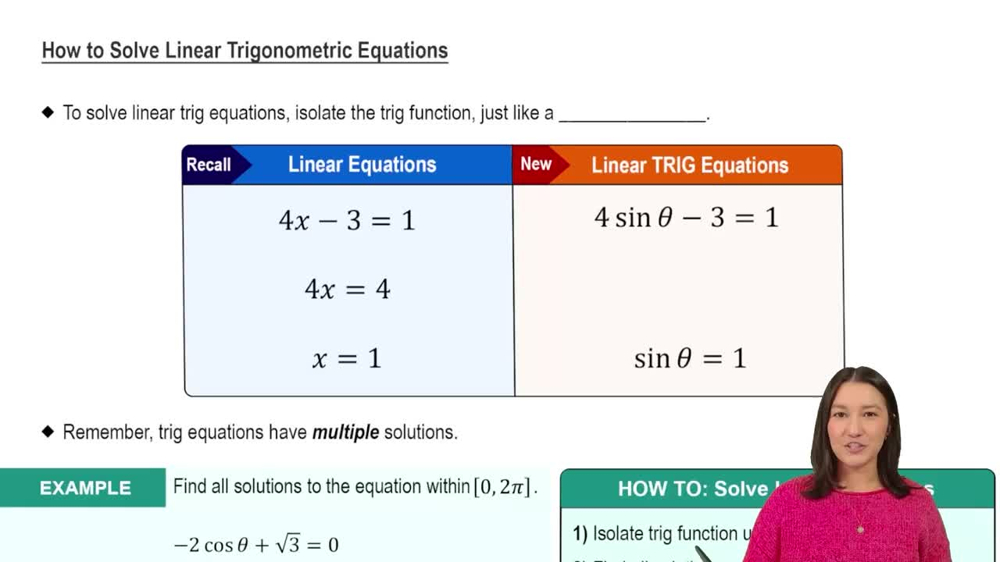
Solving trigonometric equations involves isolating the trigonometric function and finding all angles within the given interval that satisfy the equation. This often requires using identities, factoring, or substitution to find exact solutions.
Understanding the specified interval [0, 2π) for x in radians and [0°, 360°) for θ in degrees is crucial. Solutions must be found within these ranges, ensuring all valid angles are included and expressed exactly, not approximately.

 Verified step by step guidance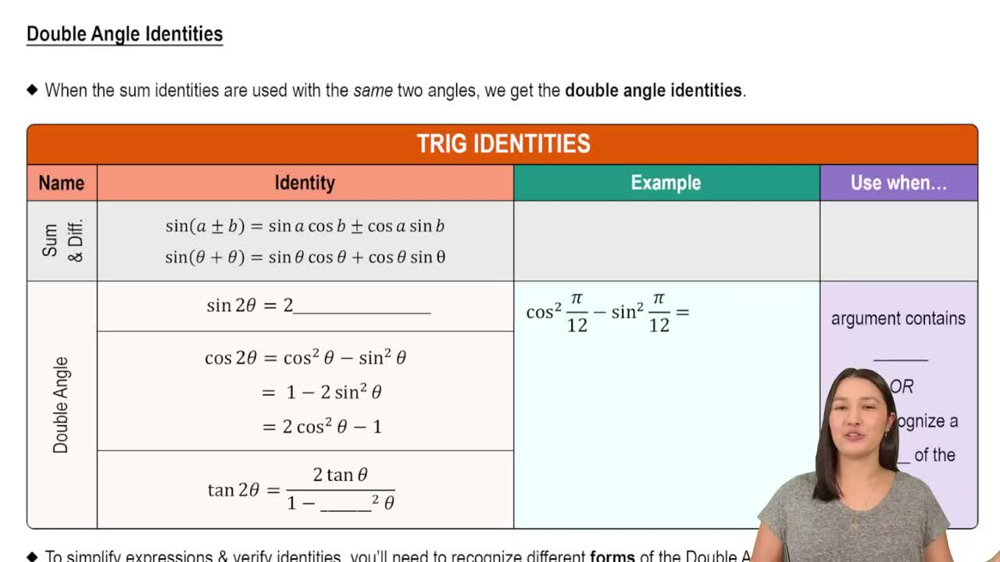
 05:06
05:06