Solve each equation (x in radians and θ in degrees) for all exact solutions where appropriate. Round approximate answers in radians to four decimal places and approximate answers in degrees to the nearest tenth. Write answers using the least possible nonnegative angle measures.
1 - sin x = cos 2x
Verified step by step guidance
1
Rewrite the given equation: \(1 - \sin x = \cos 2x\).
Recall the double-angle identity for cosine: \(\cos 2x = 1 - 2\sin^2 x\). Substitute this into the equation to get \(1 - \sin x = 1 - 2\sin^2 x\).
Simplify the equation by subtracting 1 from both sides: \(-\sin x = -2\sin^2 x\). Then multiply both sides by -1 to get \(\sin x = 2\sin^2 x\).
Rewrite the equation as \(2\sin^2 x - \sin x = 0\) and factor it: \(\sin x (2\sin x - 1) = 0\).
Set each factor equal to zero and solve for \(x\):
1) \(\sin x = 0\)
2) \(2\sin x - 1 = 0 \Rightarrow \sin x = \frac{1}{2}\).
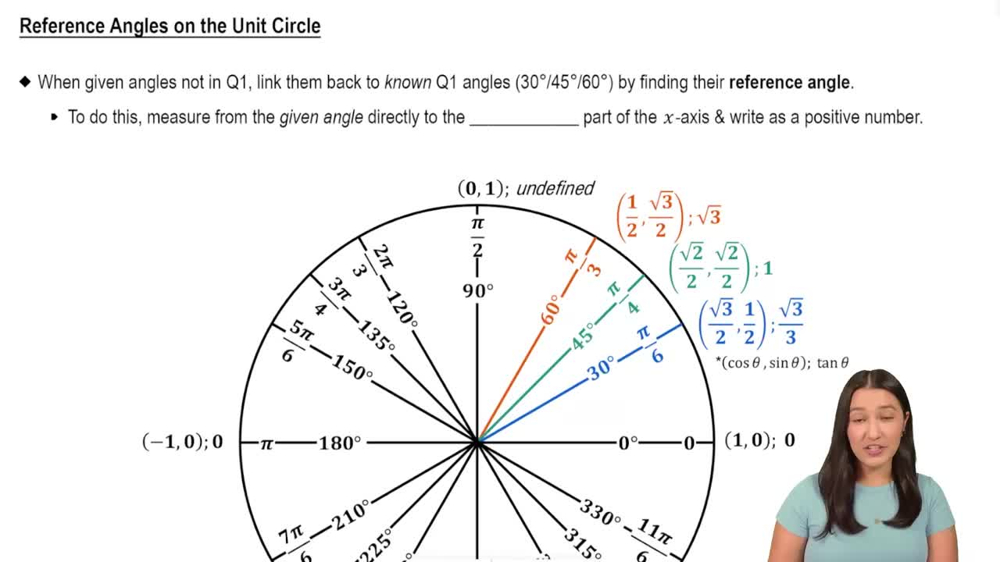
Find all solutions for \(x\) in radians within the specified domain, then convert to degrees if needed, and express answers as the least possible nonnegative angles.
Verified video answer for a similar problem:
This video solution was recommended by our tutors as helpful for the problem above
Play a video:
0 Comments
Key Concepts
Here are the essential concepts you must grasp in order to answer the question correctly.
Trigonometric Identities
Trigonometric identities are equations involving trigonometric functions that hold true for all values within their domains. For this problem, the double-angle identity for cosine, cos 2x = 1 - 2sin²x or cos 2x = 2cos²x - 1, is essential to rewrite and simplify the equation for easier solving.
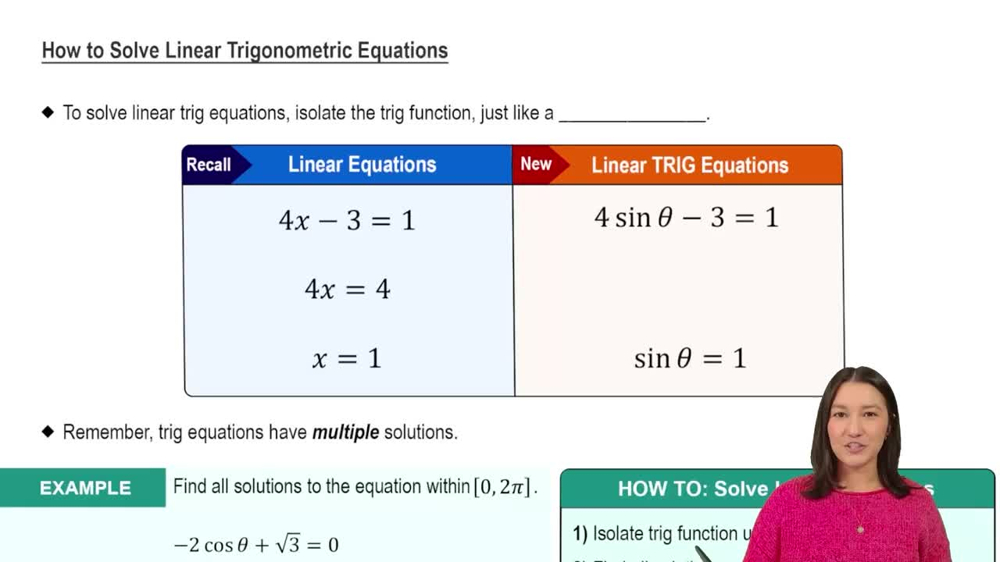
Solving trigonometric equations involves isolating the trigonometric function and finding all angle solutions within a given domain. This includes considering the periodic nature of sine and cosine functions and expressing solutions using general formulas that account for all possible angles.
Understanding angle measurements in radians and degrees is crucial, as the problem requires solutions in both units. Converting between radians and degrees and expressing answers within the least nonnegative angle measure ensures clarity and correctness in the final solutions.