Evaluate the derivative of the following functions. f(t) = ln (sin-1 t2)
Verified step by step guidance
1
First, recognize that the function f(t) = ln(sin^{-1}(t^2)) is a composition of functions, specifically a natural logarithm and an inverse sine function. To find the derivative, we will use the chain rule.
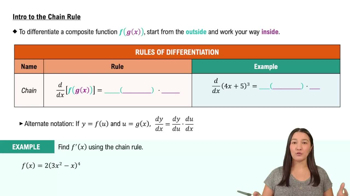
Apply the chain rule: If you have a composite function f(g(t)), the derivative is f'(g(t)) * g'(t). Here, f(u) = ln(u) and g(t) = sin^{-1}(t^2).
Differentiate the outer function f(u) = ln(u) with respect to u. The derivative is 1/u.
Differentiate the inner function g(t) = sin^{-1}(t^2) with respect to t. Use the derivative of the inverse sine function: d/dt [sin^{-1}(x)] = 1/sqrt(1-x^2). Here, x = t^2, so apply the chain rule again to differentiate t^2.
Combine the results: Multiply the derivative of the outer function by the derivative of the inner function, substituting back the expressions for u and x. Simplify the expression to get the final derivative.
Verified video answer for a similar problem:
This video solution was recommended by our tutors as helpful for the problem above
Video duration:
3m
Play a video:
0 Comments
Key Concepts
Here are the essential concepts you must grasp in order to answer the question correctly.
Derivative
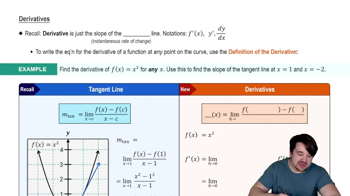
The derivative of a function measures how the function's output value changes as its input value changes. It is a fundamental concept in calculus, representing the slope of the tangent line to the function's graph at any given point. The derivative can be computed using various rules, such as the product rule, quotient rule, and chain rule, depending on the complexity of the function.
The chain rule is a formula for computing the derivative of the composition of two or more functions. It states that if you have a function that is composed of an outer function and an inner function, the derivative can be found by multiplying the derivative of the outer function evaluated at the inner function by the derivative of the inner function. This is particularly useful when dealing with nested functions, such as logarithmic and trigonometric functions.
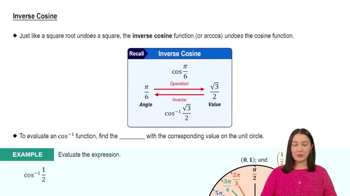
Inverse functions reverse the effect of the original function. For example, if a function f takes an input x and produces an output y, the inverse function f<sup>-1</sup> takes y back to x. In calculus, understanding inverse functions is crucial, especially when differentiating functions like arcsin or ln, as their derivatives involve specific formulas that account for their inverse nature.

 3:52 minutes
 Verified step by step guidance
 05:44
05:44