Back
Back
Problem 6.1.38b
Deceleration A car slows down with an acceleration of a(t) = −15 ft/s². Assume v(0)=60 ft/s,s(0)=0, and t is measured in seconds.
b. How far does the car travel in the time it takes to come to rest?
Problem 6.4.51b
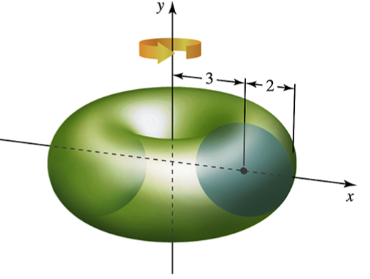
A torus (doughnut) A torus is formed when a circle of radius 2 centered at (3, 0) is revolved about the y-axis.
b. Use the washer method to write an integral for the volume of the torus.
Problem 6.1.59b
Explain why or why not Determine whether the following statements are true and give an explanation or counterexample.
b. When the velocity is positive on an interval, the displacement and the distance traveled on that interval are equal.
Problem 6.1.57b
55–58. Marginal cost Consider the following marginal cost functions.
b. Find the additional cost incurred in dollars when production is increased from 500 units to 550 units.
C′(x) = 300+10x−0.01x²
Problem 6.2.65b
Determine whether the following statements are true and give an explanation or counterexample.
b. The area of the region between y=sin x and y=cos x on the interval [0,π/2] is ∫π/20(cosx−sinx)dx.
Problem 6.6.39b
In the design of solid objects (both artificial and natural), the ratio of the surface area to the volume of the object is important. Animals typically generate heat at a rate proportional to their volume and lose heat at a rate proportional to their surface area. Therefore, animals with a low SAV ratio tend to retain heat, whereas animals with a high SAV ratio (such as children and hummingbirds) lose heat relatively quickly.
b. What is the SAV ratio of a ball with radius a?
Problem 6.3.8b
Use the region R that is bounded by the graphs of y=1+√x,x=4, and y=1 complete the exercises.
Region R is revolved about the y-axis to form a solid of revolution whose cross sections are washers.
b. What is the inner radius of a cross section of the solid at a point y in [1, 3]?
Problem 6.1.12b
Distance traveled and displacement Suppose an object moves along a line with velocity (in ft/s) v(t)=6−2t, for 0≤t≤6, where t is measured in seconds.
b. Find the displacement of the object on the interval 0≤t≤6.
Problem 6.7.39b
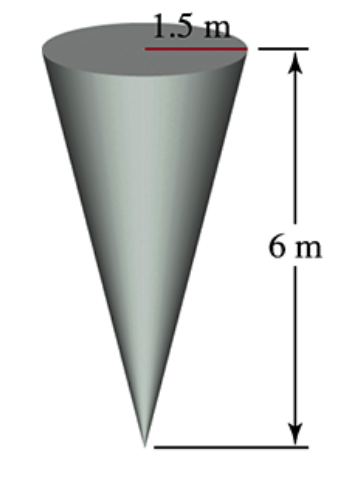
Emptying a conical tank A water tank is shaped like an inverted cone with height 6 m and base radius 1.5 m (see figure).
b. Is it true that it takes half as much work to pump the water out of the tank when it is filled to half its depth as when it is full? Explain.
Problem 6.4.5b
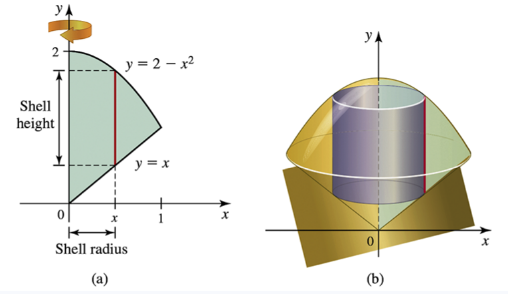
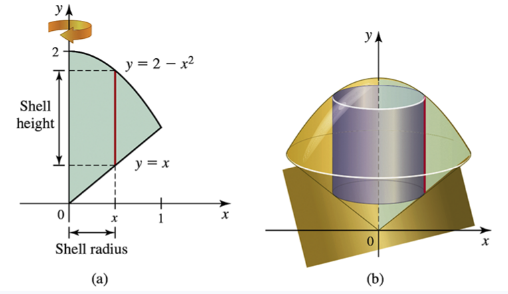
Let R be the region in the first quadrant bounded above by the curve y=2−x² and bounded below by the line y=x. Suppose the shell method is used to determine the volume of the solid generated by revolving R about the y-axis.
b. What is the height of a cylindrical shell at a point x in [0, 2]?
Problem 6.5.35b
Functions from arc length What differentiable functions have an arc length on the interval [a, b] given by the following integrals? Note that the answers are not unique. Give a family of functions that satisfy the conditions.
b. ∫a^b √1+36 cos² 2xdx
Problem 6.1.40b
40–43. Population growth
Starting with an initial value of P(0)=55, the population of a prairie dog community grows at a rate of P′(t)=20−t/5 (prairie dogs/month), for 0≤t≤200, where t is measured in months.
b. Find the population P(t), for 0≤t≤200.
Problem 6.1.66b
Two runners At noon (t=0), Alicia starts running along a long straight road at 4 mi/hr. Her velocity decreases according to the function v(t) = 4 / t + 1 for t≥0. At noon, Boris also starts running along the same road with a 2-mi head start on Alicia; his velocity is given by u(t) = 2 / t + 1, for t≥0. Assume t is measured in hours.
b. When, if ever, does Alicia overtake Boris?
Problem 6.6.23b
Determine whether the following statements are true and give an explanation or counterexample.
b. If f is not one-to-one on the interval [a, b], then the area of the surface generated when the graph of f on [a, b] is revolved about the x-axis is not defined.
Problem 6.1.50c
Blood flow A typical human heart pumps 70 mL of blood (the stroke volume) with each beat. Assuming a heart rate of 60 beats/min (1 beat/s), a reasonable model for the outflow rate of the heart is V′(t)=70(1+sin 2πt), where V(t) is the amount of blood (in milliliters) pumped over the interval [0,t],V(0)=0 and t is measured in seconds.
c. What is the cardiac output over a period of 1 min? (Use calculus; then check your answer with algebra.)
Problem 6.7.59c
A nonlinear spring Hooke’s law is applicable to idealized (linear) springs that are not stretched or compressed too far from their equilibrium positions. Consider a nonlinear spring whose restoring force is given by F(x) = 16x−0.1x³, for |x|≤7.
c. How much work is done in compressing the spring from its equilibrium position (x=0) to x=−2?
Problem 6.3.8c
Use the region R that is bounded by the graphs of y=1+√x,x=4, and y=1 complete the exercises.
Region R is revolved about the y-axis to form a solid of revolution whose cross sections are washers.
c. What is the area A(y) of a cross section of the solid at a point y in [1, 3]?
Problem 6.1.65c
Bike race Theo and Sasha start at the same place on a straight road, riding bikes with the following velocities (measured in mi/hr). Assume t is measured in hours.
Theo: vT(t)=10, for t≥0
Sasha: vS(t)=15t, for 0≤t≤1, and vS(t)=15, for t>1
c. If the riders ride for 2 hr, who rides farther? Interpret your answer geometrically using the graphs of part (a).
Problem 6.7.23c
Compressing and stretching a spring Suppose a force of 30 N is required to stretch and hold a spring 0.2 m from its equilibrium position.
c. How much work is required to stretch the spring 0.3 m from its equilibrium position?
Problem 6.1.26c
Day hike The velocity (in mi/hr) of a hiker walking along a straight trail is given by v(t) = 3 sin² πt/2, for 0≤t≤4. Assume s(0)=0 and t is measured in hours.
c. What is the hiker’s position at t=3?
Problem 6.1.13c
13–16. Displacement from velocity Consider an object moving along a line with the given velocity v. Assume time t is measured in seconds and velocities have units of m/s.
c. Find the distance traveled over the given interval.
v(t) = 3t²−6t on [0, 3]
Problem 6.3.9c
Region R is revolved about the line y=1 to form a solid of revolution.
c. Write an integral for the volume of the solid.
Problem 6.1.25c
Flying into a headwind The velocity (in mi/hr) of an airplane flying into a headwind is given by v(t) = 30(16−t²), for 0≤t≤3. Assume s(0)=0 and t is measured in hours.
c. How far has the airplane traveled at the instant its velocity reaches 400 mi/hr?
Problem 6.1.47c
Depletion of natural resources Suppose r(t) = r0e^−kt, with k>0, is the rate at which a nation extracts oil, where r0=10⁷ barrels/yr is the current rate of extraction. Suppose also that the estimate of the total oil reserve is 2×10⁹ barrels.
c. Find the minimum decay constant k for which the total oil reserves will last forever.
Problem 6.4.63c
Explain why or why not Determine whether the following statements are true and give an explanation or counterexample.
c. If a region is revolved about the x-axis, then in principle, it is possible to use the disk/washer method and integrate with respect to x or to use the shell method and integrate with respect to y.
Problem 6.1.28c
Probe speed A data collection probe is dropped from a stationary balloon, and it falls with a velocity (in m/s) given by v(t) = 9.8t, neglecting air resistance. After 10 s, a chute deploys and the probe immediately slows to a constant speed of 10 m/s, which it maintains until it enters the ocean.
c. If the probe was released from an altitude of 3 km, when does it enter the ocean?
Problem 6.6.23c
Determine whether the following statements are true and give an explanation or counterexample.
c. Let f(x)=12x^2. The area of the surface generated when the graph of f on [−4, 4] is revolved about the x-axis is twice the area of the surface generated when the graph of f on [0, 4] is revolved about the x-axis.
Problem 6.4.5c
Let R be the region in the first quadrant bounded above by the curve y=2−x² and bounded below by the line y=x. Suppose the shell method is used to determine the volume of the solid generated by revolving R about the y-axis.
c. Write an integral for the volume of the solid using the shell method.
Problem 6.1.64c
Where do they meet? Kelly started at noon (t=0) riding a bike from Niwot to Berthoud, a distance of 20 km, with velocity v(t) = 15 / (t + 1)² (decreasing because of fatigue). Sandy started at noon (t=0) riding a bike in the opposite direction from Berthoud to Niwot with velocity u(t) = 20 / (t + 1)² (also decreasing because of fatigue). Assume distance is measured in kilometers and time is measured in hours.
c. When do they meet? How far has each person traveled when they meet?
Problem 6.1.48c
Filling a tank A 2000-liter cistern is empty when water begins flowing into it (at t=0 at a rate (in L/min) given by Q′(t) = 3√t, where t is measured in minutes.
c. When will the tank be full?