Back
Back
Problem 6.4.5c
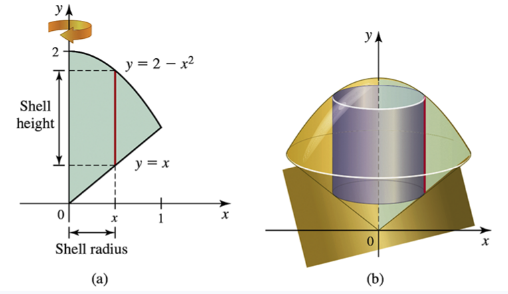
Let R be the region in the first quadrant bounded above by the curve y=2−x² and bounded below by the line y=x. Suppose the shell method is used to determine the volume of the solid generated by revolving R about the y-axis.
c. Write an integral for the volume of the solid using the shell method.
Problem 6.1.64c
Where do they meet? Kelly started at noon (t=0) riding a bike from Niwot to Berthoud, a distance of 20 km, with velocity v(t) = 15 / (t + 1)² (decreasing because of fatigue). Sandy started at noon (t=0) riding a bike in the opposite direction from Berthoud to Niwot with velocity u(t) = 20 / (t + 1)² (also decreasing because of fatigue). Assume distance is measured in kilometers and time is measured in hours.
c. When do they meet? How far has each person traveled when they meet?
Problem 6.1.48c
Filling a tank A 2000-liter cistern is empty when water begins flowing into it (at t=0 at a rate (in L/min) given by Q′(t) = 3√t, where t is measured in minutes.
c. When will the tank be full?
Problem 6.7.42c
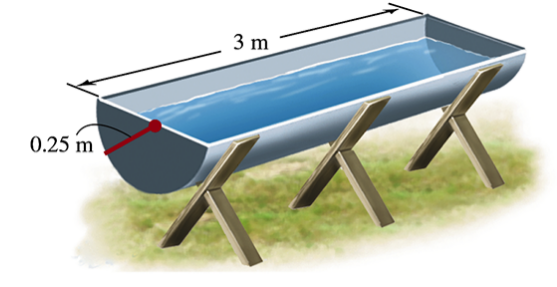
Emptying a water trough A water trough has a semicircular cross section with a radius of 0.25 m and a length of 3 m (see figure).
c. If the radius is doubled, is the required work doubled? Explain.
Problem 6.3.5c
Let R be the region bounded by the curve y=√cos x and the x-axis on [0, π/2]. A solid of revolution is obtained by revolving R about the x-axis (see figures).
c. Write an integral for the volume of the solid.
Problem 6.4.8c
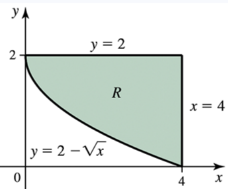
6–8. Let R be the region bounded by the curves y = 2−√x,y=2, and x=4 in the first quadrant.
Suppose the shell method is used to determine the volume of the solid generated by revolving R about the line x=4.
c. Write an integral for the volume of the solid using the shell method.
Problem 6.7.57c
Explain why or why not Determine whether the following statements are true and give an explanation or counterexample.
c. The work required to lift a 10-kg object vertically 10 m is the same as the work required to lift a 20-kg object vertically 5 m.
Problem 6.1.14c
13–16. Displacement from velocity Consider an object moving along a line with the given velocity v. Assume time t is measured in seconds and velocities have units of m/s.
c. Find the distance traveled over the given interval.
v(t) = 4t³ - 24t²+20t on [0, 5]
Problem 6.1.27c
Piecewise velocity The velocity of a (fast) automobile on a straight highway is given by the function
, where is measured in seconds and v has units of m/s.
c. What is the distance traveled by the automobile in the first 60 s?
Problem 6.1.10c
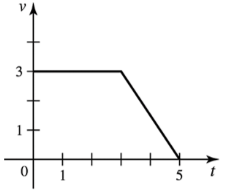
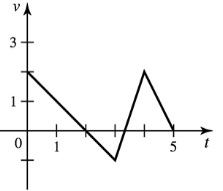
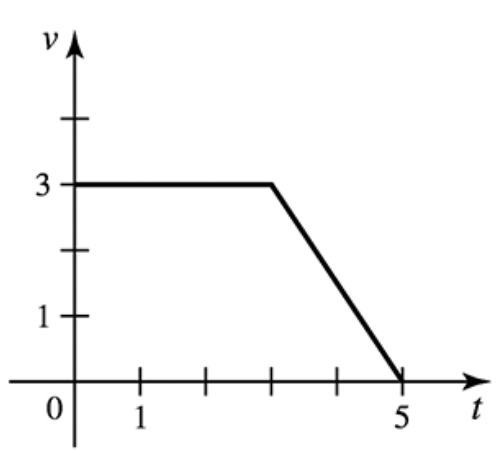
9–10. Velocity graphs The figures show velocity functions for motion along a line. Assume the motion begins with an initial position of s(0)=0. Determine the following.
c. The position at t=5
Problem 6.1.23c
{Use of Tech} Oscillating motion A mass hanging from a spring is set in motion, and its ensuing velocity is given by v(t) = 2π cos πt, for t≥0. Assume the positive direction is upward and s(0)=0.
c. At what times does the mass reach its low point the first three times?
Problem 6.5.33c
Explain why or why not Determine whether the following statements are true and give an explanation or counterexample.
Arc length may be negative if f(x) < 0 on part of the interval in question.
Problem 6.1.46c
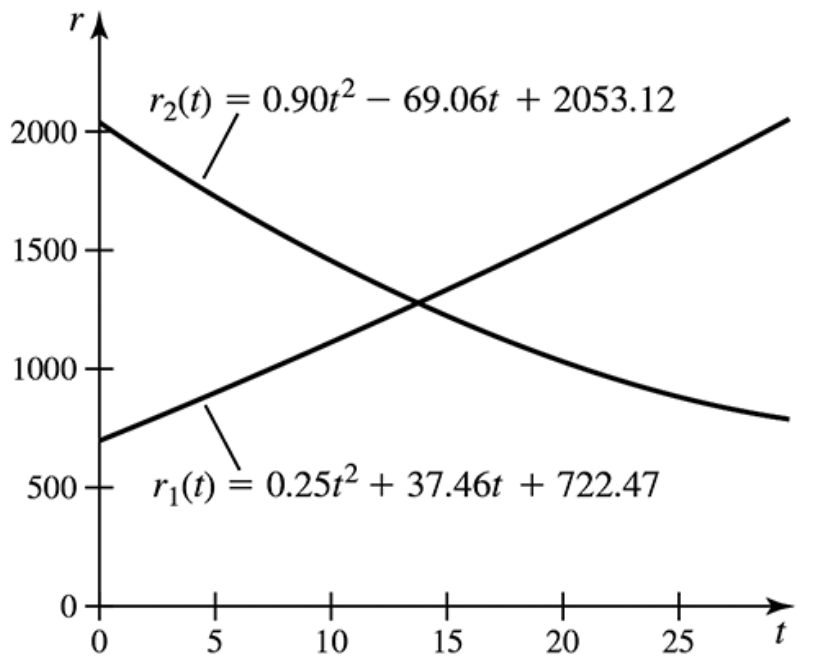
Flow rates in the Spokane River The daily discharge of the Spokane River as it flows through Spokane, Washington, in April and June is modeled by the functions
r1(t) = 0.25t²+37.46t+722.47 (April) and
r2(t) = 0.90t²−69.06t+2053.12 (June), where the discharge is measured in millions of cubic feet per day, and t=0 corresponds to the beginning of the first day of the month (see figure).
c. The Spokane River flows out of Lake Coeur d’Alene, which contains approximately 0.67mi³ of water. Determine the percentage of Lake Coeur d’Alene’s volume that flows through Spokane in April and June.
Problem 6.1.24c
Cycling distance A cyclist rides down a long straight road with a velocity (in m/min) given by v(t) = 400−20t, for 0≤t≤10, where t is measured in minutes.
c. How far has the cyclist traveled when her velocity is 250 m/min?
Problem 6.2.65c
Determine whether the following statements are true and give an explanation or counterexample.
c. ∫₀¹(x−x^2) dx=∫₀¹(√y−y) dy
Problem 6.1.52c
Oscillating growth rates Some species have growth rates that oscillate with an (approximately) constant period P. Consider the growth rate function N'(t) = r+A sin 2πt/P, where A and r are constants with units of individuals/yr, and t is measured in years. A species becomes extinct if its population ever reaches 0 after t=0.
c. Suppose P=10, A=50, and r=5. If the initial population is N(0)=10, does the population ever become extinct? Explain.
Problem 6.3.8d
Use the region R that is bounded by the graphs of y=1+√x,x=4, and y=1 complete the exercises.
Region R is revolved about the y-axis to form a solid of revolution whose cross sections are washers.
d. Write an integral for the volume of the solid.
Problem 6.3.7d
Use the region R that is bounded by the graphs of y=1+√x,x=4, and y=1 complete the exercises.
Region R is revolved about the x-axis to form a solid of revolution whose cross sections are washers.
d. Write an integral for the volume of the solid.
Problem 6.1.59d
Explain why or why not Determine whether the following statements are true and give an explanation or counterexample.
d. A particular marginal cost function has the property that it is positive and decreasing. The cost of increasing production from A units to 2A units is greater than the cost of increasing production from 2A units to 3A units.
Problem 6.1.7d
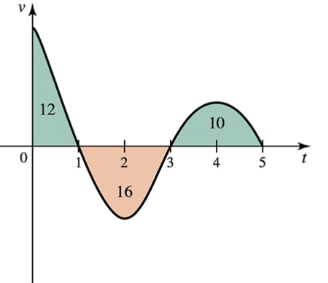
Displacement and distance from velocity Consider the graph shown in the figure, which gives the velocity of an object moving along a line. Assume time is measured in hours and distance is measured in miles. The areas of three regions bounded by the velocity curve and the t-axis are also given.
d. What is the displacement of the object over the interval [0,5]?
Problem 6.6.23d
Determine whether the following statements are true and give an explanation or counterexample.
d. Let f(x)=12x^2.. The area of the surface generated when the graph of f on [−4, 4] is revolved about the y-axis is twice the area of the surface generated when the graph of f on [0, 4] is revolved about the y-axis.
Problem 6.1.8d
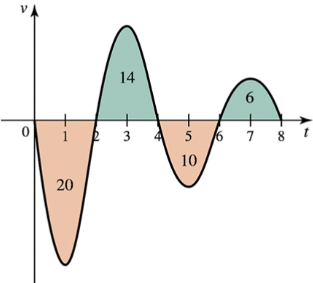
Displacement and distance from velocity Consider the velocity function shown below of an object moving along a line. Assume time is measured in seconds and distance is measured in meters. The areas of four regions bounded by the velocity curve and the t-axis are also given.
d. What is the displacement of the object over the interval [0, 8]?
Problem 6.1.9d
9–10. Velocity graphs The figures show velocity functions for motion along a line. Assume the motion begins with an initial position of s(0)=0. Determine the following.
d. A piecewise function for s(t)
Problem 6.1.64d
Where do they meet? Kelly started at noon (t=0) riding a bike from Niwot to Berthoud, a distance of 20 km, with velocity v(t) = 15 / (t + 1)² (decreasing because of fatigue). Sandy started at noon (t=0) riding a bike in the opposite direction from Berthoud to Niwot with velocity u(t) = 20 / (t + 1)² (also decreasing because of fatigue). Assume distance is measured in kilometers and time is measured in hours.
d. More generally, if the riders’ speeds are v(t)=A(t+1)² and u(t)=B(t+1)² and the distance between the towns is D, what conditions on A, B, and D must be met to ensure that the riders will pass each other?
Problem 6.1.10d
9–10. Velocity graphs The figures show velocity functions for motion along a line. Assume the motion begins with an initial position of s(0)=0. Determine the following.
d. A piecewise function for s(t)
Problem 6.7.23d
Compressing and stretching a spring Suppose a force of 30 N is required to stretch and hold a spring 0.2 m from its equilibrium position.
d. How much additional work is required to stretch the spring 0.2m if it has already been stretched 0.2m from its equilibrium position?
Problem 6.1.27d
Piecewise velocity The velocity of a (fast) automobile on a straight highway is given by the function
where is measured in seconds and v has units of m/s.
d. What is the position of the automobile when t=75?
Problem 6.1.37d
Acceleration A drag racer accelerates at a(t)=88 ft/s². Assume v(0)=0, s(0)=0, and t is measured in seconds.
d. How long does it take the racer to travel 300 ft?
Problem 6.1.37e
Acceleration A drag racer accelerates at a(t)=88 ft/s². Assume v(0)=0, s(0)=0, and t is measured in seconds.
e. How far has the racer traveled when it reaches a speed of 178 ft/s?
Problem 6.1.8e
Displacement and distance from velocity Consider the velocity function shown below of an object moving along a line. Assume time is measured in seconds and distance is measured in meters. The areas of four regions bounded by the velocity curve and the t-axis are also given.
e. Describe the position of the object relative to its initial position after 8 seconds.