Back
Back
Problem 6.7.24b
Compressing and stretching a spring Suppose a force of 15 N is required to stretch and hold a spring 0.25 m from its equilibrium position.
b. How much work is required to compress the spring 0.2 m from its equilibrium position?
Problem 6.7.25b
Work done by a spring A spring on a horizontal surface can be stretched and held 0.5 m from its equilibrium position with a force of 50 N.
b. How much work is done in compressing the spring 0.5 m from its equilibrium position?
Problem 6.3.7b
Use the region R that is bounded by the graphs of y=1+√x,x=4, and y=1 complete the exercises.
Region R is revolved about the x-axis to form a solid of revolution whose cross sections are washers.
b. What is the inner radius of a cross section of the solid at a point x in [0, 4]?
Problem 6.4.72b
Equal integrals Without evaluating integrals, explain the following equalities. (Hint: Draw pictures.)
b. ∫²₀(25−(x²+1)²) dx = 2∫₁⁵ y√y−1 dy
Problem 6.4.8b
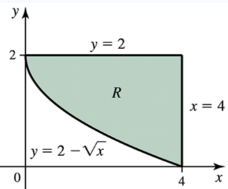
6–8. Let R be the region bounded by the curves y = 2−√x,y=2, and x=4 in the first quadrant.
Suppose the shell method is used to determine the volume of the solid generated by revolving R about the line x=4.
b. What is the height of a cylindrical shell at a point x in [0, 4]?
Problem 6.6.27b
Consider the following curves on the given intervals.
b. Use a calculator or software to approximate the surface area.
y=tan x , for 0≤x≤π/4; about the x-axis
Problem 6.1.8b
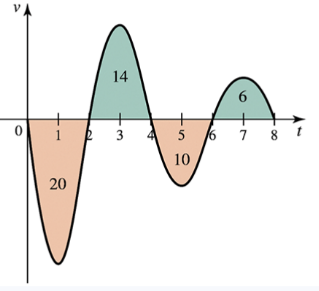
Displacement and distance from velocity Consider the velocity function shown below of an object moving along a line. Assume time is measured in seconds and distance is measured in meters. The areas of four regions bounded by the velocity curve and the t-axis are also given.
b. What is the displacement of the object over the interval [2, 6]?
Problem 6.1.53b
Power and energy The terms power and energy are often used interchangeably, but they are quite different. Energy is what makes matter move or heat up and is measured in units of joules (J) or Calories (Cal), where 1 Cal=4184 J. One hour of walking consumes roughly 10⁶ J, or 250 Cal. On the other hand, power is the rate at which energy is used and is measured in watts (W; 1W=1 J/s). Other useful units of power are kilowatts (1 kW=10³ W) and megawatts (1 MW=10⁶ W). If energy is used at a rate of 1 kW for 1 hr, the total amount of energy used is 1 kilowatt-hour (kWh), which is 3.6×10⁶ J. Suppose the power function of a large city over a 24-hr period is given by P(t) = E'(t) = 300 - 200 sin πt/12, where P is measured in megawatts and t=0 corresponds to 6:00 P.M. (see figure).
b. Burning 1 kg of coal produces about 450 kWh of energy. How many kilograms of coal are required to meet the energy needs of the city for 1 day? For 1 year?
Problem 6.4.76b
Different axes of revolution Suppose R is the region bounded by y=f(x) and y=g(x) on the interval [a, b], where f(x)≥g(x).
b. How is this formula changed if x0>b?
Problem 6.4.63b
Explain why or why not Determine whether the following statements are true and give an explanation or counterexample.
b. If a region is revolved about the y-axis, then the shell method must be used.
Problem 6.7.59b
A nonlinear spring Hooke’s law is applicable to idealized (linear) springs that are not stretched or compressed too far from their equilibrium positions. Consider a nonlinear spring whose restoring force is given by F(x) = 16x−0.1x³, for |x|≤7.
b. How much work is done in stretching the spring from its equilibrium position (x=0) to x=1.5?
Problem 6.7.36b
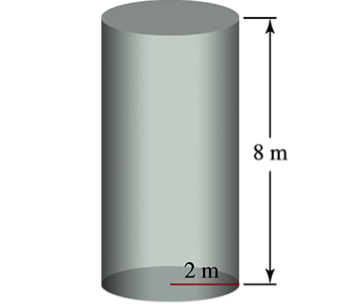
Emptying a cylindrical tank A cylindrical water tank has height 8 m and radius 2m (see figure).
b. Is it true that it takes half as much work to pump the water out of the tank when it is half full as when it is full? Explain.
Problem 6.1.13b
13–16. Displacement from velocity Consider an object moving along a line with the given velocity v. Assume time t is measured in seconds and velocities have units of m/s.
b. Find the displacement over the given interval.
v(t) = 3t²−6t on [0, 3]
Problem 6.4.73b
Volumes without calculus Solve the following problems with and without calculus. A good picture helps.
b. A cube is inscribed in a right circular cone with a radius of 1 and a height of 3. What is the volume of the cube?
Problem 6.7.42b
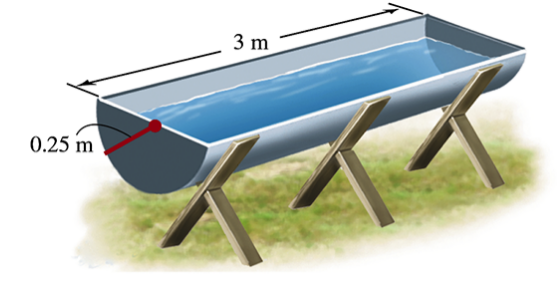
Emptying a water trough A water trough has a semicircular cross section with a radius of 0.25 m and a length of 3 m (see figure).
b. If the length is doubled, is the required work doubled? Explain.
Problem 6.1.7b
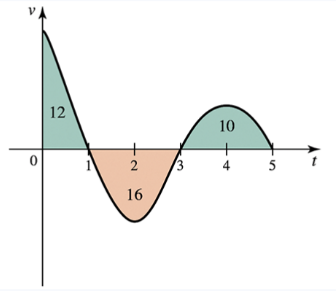
Displacement and distance from velocity Consider the graph shown in the figure, which gives the velocity of an object moving along a line. Assume time is measured in hours and distance is measured in miles. The areas of three regions bounded by the velocity curve and the t-axis are also given.
b. What is the displacement of the object over the interval [0,3]?
Problem 6.1.48b
Filling a tank A 2000-liter cistern is empty when water begins flowing into it (at t=0 at a rate (in L/min) given by Q′(t) = 3√t, where t is measured in minutes.
b. Find the function that gives the amount of water in the tank at any time t≥0.
Problem 6.1.24b
Cycling distance A cyclist rides down a long straight road with a velocity (in m/min) given by v(t) = 400−20t, for 0≤t≤10, where t is measured in minutes.
b. How far does the cyclist travel in the first 10 min?
Problem 6.5.27b
21–30. {Use of Tech} Arc length by calculator
b. If necessary, use technology to evaluate or approximate the integral.
y = cos 2x, for 0 ≤ x ≤ π
Problem 6.1.41b
40–43. Population growth
When records were first kept (t=0), the population of a rural town was 250 people. During the following years, the population grew at a rate of P′(t) = 30(1+√t), where t is measured in years.
b. Find the population P(t) at any time t≥0.
Problem 6.1.10b
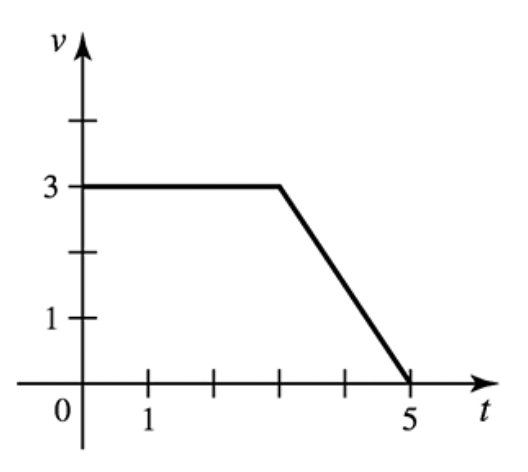
9–10. Velocity graphs The figures show velocity functions for motion along a line. Assume the motion begins with an initial position of s(0)=0. Determine the following.
b. The distance traveled between t=0 and t=5
Problem 6.1.55b
55–58. Marginal cost Consider the following marginal cost functions.
b. Find the additional cost incurred in dollars when production is increased from 500 units to 550 units.
C′(x)=200−0.05x
Problem 6.1.28b
Probe speed A data collection probe is dropped from a stationary balloon, and it falls with a velocity (in m/s) given by v(t) = 9.8t, neglecting air resistance. After 10 s, a chute deploys and the probe immediately slows to a constant speed of 10 m/s, which it maintains until it enters the ocean.
b. How far does the probe fall in the first 30 s after it is released?
Problem 6.7.28b
Calculating work for different springs Calculate the work required to stretch the following springs 0.4 m from their equilibrium positions. Assume Hooke’s law is obeyed.
b. A spring that requires 2 J of work to be stretched 0.1 m from its equilibrium position
Problem 6.4.49b
Volume of a sphere Let R be the region bounded by the upper half of the circle x²+y² = r² and the x-axis. A sphere of radius r is obtained by revolving R about the x-axis.
b. Repeat part (a) using the disk method.
Problem 6.3.61b
"Determine whether the following statements are true and give an explanation or counterexample.
b. The volume of a hemisphere can be computed using the disk method. "
Problem 6.2.35b
For the given regions R₁ and R₂, complete the following steps.
b. Find the area of region R₂ using geometry and the answer to part (a).
R₁is the region in the first quadrant bounded by the line x=1 and the curve y=6x(2−x^2)^2; R₂ is the region in the first quadrant bounded the curve y=6x(2−x^2)^2and the line y=6x.
Problem 6.3.69b
A right circular cylinder with height R and radius R has a volume of VC=πR^3 (height = radius).
b. Find the volume of the hemisphere that is inscribed in the cylinder with the same base as the cylinder. Express the volume in terms of VC.
Problem 6.1.68b
Variable gravity At Earth’s surface, the acceleration due to gravity is approximately g=9.8 m/s² (with local variations). However, the acceleration decreases with distance from the surface according to Newton’s law of gravitation. At a distance of y meters from Earth’s surface, the acceleration is given by a(y) = - g / (1+y/R)², where R=6.4×10⁶ m is the radius of Earth.
b. Use the Chain Rule to show that dv/dt = 1/2 d/dy(v²).
Problem 6.1.38b
Deceleration A car slows down with an acceleration of a(t) = −15 ft/s². Assume v(0)=60 ft/s,s(0)=0, and t is measured in seconds.
b. How far does the car travel in the time it takes to come to rest?