Back
Back
Problem 6.5.20
9–20. Arc length calculations Find the arc length of the following curves on the given interval.
y = ln (x−√x²−1), for 1 ≤ x ≤ √2(Hint: Integrate with respect to y.)
Problem 6.4.58
53–62. Choose your method Let R be the region bounded by the following curves. Use the method of your choice to find the volume of the solid generated when R is revolved about the given axis.
y = x³,y=0, and x=2; about the x-axis
Problem 6.3.34
Let R be the region bounded by the following curves. Find the volume of the solid generated when R is revolved about the given axis.
y=√sin x,y=1, and x=0; about the x-axis
Problem 6.7.20
13–20. Mass of one-dimensional objects Find the mass of the following thin bars with the given density function.
ρ(x) = {x² if 0≤x≤1 {x(2-x) if 1<x≤2
Problem 6.1.35
29–36. Position and velocity from acceleration Find the position and velocity of an object moving along a straight line with the given acceleration, initial velocity, and initial position. Use the Fundamental Theorem of Calculus (Theorems 6.1 and 6.2).
a(t) = cos2t; v(0) = 5; s(0) = 7
Problem 6.3.38
Let R be the region bounded by the following curves. Find the volume of the solid generated when R is revolved about the given axis.
y=4−x^2,x=2, and y=4; about the y-axis
Problem 6.7.38
Emptying a partially filled swimming pool If the water in the swimming pool in Exercise 35 is 2 m deep, then how much work is required to pump all the water to a level 3 m above the bottom of the pool?
Problem 6.5.2
Explain the steps required to find the length of a curve x = g(y) between y=c and y=d.
Problem 6.7.56
Force on the end of a tank Determine the force on a circular end of the tank in Figure 6.78 if the tank is full of gasoline. The density of gasoline is ρ = 737 kg/m³.
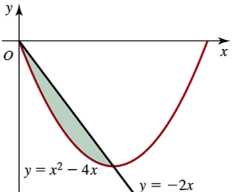
Problem 6.2.17
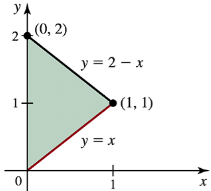
Determine the area of the shaded region in the following figures.
Problem 6.4.57
53–62. Choose your method Let R be the region bounded by the following curves. Use the method of your choice to find the volume of the solid generated when R is revolved about the given axis.
y = x,y = 2x+2,x = 2, and x=6; about the y-axis
Problem 6.3.55
Let R be the region bounded by the following curves. Find the volume of the solid generated when R is revolved about the given line.
y=2 sin x and y=0 on [0,π]; about y=−2
Problem 6.4.67
64–68. Shell method Use the shell method to find the volume of the following solids.
The solid formed when a hole of radius 3 is drilled symmetrically along the axis of a right circular cone of radius 6 and height 9
Problem 6.2.37
Find the area of the region described in the following exercises.
The region bounded by y=4x+4, y=6x+6, and x=4
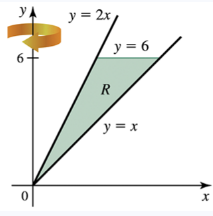
Problem 6.3.28
Let R be the region bounded by the following curves. Find the volume of the solid generated when R is revolved about the given axis.
y=x,y=2x, and y=6 ; about the y-axis
Problem 6.3.31
Let R be the region bounded by the following curves. Find the volume of the solid generated when R is revolved about the given axis.
y=sin xon [0,π] and y=0 ; about the x-axis (Hint: Recall that sin^2 x=1 − cos2x / 2.
Problem 6.5.38
Function defined as an integral Write the integral that gives the length of the curve y = f(x) = ∫₀^x sin t dt on the interval [0,π]
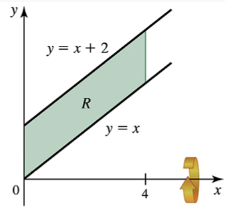
Problem 6.3.26
Let R be the region bounded by the following curves. Find the volume of the solid generated when R is revolved about the given axis.
y=x,y=x+2,x=0, and x=4 ; about the x-axis
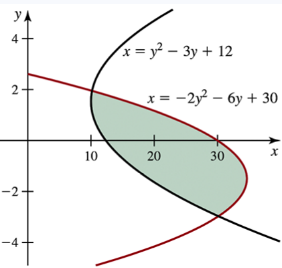
Problem 6.2.29
Determine the area of the shaded region in the following figures.
Problem 6.7.9
9–12. Consider the cylindrical tank in Example 4 that has a height of 10 m and a radius of 5 m. Recall that if the tank is full of water, then ∫₀¹⁰ 25 π ρg(15−y) dy equals the work required to pump all the water out of the tank, through an outflow pipe that is 15 m above the bottom of the tank. Revise this work integral for the following scenarios. (Do not evaluate the integrals.)
The work required to empty the top half of the tank
Problem 6.4.22
9-34. Shell method Let R be the region bounded by the following curves. Use the shell method to find the volume of the solid generated when R is revolved about indicated axis.
x = x³ ,y = 1, and x = 0; about the x-axis
Problem 6.6.35
Find the area of the surface generated when the given curve is revolved about the given axis.
x=4y^3/2−y^1/2 / 12, for 1≤y≤4; about the y-axis
Problem 6.2.7
Express the area of the shaded region in Exercise 5 as the sum of two integrals with respect to y. Do not evaluate the integrals.
Problem 6.2.49
Find the area of the region described in the following exercises.
The region in the first quadrant bounded by y=x^2/3 and y=4
Problem 6.5.7
Find the arc length of the line y = 2x+1 on [1, 5] using calculus and verify your answer using geometry.
Problem 6.5.17
9–20. Arc length calculations Find the arc length of the following curves on the given interval.
x = y⁴/4 + 1/8y², for 1≤y≤2
Problem 6.2.59
Find the area of the region described in the following exercises.
The region bounded by x=y(y−1) and y=x/3
Problem 6.4.1
Assume f and g are continuous, with f(x) ≥ g(x) ≥ 0 on [a, b]. The region bounded by the graphs of f and g and the lines x=a and x=b is revolved about the y-axis. Write the integral given by the shell method that equals the volume of the resulting solid.
Problem 6.7.54
52–54. Force on a window A diving pool that is 4 m deep and full of water has a viewing window on one of its vertical walls. Find the force on the following windows.
The window is circular, with a radius of 0.5 m, tangent to the bottom of the pool.
Problem 6.4.46
45–48. Shell and washer methods about other lines Use both the shell method and the washer method to find the volume of the solid that is generated when the region in the first quadrant bounded by y = x²,y=1, and x=0 is revolved about the following lines.
x = -1