

Ch. 7 - Logarithmic, Exponential Functions, and Hyperbolic Functions
Briggs - Calculus: Early Transcendentals 3rd Edition
Briggs3rd EditionCalculus: Early TranscendentalsISBN: 9780136847243Not the one you use?Change textbook
Chapter 7, Problem 7.2.47b

A slowing race Starting at the same time and place, Abe and Bob race, running at velocities u(t) = 4 / (t + 1) mi/hr and v(t) = 4e^(−t/2) mi/hr, respectively, for t ≥ 0.
b. Find and graph the position functions of both runners. Which runner can run only a finite distance in an unlimited amount of time?

Verified step by step guidance
1
Identify the position functions for Abe and Bob by integrating their velocity functions with respect to time, since position is the integral of velocity: \(s(t) = \int u(t) \, dt\) and \(r(t) = \int v(t) \, dt\).
For Abe, integrate \(u(t) = \frac{4}{t + 1}\): set up the integral \(s(t) = \int \frac{4}{t + 1} \, dt\). Recognize this as a natural logarithm integral.
For Bob, integrate \(v(t) = 4e^{-t/2}\): set up the integral \(r(t) = \int 4e^{-t/2} \, dt\). Use substitution to handle the exponential decay term.
Apply the initial condition that both runners start at the same place at time \(t=0\), so \(s(0) = 0\) and \(r(0) = 0\), to solve for the constants of integration in both position functions.
Analyze the behavior of both position functions as \(t \to \infty\) to determine which runner covers a finite distance and which can run indefinitely. This involves evaluating the limits of \(s(t)\) and \(r(t)\) as \(t\) approaches infinity.

Verified video answer for a similar problem:

This video solution was recommended by our tutors as helpful for the problem above.
Video duration:
11m
Was this helpful?

Key Concepts

Here are the essential concepts you must grasp in order to answer the question correctly.

Velocity and Position Relationship

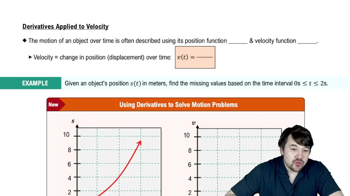
Velocity is the rate of change of position with respect to time. To find the position function from a given velocity function, you integrate the velocity over time. This process accumulates the total distance traveled starting from the initial position.
Recommended video:
06:29
Derivatives Applied To Velocity

Definite and Indefinite Integration

Integration is used to find the position function from velocity. An indefinite integral gives a general antiderivative plus a constant, while a definite integral calculates the net change over a specific interval. Proper integration techniques are essential to handle functions like rational and exponential expressions.
Recommended video:
05:43
Definition of the Definite Integral

Limits and Infinite Time Behavior

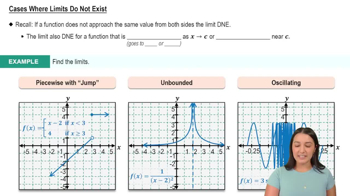
Analyzing the limit of the position function as time approaches infinity helps determine if a runner covers a finite or infinite distance. If the position approaches a finite value, the runner can only run a limited distance despite unlimited time. This concept involves understanding improper integrals and convergence.
Recommended video:
03:07
Cases Where Limits Do Not Exist
Related Practice
Textbook Question

Oil consumption Starting in 2018 (t=0), the rate at which oil is consumed by a small country increases at a rate of 1.5%/yr, starting with an initial rate of 1.2 million barrels/yr.


b. Find the function that gives the amount of oil consumed between t=0 and any future time t.

51
views
Textbook Question

Theorem 7.8

Differentiate sinh⁻¹ x = ln (x + √(x² + 1)) to show that d/dx (sinh⁻¹ x) = 1 / √(x² + 1).

79
views
Textbook Question

Explain why or why not Determine whether the following statements are true and give an explanation or counterexample. Assume x > 0 and y > 0.


b. ln 0 = 1

93
views
Textbook Question

61–62. Points of intersection and area

b. Compute the area of the region described.


f(x) = sinh x, g(x) = tanh x; the region bounded by the graphs of f, g, and x = ln 3

47
views
Textbook Question

A running model A model for the startup of a runner in a short race results in the velocity function v(t) = a(1 - e⁻ᵗ/ᶜ), where a and c are positive constants, t is measured in seconds, and v has units of m/s. (Source: Joe Keller, A Theory of Competitive Running, Physics Today, 26, Sep 1973)


b. Using the velocity in part (a) and assuming s(0) = 0, find the position function s(t), for t ≥ 0.

57
views
Textbook Question

Depreciation of equipment A large die-casting machine used to make automobile engine blocks is purchased for \$2.5 million. For tax purposes, the value of the machine can be depreciated by 6.8% of its current value each year.


b. After how many years is the value of the machine 10% of its original value?

91
views