Back
Back
Problem 7.3.50
37–56. Integrals Evaluate each integral.
∫ dx/x√(16 + x²)
Problem 7.1.57
29–62. Integrals Evaluate the following integrals. Include absolute values only when needed.
∫₁ᵉ^² (ln x)^5 / x dx
Problem 7.1.72
Derivative of ln|x| Differentiate ln x, for x > 0, and differentiate ln(−x), for x < 0, to conclude that d/dx (ln|x|) = 1/x
Problem 7.3.34
22–36. Derivatives Find the derivatives of the following functions.
f(x) = csch⁻¹(2/x)
Problem 7.1.78
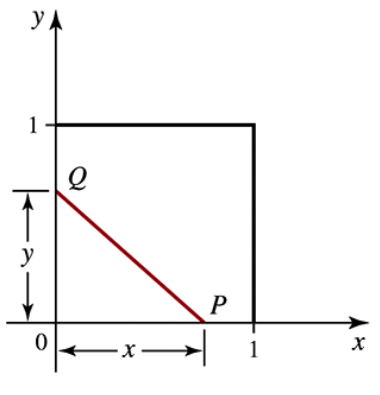
Probability as an integral Two points P and Q are chosen randomly, one on each of two adjacent sides of a unit square (see figure). What is the probability that the area of the triangle formed by the sides of the square and the line segment PQ is less than one-fourth the area of the square? Begin by showing that x and y must satisfy xy < 1/2 in order for the area condition to be met. Then argue that the required probability is: 1/2 + ∫[1/2 to 1] (dx / 2x) and evaluate the integral.
Problem 7.1.33
29–62. Integrals Evaluate the following integrals. Include absolute values only when needed.
∫ e^{2x} / (4 + e^{2x}) dx
Problem 7.3.76
Tsunamis A tsunami is an ocean wave often caused by earthquakes on the ocean floor; these waves typically have long wavelengths, ranging from 150 to 1000 km. Imagine a tsunami traveling across the Pacific Ocean, which is the deepest ocean in the world, with an average depth of about 4000 m. Explain why the shallow-water velocity equation (Exercise 75) applies to tsunamis even though the actual depth of the water is large. What does the shallow-water equation say about the speed of a tsunami in the Pacific Ocean (use d = 4000 m)?
Problem 7.3.5
Express sinh⁻¹ x in terms of logarithms.
Problem 7.1.10
7–28. Derivatives Evaluate the following derivatives.
d/dx (ln (cos² x))
Problem 7.1.25
Evaluate the following derivatives.
d/dx ((1/x)ˣ)
Problem 7.3.12
11–15. Identities Prove each identity using the definitions of the hyperbolic functions.
tanh(−x) = −tanh x
Problem 7.2.52
"General relative growth rates Define the relative growth rate of the function f over the time interval T to be the relative change in f over an interval of length T:
R_T = [f(t + T) − f(t)] / f(t)
Show that for the exponential function y(t) = y₀ e^{kt}, the relative growth rate R_T, for fixed T, is constant for all t."
Problem 7.3.32
22–36. Derivatives Find the derivatives of the following functions.
f(t) = 2 tanh⁻¹ √t
Problem 7.53
37–56. Integrals Evaluate each integral.
∫ (cosh z) / (sinh² z) dz
Problem 7.1.44
29–62. Integrals Evaluate the following integrals. Include absolute values only when needed.
∫₀^{π/2} 4^{sin x} cos x dx
Problem 7.2.54
Geometric means A quantity grows exponentially according to y(t) = y₀eᵏᵗ. What is the relationship among m, n, and p such that y(p) = √(y(m)y(n))?
Problem 7.2.20
15–20. Designing exponential growth functions Complete the following steps for the given situation.
a. Find the rate constant k and use it to devise an exponential growth function that fits the given data.
b. Answer the accompanying question.
Cell growth The number of cells in a tumor doubles every 6 weeks starting with 8 cells. After how many weeks does the tumor have 1500 cells?
Problem 7.3.83
Points of inflection Find the x-coordinate of the point(s) of inflection of f(x) = tanh² x.
Problem 7.3.6
What is the domain of sech⁻¹ x? How is sech⁻¹ x defined in terms of the inverse hyperbolic cosine?
Problem 7.3.25
22–36. Derivatives Find the derivatives of the following functions.
f(x) = tanh²x
Problem 7.3.44
37–56. Integrals Evaluate each integral.
∫₀⁴ sech²√x / √x dx
Problem 7.3.72
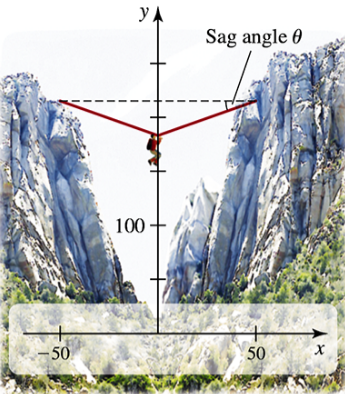
Sag angle Imagine a climber clipping onto the rope described in Example 7 and pulling himself to the rope’s midpoint. Because the rope is supporting the weight of the climber, it no longer takes the shape of the catenary y = 200 cosh x/200. Instead, the rope (nearly) forms two sides of an isosceles triangle. Compute the sag angle θ illustrated in the figure, assuming the rope does not stretch when weighted. Recall from Example 7 that the length of the rope is 101 ft.
Problem 7.1.68
Logarithm properties Use the integral definition of the natural logarithm to prove that ln(x/y) = ln x - ln y.
Problem 7.2.25
Population of Texas Texas was the third fastest growing state in the United States in 2016. Texas grew from 25.1 million in 2010 to 26.47 million in 2016. Use an exponential growth model to predict the population of Texas in 2025.
Problem 7.1.45
29–62. Integrals Evaluate the following integrals. Include absolute values only when needed.
∫₁² (1 + ln x) x^x dx
Problem 7.3.56
37–56. Integrals Evaluate each integral.
∫₂₅²²⁵ dx / (x² + 25x) (Hint: √(x² + 25x) = √x √(x + 25).)
Problem 7.3.47
37–56. Integrals Evaluate each integral.
∫ dx/(8 – x²), x > 2√2
Problem 7.3.49
37–56. Integrals Evaluate each integral.
∫ eˣ/(36 – e²ˣ), x < ln 6
Problem 7.1.11
7–28. Derivatives Evaluate the following derivatives.
d/dx ((ln 2x)⁻⁵)
Problem 7.3.27
22–36. Derivatives Find the derivatives of the following functions.
f(x) = ln sech x