Back
Back
Problem 7.1.73b
Properties of exp(x) Use the inverse relations between ln x and exp(x), and the properties of ln x, to prove the following properties:
b. exp(x − y) = exp(x) / exp(y)
Problem 7.3.108b
"Integral formula Carry out the following steps to derive the formula ∫ csch x dx = ln |tanh(x / 2)| + C (Theorem 7.6).
b. Use the identity for sinh(2u) to show that 2 / sinh(2u) = sech² u / tanh u."
Problem 7.2.23b
Projection sensitivity
According to the 2014 national population projections published by the U.S. Census Bureau, the U.S. population is projected to be 334.4 million in 2020 with an estimated growth rate of 0.79%/yr.
b. Suppose the actual growth rate is instead 0.7%. What are the resulting doubling time and projected 2050 population?
Problem 7.2.46b
Overtaking City A has a current population of 500,000 people and grows at a rate of 3%/yr. City B has a current population of 300,000 and grows at a rate of 5%/yr.
b. Suppose City C has a current population of y₀ < 500,000 and a growth rate of p > 3%/yr. What is the relationship between y₀ and p such that Cities A and C have the same population in 10 years?
Problem 7.3.38b
37–38. Caffeine After an individual drinks a beverage containing caffeine, the amount of caffeine in the bloodstream can be modeled by an exponential decay function, with a half-life that depends on several factors, including age and body weight. For the sake of simplicity, assume the caffeine in the following drinks immediately enters the bloodstream upon consumption.
An individual consumes two cups of coffee, each containing 90 mg of caffeine, two hours apart. Assume the half-life of caffeine for this individual is 5.7 hours.
b. Determine the amount of caffeine in the bloodstream 1 hour after drinking the second cup of coffee.
Problem 7.3.107b
Many formulas There are several ways to express the indefinite integral of sech x.
b. Show that ∫ sech x dx = sin⁻¹ (tanh x) + C. (Hint: Show that sech x = sech² x / √(1 − tanh² x) and then make a change of variables.)
Problem 7.2.24b
Energy consumption On the first day of the year (t=0), a city uses electricity at a rate of 2000 MW. That rate is projected to increase at a rate of 1.3% per year.
b. Find the total energy (in MW-yr) used by the city over four full years beginning at t=0.
Problem 7.3.112b
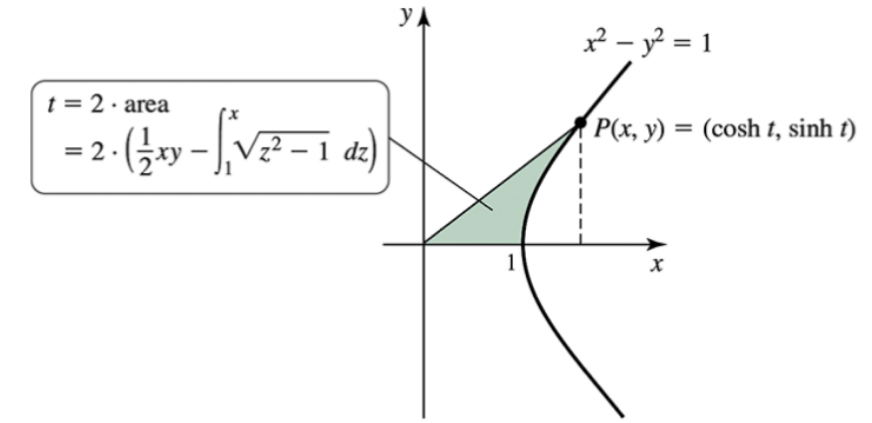
Definitions of hyperbolic sine and cosine Complete the following steps to prove that when the x- and y-coordinates of a point on the hyperbola x² - y² = 1 are defined as cosh t and sinh t, respectively, where t is twice the area of the shaded region in the figure, x and y can be expressed as
x = cosh t = (eᵗ + e⁻ᵗ) / 2 and y = sinh t = (eᵗ - e⁻ᵗ) / 2.
b. In Chapter 8, the formula for the integral in part (a) is derived:
∫ √(z² − 1) dz = (z/2)√(z² − 1) − (1/2) ln|z + √(z² − 1)| + C.
Evaluate this integral on the interval [1, x], explain why the absolute value can be dropped, and combine the result with part (a) to show that:
t = ln(x + √(x² − 1)).
Problem 7.1.71c
Power lines A power line is attached at the same height to two utility poles that are separated by a distance of 100 ft; the power line follows the curve ƒ(x) = a cosh x/a. Use the following steps to find the value of a that produces a sag of 10 ft midway between the poles. Use a coordinate system that places the poles at x = ±50.
c. Use your answer in part (b) to find a, and then compute the length of the power line.
Problem 7.2.50c
Acceleration, velocity, position Suppose the acceleration of an object moving along a line is given by a(t) = -k v(t), where k is a positive constant and v is the object's velocity. Assume the initial velocity and position are given by v(0) = 10 and s(0) = 0, respectively.
c. Use the fact that dv/dt = (dv/ds)(ds/dt) (by the Chain Rule) to find the velocity as a function of position.
Problem 7.3.77c
Explain why or why not Determine whether the following statements are true and give an explanation or counterexample.
c. ln(1 + √2) = −ln(−1 + √2)
Problem 7.3.78c
Evaluating hyperbolic functions Use a calculator to evaluate each expression or state that the value does not exist. Report answers accurate to four decimal places to the right of the decimal point.
c. csch⁻¹ 5
Problem 7.1.73c
Properties of exp(x) Use the inverse relations between ln x and exp(x), and the properties of ln x, to prove the following properties:
c. (exp(x))ᵖ = exp(px), p rational
Problem 7.3.96c
Velocity of falling body Refer to Exercise 95, which gives the position function for a falling body. Use m = 75 kg and k = 0.2.
c. How long does it take for the BASE jumper to reach a speed of 45 m/s (roughly 100 mi/hr)?
Problem 7.1.74c
ln x is unbounded Use the following argument to show that lim (x → ∞) ln x = ∞ and lim (x → 0⁺) ln x = −∞.
c. Show that ln 2ⁿ > n/2 and ln 2^(−n) < −n/2.
Problem 7.2.26c
Oil consumption Starting in 2018 (t=0), the rate at which oil is consumed by a small country increases at a rate of 1.5%/yr, starting with an initial rate of 1.2 million barrels/yr.
c. How many years after 2018 will the amount of oil consumed since 2018 reach 10 million barrels?
Problem 7.2.24c
Energy consumption On the first day of the year (t=0), a city uses electricity at a rate of 2000 MW. That rate is projected to increase at a rate of 1.3% per year.
c. Find a function that gives the total energy used (in MW-yr) between t=0 and any future time t>0.
Problem 7.1.67c
Explain why or why not Determine whether the following statements are true and give an explanation or counterexample. Assume x > 0 and y > 0.
c. ln (x + y) = ln x + ln y
Problem 7.2.45d
Chemotherapy In an experimental study at Dartmouth College, mice with tumors were treated with the chemotherapeutic drug Cisplatin. Before treatment, the tumors consisted entirely of clonogenic cells that divide rapidly, causing the tumors to double in size every 2.9 days. Immediately after treatment, 99% of the cells in the tumor became quiescent cells which do not divide and lose 50% of their volume every 5.7 days. For a particular mouse, assume the tumor size is 0.5 cm³ at the time of treatment.
d. Plot a graph of V(t) for 0 ≤ t ≤ 15. What happens to the size of the tumor, assuming there are no follow-up treatments with Cisplatin?
Problem 7.3.97d
Terminal velocity Refer to Exercises 95 and 96.
d. How tall must a cliff be so that the BASE jumper (m = 75 kg and k = 0.2) reaches 95% of terminal velocity? Assume the jumper needs at least 300 m at the end of free fall to deploy the chute and land safely.
Problem 7.3.43d
Explain why or why not Determine whether the following statements are true and give an explanation or counterexample.
d. If the rate constant of an exponential growth function is increased, its doubling time is decreased.
Problem 7.3.79d
Evaluating hyperbolic functions Evaluate each expression without using a calculator or state that the value does not exist. Simplify answers as much as possible.
d. sech (sinh 0)
Problem 7.1.67e
Explain why or why not Determine whether the following statements are true and give an explanation or counterexample. Assume x > 0 and y > 0.
e. The area under the curve y = 1/x and the x-axis on the interval [1, e] is 1.
Problem 7.3.79f
Evaluating hyperbolic functions Evaluate each expression without using a calculator or state that the value does not exist. Simplify answers as much as possible.
f. sinh (2 ln 3)
Problem 7.3.78f
Evaluating hyperbolic functions Use a calculator to evaluate each expression or state that the value does not exist. Report answers accurate to four decimal places to the right of the decimal point.
f. tan⁻¹(sinh x) |₋₃³
Problem 7.3.79g
Evaluating hyperbolic functions Evaluate each expression without using a calculator or state that the value does not exist. Simplify answers as much as possible.
g. cosh² 1
Problem 7.3.79j
Evaluating hyperbolic functions Evaluate each expression without using a calculator or state that the value does not exist. Simplify answers as much as possible.
j. sinh⁻¹ (e² − 1)/2e