Back
Back
Problem 9.5.38a
U.S. population projections According to the U.S. Census Bureau, the nation’s population (to the nearest million) was 296 million in 2005 and 321 million in 2015. The Bureau also projects a 2050 population of 398 million. To construct a logistic model, both the growth rate and the carrying capacity must be estimated. There are several ways to estimate these parameters. Here is one approach:
a. Assume t = 0 corresponds to 2005 and that the population growth is exponential for the first ten years; that is, between 2005 and 2015, the population is given by P(t) = P(0)exp(rt). Estimate the growth rate r using this assumption.
Problem 9.2.41a
38–43. Equilibrium solutions A differential equation of the form y′(t)=f(y) is said to be autonomous (the function f depends only on y). The constant function y=y0 is an equilibrium solution of the equation provided f(y0)=0 (because then y'(t)=0 and the solution remains constant for all t). Note that equilibrium solutions correspond to horizontal lines in the direction field. Note also that for autonomous equations, the direction field is independent of t. Carry out the following analysis on the given equations.
a. Find the equilibrium solutions.
y′(t) = y(y - 3)
Problem 9.5.32a
Growth rate functions
a. Show that the logistic growth rate function f(P)=rP(1−P/K) has a maximum value of rK/4 at the point P=K/2.
Problem 9.1.50a
A second-order equation Consider the differential equation y''(t) - k²y(t) = 0 where k > 0 is a real number.
a. Verify by substitution that when k = 1, a solution of the equation is y(t) = C₁eᵗ + C₂e⁻ᵗ. You may assume this function is the general solution.
Problem 9.1.53a
52-56. In this section, several models are presented and the solution of the associated differential equation is given. Later in the chapter, we present methods for solving these differential equations.
where P(t) is the population, for t ≥ 0, and r > 0 and K > 0 are given constants.
a. Verify by substitution that the general solution of the equation is P(t) = K/(1 + Ce⁻ʳᵗ), where C is an arbitrary constant.
Problem 9.4.38a
Cooling time Suppose an object with an initial temperature of T₀ > 0 is put in surroundings with an ambient temperature of A, where A < T₀/2. Let t₁/₂ be the time required for the object to cool to T₀/2.
a. Show that t₁/₂ = −1/k ln((T₀ − 2A)/(2(T₀ − A))).
Problem 9.3.54a
[Use of Tech] Analysis of a separable equation Consider the differential equation yy'(t) = ½eᵗ + t and carry out the following analysis.
a. Find the general solution of the equation and express it explicitly as a function of t in two cases: y > 0 and y < 0.
Problem 9.5.36a
A physiological model A common assumption in modeling drug assimilation is that the blood volume in a person is a single compartment that behaves like a stirred tank. Suppose the blood volume is a four-liter tank that initially has a zero concentration of a particular drug. At time t = 0, an intravenous line is inserted into a vein (into the tank) that carries a drug solution with a concentration of 500 mg/L. The inflow rate is 0.06 L/min. Assume the drug is quickly mixed thoroughly in the blood and that the volume of blood remains constant.
a. Write an initial value problem that models the mass of the drug in the blood, for t ≥ 0.
Problem 9.3.46a
{Use of Tech} Logistic equation for spread of rumors Sociologists model the spread of rumors using logistic equations. The key assumption is that at any given time, a fraction y of the population, where 0≤y≤1, knows the rumor, while the remaining fraction 1−y does not. Furthermore, the rumor spreads by interactions between those who know the rumor and those who do not. The number of such interactions is proportional to y1−y. Therefore, the equation that describes the spread of the rumor is y′(t)=ky (1−y), for t≥0 where k is a positive real number and t is measured in weeks. The number of people who initially know the rumor is y(0)=y0, where 0≤y0≤1.
a. Solve this initial value problem and give the solution in terms of k and y0.
Problem 9.1.1a
Consider the differential equation y'(t)+9y(t)=10.
a. How many arbitrary constants appear in the general solution of the differential equation?
Problem 9.5.39a
{Use of Tech} Analytical solution of the predator-prey equations The solution of the predator-prey equations
X'(t) = -ax + bxy,y’(t) = cy - dxy
can be viewed as parametric equations that describe the solution curves. Assume a, b, c, and d are positive constants and consider solutions in the first quadrant.
a. Recalling that dy/dx = y(t)/x′(t), divide the first equation by the second equation to obtain a separable differential equation in terms of x and y.
Problem 9.3.42a
42–43. Implicit solutions for separable equations For the following separable equations, carry out the indicated analysis.
a. Find the general solution of the equation.
y'(t) = t²/(y² + 1); y(−1) = 1, y(0) = 0, y(−1) = −1
Problem 9.4.34a
{Use of Tech} Endowment model An endowment is an investment account in which the balance ideally remains constant and withdrawals are made on the interest earned by the account. Such an account may be modeled by the initial value problem B′(t)=rB−m, for t≥0, with B(0)=B0. The constant r>0 reflects the annual interest rate, m>0 is the annual rate of withdrawal, B0 is the initial balance in the account, and t is measured in years.
a. Solve the initial value problem with r=0.05, m=$1000/year, and B0=$15,000 Does the balance in the account increase or decrease?
Problem 9.2.18a
17–20. Increasing and decreasing solutions Consider the following differential equations. A detailed direction field is not needed.
a. Find the solutions that are constant, for all t ≥ 0 (the equilibrium solutions).
y'(t) = (y−2)(y+1)
Problem 9.5.26a
23–26. Stirred tank reactions For each of the following stirred tank reactions, carry out the following analysis.
a. Write an initial value problem for the mass of the substance.
A one-million-liter pond is contaminated by a chemical pollutant with a concentration of 20 g/L. The source of the pollutant is removed, and pure water is allowed to flow into the pond at a rate of 1200 L/hr. Assuming the pond is thoroughly mixed and drained at a rate of 1200 L/hr, how long does it take to reduce the concentration of the solution in the pond to 10% of the initial value?
Problem 9.1.49a
Explain why or why not Determine whether the following statements are true and give an explanation or counterexample.
a. The general solution of the differential equation y'(t) = 1 is y(t) = t
Problem 9.3.49a
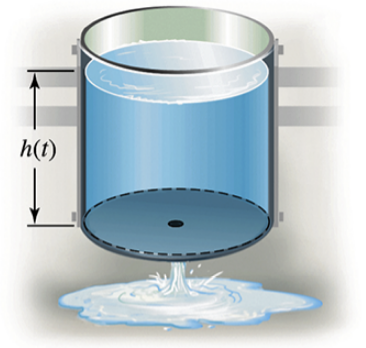
{Use of Tech} Torricelli’s law An open cylindrical tank initially filled with water drains through a hole in the bottom of the tank according to Torricelli’s law (see figure). If h(t) is the depth of water in the tank for t≥0 s, then Torricelli’s law implies h′(t)=−k√h, where k is a constant that includes g=9.8m/s², the radius of the tank, and the radius of the drain. Assume the initial depth of the water is h(0)=Hm.
a. Find the solution of the initial value problem.
Problem 9.2.44a
Direction field analysis Consider the first-order initial value problem y'(t)=ay+b, y(0)=A for t≥0 where a, b, and A are real numbers.
a. Explain why y=−b/a is an equilibrium solution and corresponds to a horizontal line in the direction field.
Problem 9.2.30a
29–32. {Use of Tech} Errors in Euler’s method Consider the following initial value problems.
a. Find the approximations to y(0.2) and y(0.4) using Euler’s method with time steps of Δt = 0.2, 0.1, 0.05, and 0.025.
y′(t) = y/2, y(0) = 2; y(t) = 2eᵗᐟ²
Problem 9.3.40a
{Use of Tech} Logistic equation for an epidemic When an infected person is introduced into a closed and otherwise healthy community, the number of people who contract the disease (in the absence of any intervention) may be modeled by the logistic equation
dP/dt=kP(1−P/A),P0 =P_0,
where K is a positive infection rate, A is the number of people in the community, and P0 is the number of infected people at t=0. The model also assumes no recovery.
a. Find the solution of the initial value problem, for t≥0, in terms of K, A, and P0.
Problem 9.3.43a
42–43. Implicit solutions for separable equations For the following separable equations, carry out the indicated analysis.
a. Find the general solution of the equation.
e⁻ʸᐟ²y'(x) = 4x sin x² − x; y(0) = 0, y(0) = ln(1/4), y(√(π/2)) = 0
Problem 9.2.36a
33–36. {Use of Tech} Computing Euler approximations Use a calculator or computer program to carry out the following steps.
a. Approximate the value of y(T) using Euler’s method with the given time step on the interval [0,T].
y′(t) = t/y, y(0) = 4; Δt = 0.1, T = 2; y(t) = √(t² + 16)
Problem 9.2.33a
33–36. {Use of Tech} Computing Euler approximations Use a calculator or computer program to carry out the following steps.
a. Approximate the value of y(T) using Euler’s method with the given time step on the interval [0,T].
y′(t) = -2y, y(0) = 1; Δt = 0.2, T = 2; y(t) = e⁻²ᵗ
Problem 9.2.40a
38–43. Equilibrium solutions A differential equation of the form y′(t)=f(y) is said to be autonomous (the function f depends only on y). The constant function y=y0 is an equilibrium solution of the equation provided f(y0)=0 (because then y'(t)=0 and the solution remains constant for all t). Note that equilibrium solutions correspond to horizontal lines in the direction field. Note also that for autonomous equations, the direction field is independent of t. Carry out the following analysis on the given equations.
a. Find the equilibrium solutions.
y′(t) = y(2 - y)
Problem 9.2.38a
38–43. Equilibrium solutions A differential equation of the form y′(t)=f(y) is said to be autonomous (the function f depends only on y). The constant function y=y0 is an equilibrium solution of the equation provided f(y0)=0 (because then y'(t)=0 and the solution remains constant for all t). Note that equilibrium solutions correspond to horizontal lines in the direction field. Note also that for autonomous equations, the direction field is independent of t. Carry out the following analysis on the given equations.
a. Find the equilibrium solutions.
y′(t) = 2y + 4
Problem 9.4.44a
Solving Bernoulli equations Use the method outlined in Exercise 43 to solve the following Bernoulli equations.
a. y′(t) + y = 2y²
Problem 9.2.39a
38–43. Equilibrium solutions A differential equation of the form y′(t)=f(y) is said to be autonomous (the function f depends only on y). The constant function y=y0 is an equilibrium solution of the equation provided f(y0)=0 (because then y'(t)=0 and the solution remains constant for all t). Note that equilibrium solutions correspond to horizontal lines in the direction field. Note also that for autonomous equations, the direction field is independent of t. Carry out the following analysis on the given equations.
a. Find the equilibrium solutions.
y′(t) = 6 - 2y
Problem 9.5.23a
23–26. Stirred tank reactions For each of the following stirred tank reactions, carry out the following analysis.
a. Write an initial value problem for the mass of the substance.
A 500-L tank is initially filled with pure water. A copper sulfate solution with a concentration of 20 g/L flows into the tank at a rate of 4 L/min. The thoroughly mixed solution is drained from the tank at a rate of 4 L/min.
Problem 9.5.29a
27–30. Predator-prey models Consider the following pairs of differential equations that model a predator-prey system with populations x and y. In each case, carry out the following steps.
a. Identify which equation corresponds to the predator and which corresponds to the prey.
x′(t) = −3x + xy, y′(t) = 2y − xy
Problem 9.2.43a
38–43. Equilibrium solutions A differential equation of the form y′(t)=f(y) is said to be autonomous (the function f depends only on y). The constant function y=y0 is an equilibrium solution of the equation provided f(y0)=0 (because then y'(t)=0 and the solution remains constant for all t). Note that equilibrium solutions correspond to horizontal lines in the direction field. Note also that for autonomous equations, the direction field is independent of t. Carry out the following analysis on the given equations.
a. Find the equilibrium solutions.
y′(t) = y(y - 3)(y + 2)