Back
Back
Problem 9.2.37b
Explain why or why not Determine whether the following statements are true and give an explanation or counterexample.
b. Euler’s method is used to compute exact values of the solution of an initial value problem.
Problem 9.2.39b
38–43. Equilibrium solutions A differential equation of the form y′(t)=f(y) is said to be autonomous (the function f depends only on y). The constant function y=y0 is an equilibrium solution of the equation provided f(y0)=0 (because then y'(t)=0 and the solution remains constant for all t). Note that equilibrium solutions correspond to horizontal lines in the direction field. Note also that for autonomous equations, the direction field is independent of t. Carry out the following analysis on the given equations.
b. Sketch the direction field, for t≥0.
y′(t) = 6 - 2y
Problem 9.3.44b
brOrthogonal trajectories Two curves are orthogonal to each other if their tangent lines are perpendicular at each point of intersection. A family of curves forms orthogonal trajectories with another family of curves if each curve in one family is orthogonal to each curve in the other family. Use the following steps to find the orthogonal trajectories of the family of ellipses 2x² + y² = a²
b. The family of trajectories orthogonal to 2x² + y² = a² satisfies the differential equation dy/dx = y/(2x). Why?
Problem 9.1.52b
52-56. In this section, several models are presented and the solution of the associated differential equation is given. Later in the chapter, we present methods for solving these differential equations.
{Use of Tech} Drug infusion The delivery of a drug (such as an antibiotic) through an intravenous line may be modeled by the differential equation m'(t) + km(t) = I, where m(t) is the mass of the drug in the blood at time t ≥ 0, k is a constant that describes the rate at which the drug is absorbed, and I is the infusion rate.
b. Graph the solution for I = 10 mg/hr and k = 0.05 hr⁻¹.
Problem 9.3.42b
42–43. Implicit solutions for separable equations For the following separable equations, carry out the indicated analysis.
b. Find the value of the arbitrary constant associated with each initial condition. (Each initial condition requires a different constant.)
y'(t) = t²/(y² + 1); y(−1) = 1, y(0) = 0, y(−1) = −1
Problem 9.4.37b
A bad loan Consider a loan repayment plan described by the initial value problem
B'(t)=0.03B−600,B(0)=40,000,
where the amount borrowed is B(0)=$40,000, the monthly payments are $600, and B(t) is the unpaid balance in the loan.
b. What is the most that you can borrow under the terms of this loan without going further into debt each month?
Problem 9.5.31b
Explain why or why not Determine whether the following statements are true and give an explanation or counterexample.
b. The solution of a stirred tank initial value problem always approaches a constant as t→∞
Problem 9.3.49b
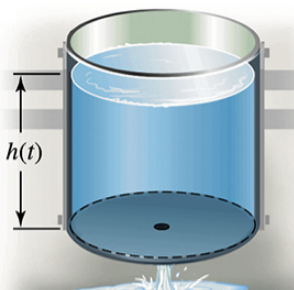
{Use of Tech} Torricelli’s law An open cylindrical tank initially filled with water drains through a hole in the bottom of the tank according to Torricelli’s law (see figure). If h(t) is the depth of water in the tank for t≥0 s, then Torricelli’s law implies h′(t)=−k√h, where k is a constant that includes g=9.8m/s², the radius of the tank, and the radius of the drain. Assume the initial depth of the water is h(0)=Hm.
b. Find the solution in k=0.1the case that and H=0 .5m.
Problem 9.2.49b
Convergence of Euler's method Suppose Euler's method is applied to the initial value problem y′(t) = ay, y(0) = 1, which has the exact solution y(t) = eᵃᵗ. For this exercise, let h denote the time step (rather than Δt). The grid points are then given by tₖ = kh. We let uₖ be the Euler approximation to the exact solution y(tₖ), for k = 0, 1, 2, ...
b. Show by substitution that uₖ = (1 + ah)ᵏ is a solution of the equations in part (a), for k = 0, 1, 2, ...
Problem 9.3.50b
{Use of Tech} Chemical rate equations Let y(t) be t he concentration of a substance in a chemical reaction (typical units are moles/liter). The change in the concentration, under appropriate conditions, is modeled by the equation dy/dt=-ky^n for t≥0, where k>0 is a rate constant and the positive integer n is the order of the reaction.
b. Solve the initial value problem for a second-order reaction (n=2) assuming y(0)=y0.
Problem 9.3.53b
Blowup in finite time Consider the initial value problem y'(t) = yⁿ + 1, y(0) = y₀, where n is a positive integer.
b. Solve the initial value problem with n = 2 and y₀ = 1/√2.
Problem 9.5.28b
27–30. Predator-prey models Consider the following pairs of differential equations that model a predator-prey system with populations x and y. In each case, carry out the following steps.
b. Find the lines along which x'(t) = 0. Find the lines along which y'(t) = 0.
x′(t) = 2x − 4xy, y′(t) = −y + 2xy
Problem 9.2.32b
29–32. {Use of Tech} Errors in Euler’s method Consider the following initial value problems.
b. Using the exact solution given, compute the errors in the Euler approximations at t=0.2 and t=0.4.
y′(t) = 2t + 1, y(0) = 0; y(t) = t² + t
Problem 9.2.17b
17–20. Increasing and decreasing solutions Consider the following differential equations. A detailed direction field is not needed.
b. In what regions are solutions increasing? Decreasing?
y'(t) = (y−1)(1+y)
Problem 9.2.38b
38–43. Equilibrium solutions A differential equation of the form y′(t)=f(y) is said to be autonomous (the function f depends only on y). The constant function y=y0 is an equilibrium solution of the equation provided f(y0)=0 (because then y'(t)=0 and the solution remains constant for all t). Note that equilibrium solutions correspond to horizontal lines in the direction field. Note also that for autonomous equations, the direction field is independent of t. Carry out the following analysis on the given equations.
b. Sketch the direction field, for t≥0.
y′(t) = 2y + 4
Problem 9.4.31b
{Use of Tech} Intravenous drug dosing The amount of drug in the blood of a patient (in milligrams) administered via an intravenous line is governed by the initial value problem y’(t) = -0.02y + 3, y(0) = 0 where t is measured in hours.
b. What is the steady-state level of the drug?
Problem 9.2.29b
29–32. {Use of Tech} Errors in Euler’s method Consider the following initial value problems.
b. Using the exact solution given, compute the errors in the Euler approximations at t=0.2 and t=0.4.
y′(t) = −y, y(0) = 1; y(t) = e⁻ᵗ
Problem 9.2.33b
33–36. {Use of Tech} Computing Euler approximations Use a calculator or computer program to carry out the following steps.
b. Using the exact solution (also given), find the error in the approximation to y(T) (only at the right endpoint of the time interval).
y′(t) = -2y, y(0) = 1; Δt = 0.2, T = 2; y(t) = e⁻²ᵗ
Problem 9.2.36b
33–36. {Use of Tech} Computing Euler approximations Use a calculator or computer program to carry out the following steps.
b. Using the exact solution (also given), find the error in the approximation to y(T) (only at the right endpoint of the time interval).
y′(t) = t/y, y(0) = 4; Δt = 0.1, T = 2; y(t) = √(t² + 16)
Problem 9.5.30b
27–30. Predator-prey models Consider the following pairs of differential equations that model a predator-prey system with populations x and y. In each case, carry out the following steps.
b. Find the lines along which x'(t) = 0. Find the lines along which y'(t) = 0.
x′(t) = 2x − xy, y′(t) = −y + xy
Problem 9.3.51b
{Use of Tech} Tumor growth The Gompertz growth equation is often used to model the growth of tumors. Let M(t) be the mass of a tumor at time t≥0. The relevant initial value problem is
dM/dt=−rM ln (M/K), M(0)=M0,
where r and K are positive constants and 0<M0<K.
b. Solve the initial value problem and graph the solution for r=1, K=4, and M0=1. Describe the growth pattern of the tumor. Is the growth unbounded? If not, what is the limiting size of the tumor?
Problem 9.3.41b
Explain why or why not Determine whether the following statements are true and give an explanation or counterexample.
b. The general solution of the separable equation y'(t) = t/(y' + 10y⁴) can be expressed explicitly with y in terms of t.
Problem 9.5.35b
Properties of stirred tank solutions
b. Verify that M(0) = M₀
Problem 9.1.56b
52-56. In this section, several models are presented and the solution of the associated differential equation is given. Later in the chapter, we present methods for solving these differential equations.
{Use of Tech} Tumor growth The growth of cancer tumors may be modeled by the Gompertz growth equation. Let M(t) be the mass of a tumor, for t ≥ 0. The relevant initial value problem is:
dM/dt = -rM(t)ln(M(t)/K), M(0) = M₀,
where r and K are positive constants and 0 < M₀ < K.
b. Graph the solution for M₀ = 100 and r = 0.05.
Problem 9.4.35b
Explain why or why not Determine whether the following statements are true and give an explanation or counterexample
b. If k>0 and b>0 then y(t)=0 is never a solution of y'(t)=ky−b.
Problem 9.5.26b
23–26. Stirred tank reactions For each of the following stirred tank reactions, carry out the following analysis.
b. Solve the initial value problem.
A one-million-liter pond is contaminated by a chemical pollutant with a concentration of 20 g/L. The source of the pollutant is removed, and pure water is allowed to flow into the pond at a rate of 1200 L/hr. Assuming the pond is thoroughly mixed and drained at a rate of 1200 L/hr, how long does it take to reduce the concentration of the solution in the pond to 10% of the initial value?
Problem 9.5.23b
23–26. Stirred tank reactions For each of the following stirred tank reactions, carry out the following analysis.
b. Solve the initial value problem.
A 500-L tank is initially filled with pure water. A copper sulfate solution with a concentration of 20 g/L flows into the tank at a rate of 4 L/min. The thoroughly mixed solution is drained from the tank at a rate of 4 L/min.
Problem 9.2.20b
17–20. Increasing and decreasing solutions Consider the following differential equations. A detailed direction field is not needed.
b. In what regions are solutions increasing? Decreasing?
y'(t) = y(y+3)(4-y)
Problem 9.2.45b
Euler’s method on more general grids Suppose the solution of the initial value problem y'(t)=f(t, y),y(a)=A is to be approximated on the interval [a, b].
b. Write the first step of Euler’s method to compute u1.
Problem 9.1.55c
52-56. In this section, several models are presented and the solution of the associated differential equation is given. Later in the chapter, we present methods for solving these differential equations.
(Use of Tech) Chemical rate equations The reaction of certain chemical compounds can be modeled using a differential equation of the form y'(t) = -kyⁿ(t), where y(t) is the concentration of the compound, for t ≥ 0, k > 0 is a constant that determines the speed of the reaction, and n is a positive integer called the order of the reaction. Assume the initial concentration of the compound is y(0) = y₀ > 0.
c. Let y₀ = 1 and k = 0.1. Graph the first-order and second-order solutions found in parts (a) and (b). Compare the two reactions.