Predict the crystal field energy-level diagram for a square pyramidal ML5 complex that has two ligands along the axes but only one ligand along the z axis. Your diagram should be intermediate between those for an octahedral ML6 complex and a square planar ML4 complex.
Ch.21 - Transition Elements and Coordination Chemistry
All textbooks
McMurry 8th Edition
Ch.21 - Transition Elements and Coordination Chemistry
Problem 21.133
McMurry 8th Edition
Ch.21 - Transition Elements and Coordination Chemistry
Problem 21.133Chapter 21, Problem 21.133
The amount of paramagnetism for a first-series transition metal complex is related approximately to its spin-only magnetic moment. The spin-only value of the magnetic moment in units of Bohr magnetons (BM) is given by sqrt(n(n + 2)), where n is the number of unpaired electrons. Calculate the spin-only value of the magnetic moment for the 2+ ions of the first-series transition metals (except Sc) in octahedral complexes with (a) weak-field ligands and (b) strong-field ligands. For which electron configurations can the magnetic moment distinguish between high-spin and low-spin electron configurations?
Verified step by step guidance1
Identify the first-series transition metals, which range from Titanium (Ti) to Zinc (Zn). Exclude Scandium (Sc) as per the problem statement.
Determine the electron configuration for each 2+ ion of these transition metals. This involves removing two electrons from the neutral atom's electron configuration, typically from the 4s orbital first, followed by the 3d orbital if necessary.
For each 2+ ion, calculate the number of unpaired electrons (n) in both weak-field (high-spin) and strong-field (low-spin) octahedral complexes. Weak-field ligands do not cause significant splitting of the d-orbitals, leading to more unpaired electrons, while strong-field ligands cause greater splitting, potentially leading to paired electrons.
Use the formula for the spin-only magnetic moment, \( \mu = \sqrt{n(n + 2)} \), to calculate the magnetic moment for each ion in both high-spin and low-spin configurations.
Identify which electron configurations result in different magnetic moments for high-spin and low-spin states. This occurs when the number of unpaired electrons differs between the two configurations, allowing the magnetic moment to distinguish between them.

Verified video answer for a similar problem:
This video solution was recommended by our tutors as helpful for the problem above.
Was this helpful?
Key Concepts
Here are the essential concepts you must grasp in order to answer the question correctly.
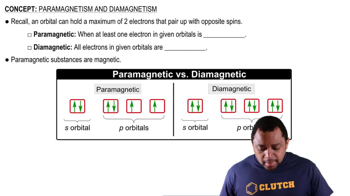
Paramagnetism
Paramagnetism is a form of magnetism that occurs in materials with unpaired electrons. These unpaired electrons create a net magnetic moment, allowing the material to be attracted to an external magnetic field. In transition metal complexes, the presence of unpaired electrons is crucial for determining the magnetic properties, which can be quantified using the spin-only magnetic moment formula.
Recommended video:
Guided course
Paramagnetism and Diamagnetism
Spin-Only Magnetic Moment
The spin-only magnetic moment is a theoretical calculation used to estimate the magnetic behavior of transition metal complexes based solely on the number of unpaired electrons. It is expressed in Bohr magnetons (BM) and calculated using the formula sqrt(n(n + 2)), where n represents the number of unpaired electrons. This value helps distinguish between different spin states in coordination complexes.
Recommended video:
Guided course
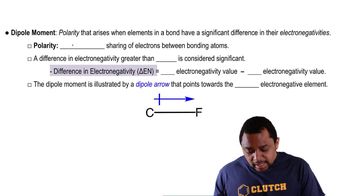
Dipole Moment
High-Spin vs. Low-Spin Configurations
High-spin and low-spin configurations refer to the arrangement of electrons in d-orbitals of transition metal complexes in the presence of ligands. Weak-field ligands typically lead to high-spin configurations, where electrons occupy higher energy orbitals to minimize repulsion, resulting in more unpaired electrons. In contrast, strong-field ligands cause low-spin configurations, where electrons pair up in lower energy orbitals, leading to fewer unpaired electrons and a lower magnetic moment.
Recommended video:
Guided course
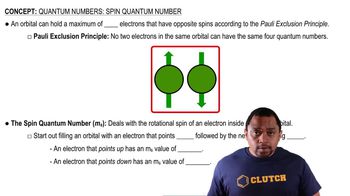
Spin Quantum Number
Related Practice
Textbook Question
109
views
Textbook Question
What is a racemic mixture? Does it affect plane-polarized light? Explain.
87
views

Textbook Question
Which of the following complexes are diamagnetic?
(a) [Ni(H2O)6]2+
(b) [Co(CN)6]3-
(c) [HgI4]2- (tetrahedral)
(d) [Cu(NH3)4]2+ (square planar)
122
views
Textbook Question
What is the systematic name for each of the following coordination compounds?
(c) [Co(NH3)4Br2]Br
(d) Cu(gly)2
170
views
Textbook Question
What is the name of the compound [Fe(H2O)5(SCN)]Cl2?
(a) pentaaquathiocyanatoiron(III) chloride
(b) pentaaquachlorothiocyanato iron(III)
(c) pentaaquathiocyanatoiron(III) dichloride
(d) pentaaquathiocyanatoiron(II) chloride
491
views
Textbook Question
For each of the following complexes, draw a crystal field energy-level diagram, assign the electrons to orbitals, and predict the number of unpaired electrons.
(a) [CrF6]3-
(b) [V(H2O)6]3+
(c) [Fe(CN)6]3-
96
views