


Ch. 16 - Aromatic Compounds
Wade - Organic Chemistry 9th Edition
Wade9th EditionOrganic ChemistryISBN: 9780135213728Not the one you use?Change textbook
Chapter 16, Problem 36b

The benzene ring alters the reactivity of a neighboring group in the benzylic position much as a double bond alters the reactivity of groups in the allylic position.

Benzylic cations, anions, and radicals are all more stable than simple alkyl intermediates.
b. Toluene reacts with bromine in the presence of light to give benzyl bromide. Propose a mechanism for this reaction.

Verified step by step guidance
1
Step 1: Recognize that the reaction involves the bromination of toluene at the benzylic position under photochemical conditions (light, hv). This is a free radical substitution reaction.
Step 2: Initiation: Light (hv) causes homolytic cleavage of the bromine molecule (Br₂) into two bromine radicals. This step generates reactive species to start the chain reaction. The equation for this step is: Br2Br+Br
Step 3: Propagation: A bromine radical abstracts a hydrogen atom from the benzylic position of toluene, forming a benzyl radical and HBr. The benzyl radical is stabilized due to resonance with the aromatic ring. The equation for this step is: Br+CH3CH2+HBr
Step 4: Propagation (continued): The benzyl radical reacts with another bromine molecule (Br₂), forming benzyl bromide and regenerating a bromine radical to continue the chain reaction. The equation for this step is: CH2+Br2CH2Br+Br
Step 5: Termination: The reaction can terminate when two radicals combine to form a stable molecule, such as two bromine radicals forming Br₂ or a bromine radical combining with a benzyl radical to form benzyl bromide. This step stops the chain reaction.

Verified video answer for a similar problem:

This video solution was recommended by our tutors as helpful for the problem above.
Video duration:
12m
Was this helpful?

Key Concepts

Here are the essential concepts you must grasp in order to answer the question correctly.

Benzylic Position

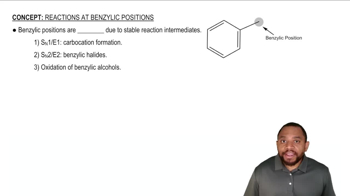
The benzylic position refers to the carbon atom directly attached to a benzene ring. This position is significant because it exhibits unique reactivity patterns due to the resonance stabilization provided by the aromatic system. Reactions involving benzylic intermediates, such as cations, anions, and radicals, are generally more favorable compared to their non-aromatic counterparts.
Recommended video:
1:01
Reactions at Benzylic Positions Concept 1

Stability of Benzylic Intermediates

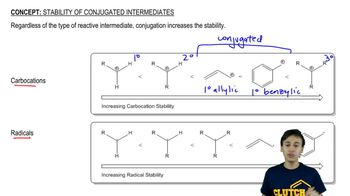
Benzylic cations, anions, and radicals are more stable than their simple alkyl counterparts due to resonance stabilization. The positive charge in a benzylic cation can be delocalized into the aromatic ring, while benzylic radicals benefit from similar delocalization of the unpaired electron. This increased stability influences the reactivity and mechanisms of reactions involving benzylic compounds.
Recommended video:
Guided course
04:31
Stability of Conjugated Intermediates

Free Radical Halogenation Mechanism

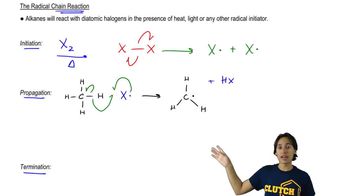
The reaction of toluene with bromine in the presence of light involves a free radical halogenation mechanism. This process includes initiation (formation of bromine radicals), propagation (reaction of bromine radicals with toluene to form benzyl radicals), and termination (combination of radicals). Understanding this mechanism is crucial for predicting the products and the conditions under which the reaction occurs.
Recommended video:
Guided course
12:11
Radical Chain Reaction Mechanism.
Related Practice
Textbook Question

Before spectroscopy was invented, Körner’s absolute method was used to determine whether a disubstituted benzene derivative was the ortho, meta, or para isomer. Körner’s method involves adding a third group (often a nitro group) and determining how many isomers are formed. For example, when o-xylene is nitrated (by a method shown in Chapter 17), two isomers are formed.

a. How many isomers are formed by nitration of m-xylene?

1094
views
Textbook Question

The benzene ring alters the reactivity of a neighboring group in the benzylic position much as a double bond alters the reactivity of groups in the allylic position.

Benzylic cations, anions, and radicals are all more stable than simple alkyl intermediates.

a. Use resonance forms to show the delocalization (over four carbon atoms) of the unpaired electron of the benzyl radical.

1274
views
Textbook Question

The benzene ring alters the reactivity of a neighboring group in the benzylic position much as a double bond alters the reactivity of groups in the allylic position.

Benzylic cations, anions, and radicals are all more stable than simple alkyl intermediates.

c. Which of the following reactions will have the faster rate and give the better yield? Use a drawing of the transition state to explain your answer.

1401
views
Textbook Question

The benzene ring alters the reactivity of a neighboring group in the benzylic position much as a double bond alters the reactivity of groups in the allylic position.


Benzylic cations, anions, and radicals are all more stable than simple alkyl intermediates.

a. Use resonance forms to show the delocalization (over four carbon atoms) of the positive charge of the benzyl cation.

1387
views
Textbook Question

Before spectroscopy was invented, Körner’s absolute method was used to determine whether a disubstituted benzene derivative was the ortho, meta, or para isomer. Körner’s method involves adding a third group (often a nitro group) and determining how many isomers are formed. For example, when o-xylene is nitrated (by a method shown in Chapter 17), two isomers are formed.

b. How many isomers are formed by nitration of p-xylene?

831
views
Textbook Question

The benzene ring alters the reactivity of a neighboring group in the benzylic position much as a double bond alters the reactivity of groups in the allylic position.

Benzylic cations, anions, and radicals are all more stable than simple alkyl intermediates.

a. Use resonance forms to show the delocalization (over four carbon atoms) of the negative charge of the benzyl anion.

1280
views