

Ch. 2 - Acids and Bases; Functional Groups
Wade - Organic Chemistry 9th Edition
Wade9th EditionOrganic ChemistryISBN: 9780135213728Not the one you use?Change textbook
Chapter 2, Problem 36

Rank the following species in order of increasing acidity. Explain your reasons for ordering them as you do.
HF NH3 H2SO4 CH3OH CH3COOH H3O+ H2O

Verified step by step guidance
1
Identify the acidic hydrogen in each species. For example, in HF, the acidic hydrogen is the one bonded to fluorine.
Consider the stability of the conjugate base formed after the acidic hydrogen is removed. A more stable conjugate base indicates a stronger acid.
Evaluate the electronegativity of the atom bonded to the acidic hydrogen. Higher electronegativity generally increases acidity as it stabilizes the negative charge on the conjugate base.
Consider the resonance stabilization of the conjugate base. Species like CH3COOH have resonance-stabilized conjugate bases, which increases their acidity.
Rank the species based on the above considerations, from least acidic to most acidic. Typically, H2SO4 and H3O+ are very strong acids, while NH3 is a weak acid.

Verified video answer for a similar problem:

This video solution was recommended by our tutors as helpful for the problem above.
Video duration:
6m
Was this helpful?

Key Concepts

Here are the essential concepts you must grasp in order to answer the question correctly.

Acidity and pKa

Acidity in organic chemistry is often measured by the pKa value, which indicates the strength of an acid. A lower pKa value corresponds to a stronger acid, as it more readily donates protons (H+ ions). Understanding pKa values is crucial for ranking acids, as it provides a quantitative measure of their relative strengths.
Recommended video:
Guided course
07:45
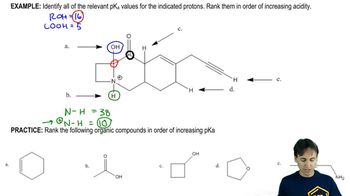
Identifying pKa values

Resonance Stabilization

Resonance stabilization refers to the delocalization of electrons in a molecule, which can stabilize the conjugate base formed after an acid donates a proton. For example, acetic acid (CH3COOH) has a conjugate base that is resonance-stabilized, making it a stronger acid compared to alcohols like methanol (CH3OH), which lack such stabilization.
Recommended video:
Guided course
03:43
The radical stability trend.

Electronegativity and Inductive Effect

Electronegativity affects acidity as more electronegative atoms can better stabilize negative charges. The inductive effect involves the transmission of charge through a chain of atoms, influencing acidity. For instance, in HF, the high electronegativity of fluorine stabilizes the conjugate base, making HF more acidic than water (H2O) or ammonia (NH3).
Recommended video:
Guided course
1:47
Electronegativity