Ch. 2 - Acids and Bases; Functional Groups
Wade - Organic Chemistry 9th Edition
Wade9th EditionOrganic ChemistryISBN: 9780135213728Not the one you use?Change textbook
Chapter 2, Problem 39a,b

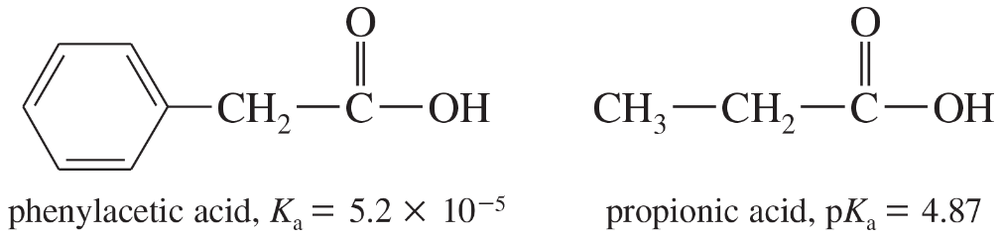
The Ka of phenylacetic acid is 5.2 × 10⁻⁵, and the pKa of propionic acid is 4.87.

a. Calculate the pKa of phenylacetic acid and the Ka of propionic acid.
b. Which of these is the stronger acid? Calculate how much stronger an acid it is.

Verified step by step guidance
1
To calculate the pKa of phenylacetic acid, use the formula pKa = -log(Ka). Substitute the given Ka value of phenylacetic acid (5.2 × 10^−5) into the formula.
To find the Ka of propionic acid, use the formula Ka = 10^(-pKa). Substitute the given pKa value of propionic acid (4.87) into the formula.
Compare the pKa values of phenylacetic acid and propionic acid. The lower the pKa value, the stronger the acid.
Calculate the difference in pKa values to determine how much stronger one acid is compared to the other. Use the formula: difference = pKa(propionic acid) - pKa(phenylacetic acid).
To express how much stronger one acid is, use the formula: strength factor = 10^(difference in pKa). This will give you the factor by which one acid is stronger than the other.

Verified video answer for a similar problem:

This video solution was recommended by our tutors as helpful for the problem above.
Video duration:
5m
Was this helpful?

Key Concepts

Here are the essential concepts you must grasp in order to answer the question correctly.

Acid Dissociation Constant (Ka)

The acid dissociation constant (Ka) quantifies the strength of an acid in solution. It measures the extent to which an acid donates protons (H+) to water, forming its conjugate base. A higher Ka value indicates a stronger acid, as it dissociates more completely in solution. In this question, the Ka values for phenylacetic and propionic acids are provided, which are essential for comparing their acid strengths.
Recommended video:
Guided course
02:19
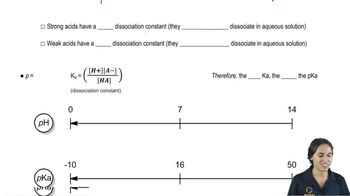
The relationship between equilibrium constant and pKa.

pKa and Its Significance

The pKa is the negative logarithm of the Ka value and provides a more convenient way to express acid strength. It is calculated using the formula pKa = -log(Ka). Lower pKa values correspond to stronger acids, making it easier to compare acid strengths. In this question, the pKa of propionic acid is given, and calculating the pKa of phenylacetic acid from its Ka will help determine which acid is stronger.
Recommended video:
Guided course
07:45
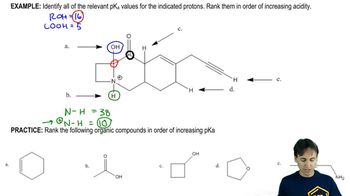
Identifying pKa values

Comparative Acid Strength

To determine which acid is stronger, one can compare their Ka or pKa values. The difference in pKa values can be used to calculate how much stronger one acid is than another. This is done using the formula: difference in pKa = pKa(stronger acid) - pKa(weaker acid). A smaller pKa indicates a stronger acid, and the calculations will reveal the relative strength of phenylacetic acid compared to propionic acid.
Recommended video:
Guided course
02:41
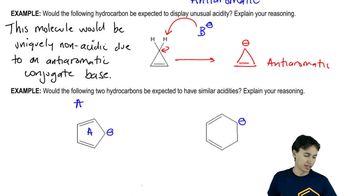
Comparing hydrocarbon acidity