
Ch. 16 - Aromatic Compounds
Wade - Organic Chemistry 9th Edition
Wade9th EditionOrganic ChemistryISBN: 9780135213728Not the one you use?Change textbook
Chapter 16, Problem 34d,e

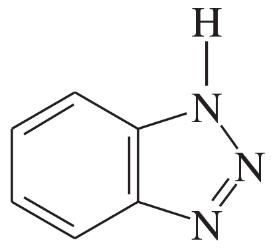
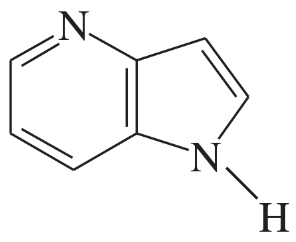
Each of the following heterocycles includes one or more nitrogen atoms. Classify each nitrogen atom as strongly basic or weakly basic, according to the availability of its lone pair of electrons.
(d)
(e)

Verified step by step guidance
1
Step 1: Analyze the structure of heterocycle (i). Identify the nitrogen atoms and determine whether their lone pairs are involved in resonance or conjugation with the aromatic ring. Lone pairs involved in resonance are less available for protonation, making the nitrogen weakly basic.
Step 2: For heterocycle (i), classify the nitrogen atom in the imine group (double-bonded nitrogen) as weakly basic because its lone pair is part of the conjugated system and contributes to the aromaticity of the ring.
Step 3: For heterocycle (i), classify the nitrogen atom in the amine group (single-bonded nitrogen) as strongly basic because its lone pair is not involved in resonance and is readily available for protonation.
Step 4: Analyze the structure of heterocycle (ii). Identify the nitrogen atoms and determine whether their lone pairs are involved in resonance or conjugation with the aromatic ring. Lone pairs involved in resonance are less available for protonation, making the nitrogen weakly basic.
Step 5: For heterocycle (ii), classify the nitrogen atom in the pyridine-like structure as weakly basic because its lone pair is part of the conjugated system. The nitrogen atom in the amine group (single-bonded nitrogen) is strongly basic because its lone pair is not involved in resonance and is readily available for protonation.

Verified video answer for a similar problem:

This video solution was recommended by our tutors as helpful for the problem above.
Video duration:
12m
Was this helpful?

Key Concepts

Here are the essential concepts you must grasp in order to answer the question correctly.

Basicity of Nitrogen Atoms

The basicity of nitrogen atoms in heterocycles is determined by the availability of their lone pair of electrons for protonation. Strongly basic nitrogen atoms have lone pairs that are readily available for bonding with protons, while weakly basic nitrogen atoms have lone pairs that are less accessible due to resonance or steric hindrance.
Recommended video:
1:45
Nitrogenous Bases Concept 3

Resonance Effects

Resonance occurs when electrons are delocalized across multiple atoms, which can stabilize a molecule. In heterocycles, if a nitrogen atom participates in resonance with adjacent double bonds, its lone pair may be involved in resonance structures, reducing its availability for protonation and thus its basicity.
Recommended video:
Guided course
03:32
Understanding Resonance Effects

Aromaticity and Basicity

Aromatic compounds are cyclic, planar structures with a ring of resonance that follow Huckel's rule. The presence of nitrogen in an aromatic system can influence basicity; nitrogen atoms that contribute to the aromatic system may have their lone pairs involved in maintaining aromaticity, making them less basic compared to non-aromatic nitrogen atoms.
Recommended video:
Guided course
06:21
Understanding the difference between basicity and nucleophilicity.