Ch.6 - Alkyl Halides; Nucleophilic Substitution
Wade - Organic Chemistry 9th Edition
Wade9th EditionOrganic ChemistryISBN: 9780135213728Not the one you use?Change textbook
Chapter 6, Problem 49b

In contrast, optically active butan-2-ol does not racemize on treatment with a solution of KOH. Explain why a reaction like that in part (a) does not occur.

Verified step by step guidance
1
Understand the concept of racemization: Racemization occurs when a chiral molecule converts into a racemic mixture (equal amounts of enantiomers), typically through a reaction that involves the loss of chirality. This often requires the formation of an intermediate that is achiral or planar, allowing for free rotation or attack from either side.
Analyze the structure of butan-2-ol: Butan-2-ol is a secondary alcohol with a chiral center at the second carbon. Its chirality arises from the four different groups attached to this carbon.
Consider the role of KOH: KOH is a strong base, and in the presence of an alcohol, it can deprotonate the hydroxyl group to form an alkoxide ion. However, this does not lead to the loss of chirality because the alkoxide ion retains the tetrahedral geometry around the chiral carbon.
Compare with part (a): In part (a), racemization likely occurred due to the formation of a planar intermediate, such as a carbocation, which allows for attack from either side. However, in the case of butan-2-ol, the reaction with KOH does not involve the formation of a carbocation or any planar intermediate.
Conclude why racemization does not occur: Since the reaction with KOH does not disrupt the tetrahedral geometry of the chiral center in butan-2-ol, the molecule retains its chirality, and no racemization takes place.

Verified video answer for a similar problem:

This video solution was recommended by our tutors as helpful for the problem above.
Video duration:
4m
Was this helpful?

Key Concepts

Here are the essential concepts you must grasp in order to answer the question correctly.

Optical Activity

Optical activity refers to the ability of a chiral compound to rotate the plane of polarized light. This property arises from the presence of a chiral center, which is typically a carbon atom bonded to four different substituents. In the case of butan-2-ol, the presence of a chiral center makes it optically active, meaning it can exist in two enantiomeric forms that rotate light in opposite directions.
Recommended video:
Guided course
08:17
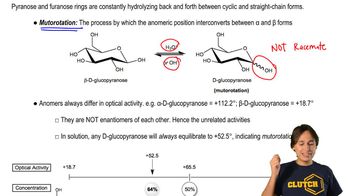
Mutorotation and Optical Activity

Racemization

Racemization is the process by which an optically active compound converts into a racemic mixture, containing equal amounts of both enantiomers. This typically occurs when the chiral center can be temporarily converted into a prochiral state, allowing for the formation of both enantiomers. In the case of butan-2-ol with KOH, the conditions do not favor racemization, as the reaction does not lead to the necessary transition state for this process.
Recommended video:
Guided course
03:59
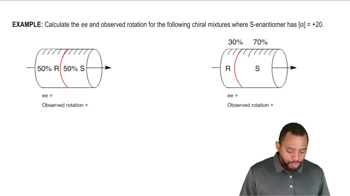
Calculating Enantiomeric Excess and Observed Rotation

Base-Induced Elimination Reactions

Base-induced elimination reactions, such as those involving KOH, typically lead to the formation of alkenes through the removal of a leaving group and a hydrogen atom. In butan-2-ol, the presence of a strong base like KOH can promote elimination rather than substitution, resulting in the formation of an alkene without racemization. This is because the reaction pathway does not involve the formation of a planar intermediate that would allow for the reformation of both enantiomers.
Recommended video:
Guided course
00:40
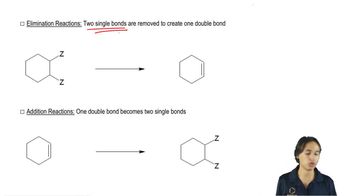
Recognizing Elimination Reactions.