

Ch.6 - Alkyl Halides; Nucleophilic Substitution
Wade - Organic Chemistry 9th Edition
Wade9th EditionOrganic ChemistryISBN: 9780135213728Not the one you use?Change textbook
Chapter 6, Problem 50f

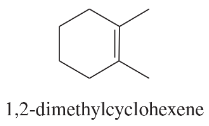
Using 1,2-dimethylcyclohexene as your starting material, show how you would synthesize the following compounds. (Once you have shown how to synthesize a compound, you may use it as the starting material in any later parts of this problem.) If a chiral product is shown, assume that it is part of a racemic mixture.

(f)

Verified step by step guidance
1
Step 1: Analyze the starting material, 1,2-dimethylcyclohexene. It is a cyclohexene ring with two methyl groups attached at the 1 and 2 positions. The double bond is located between carbons 1 and 2.
Step 2: Identify the target compound. The structure provided shows a cyclohexane ring with two double bonds, making it a conjugated diene. The double bonds are located between carbons 1-2 and 3-4.
Step 3: To synthesize the conjugated diene, perform a dehydrogenation reaction. This involves removing hydrogen atoms from the cyclohexene ring to form the second double bond. A suitable reagent for this step is a strong base such as potassium tert-butoxide (KOtBu) or a catalytic dehydrogenation process.
Step 4: Ensure that the reaction conditions favor the formation of the conjugated diene. Conjugated systems are thermodynamically stable due to delocalization of π-electrons. Heat may be applied to drive the reaction toward the formation of the conjugated product.
Step 5: Verify the stereochemistry and ensure that the product is a racemic mixture if chirality is involved. Since the target compound does not show stereochemical indicators, focus on achieving the correct connectivity and conjugation in the final product.

Verified video answer for a similar problem:

This video solution was recommended by our tutors as helpful for the problem above.
Video duration:
3m
Was this helpful?

Key Concepts

Here are the essential concepts you must grasp in order to answer the question correctly.

Electrophilic Addition Reactions

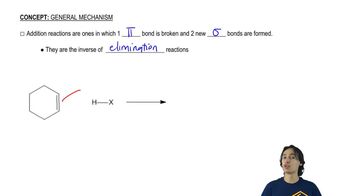
Electrophilic addition reactions are fundamental in organic chemistry, particularly for alkenes like 1,2-dimethylcyclohexene. In these reactions, an electrophile reacts with the electron-rich double bond of the alkene, leading to the formation of a more stable carbocation intermediate. This process is crucial for synthesizing various compounds, as it allows for the introduction of new functional groups into the molecule.
Recommended video:
Guided course
05:39
Features of Addition Mechanisms.

Stereochemistry

Stereochemistry is the study of the spatial arrangement of atoms in molecules and how this affects their chemical behavior. In the context of synthesizing compounds from 1,2-dimethylcyclohexene, understanding stereochemistry is essential, especially when dealing with chiral products. The formation of stereoisomers can occur during reactions, and recognizing these configurations is vital for predicting the properties and reactivity of the resulting compounds.
Recommended video:
1:38
Polymer Stereochemistry Concept 1

Rearrangement Reactions

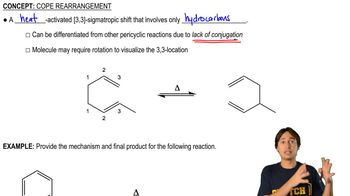
Rearrangement reactions involve the structural reorganization of a molecule, often leading to more stable products. In the synthesis of compounds from 1,2-dimethylcyclohexene, rearrangements can occur after electrophilic addition, where the initial carbocation may shift to form a more stable carbocation. This concept is important for understanding how to manipulate reaction pathways to achieve desired products in organic synthesis.
Recommended video:
Guided course
06:28
Definition of Cope Rearrangement
Related Practice
Textbook Question

Triethyloxonium tetrafluoroborate, (CH3CH2)3O+ BF4, is a solid with melting point 91–92°C. Show how this reagent can transfer an ethyl group to a nucleophile (Nuc:) in an SN2 reaction. What is the leaving group? Why might this reagent be preferred to using an ethyl halide? (Consult Table 6-2)

1209
views
Textbook Question

Give a mechanism to explain the two products formed in the following reaction.

1084
views
Textbook Question

In contrast, optically active butan-2-ol does not racemize on treatment with a solution of KOH. Explain why a reaction like that in part (a) does not occur.

1320
views
Textbook Question

Optically active butan-2-ol racemizes in dilute acid. Propose a mechanism for this racemization.

1333
views
Textbook Question

Because the SN1 reaction goes through a flat carbocation, we might expect an optically active starting material to give a completely racemized product. In most cases, however, SN1 reactions actually give more of the inversion product. In general, as the stability of the carbocation increases, the excess inversion product decreases. Extremely stable carbocations give completely racemic products. Explain these observations.

1764
views
Textbook Question

Furfuryl chloride can undergo substitution by both SN2 and SN1 mechanisms. Because it is a 1° alkyl halide, we expect SN2 but not SN1 reactions. Draw a mechanism for the SN1 reaction shown below, paying careful attention to the structure of the intermediate. How can this primary halide undergo SN1 reactions?

1793
views
1
rank