Ch. 18 - Ketones and Aldehydes
Wade - Organic Chemistry 9th Edition
Wade9th EditionOrganic ChemistryISBN: 9780135213728Not the one you use?Change textbook
Chapter 18, Problem 53h

Predict the products formed when cyclohexanone reacts with the following reagents.
(h) sodium acetylide, then mild H3O+

Verified step by step guidance
1
Identify the functional group in cyclohexanone. Cyclohexanone is a cyclic ketone, which contains a carbonyl group (C=O) as its functional group.
Understand the reactivity of sodium acetylide (NaC≡CH). Sodium acetylide is a strong nucleophile due to the negatively charged carbon in the acetylide ion (C≡C⁻). It can attack electrophilic centers, such as the carbonyl carbon in cyclohexanone.
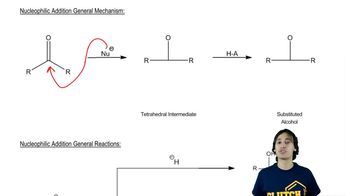
Propose the nucleophilic addition mechanism. The acetylide ion will attack the electrophilic carbonyl carbon of cyclohexanone, breaking the π bond of the carbonyl group and forming a tetrahedral alkoxide intermediate.
Account for the role of mild H3O⁺. The alkoxide intermediate formed in the previous step will be protonated by the mild acid (H3O⁺), resulting in the formation of a hydroxy group (-OH) at the former carbonyl carbon.
Predict the final product. The reaction will yield a compound where the acetylide group (C≡CH) is attached to the former carbonyl carbon, and the oxygen atom is converted into a hydroxyl group (-OH), forming a propargylic alcohol.

Verified video answer for a similar problem:

This video solution was recommended by our tutors as helpful for the problem above.
Video duration:
1m
Was this helpful?

Key Concepts

Here are the essential concepts you must grasp in order to answer the question correctly.

Nucleophilic Addition

Nucleophilic addition is a fundamental reaction mechanism in organic chemistry where a nucleophile attacks an electrophilic carbon atom, typically in a carbonyl group. In the case of cyclohexanone, the carbonyl carbon is susceptible to attack by nucleophiles like sodium acetylide, leading to the formation of an alkoxide intermediate.
Recommended video:
Guided course
08:27
Nucleophilic Addition

Acetylide Ion

The acetylide ion is a strong nucleophile derived from terminal alkynes, formed by deprotonating an alkyne with a strong base like sodium amide or sodium hydride. In this reaction, sodium acetylide acts as a nucleophile that adds to the carbonyl carbon of cyclohexanone, resulting in a new carbon-carbon bond.
Recommended video:
3:39
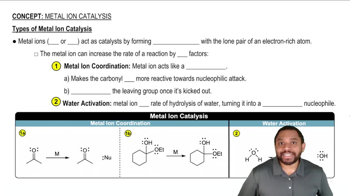
Metal Ion Catalysis Concept 1

Hydrolysis

Hydrolysis is a chemical reaction involving the addition of water to a compound, often leading to the breakdown of that compound. After the nucleophilic addition of sodium acetylide to cyclohexanone, mild H3O+ (acidic water) is used to protonate the alkoxide intermediate, resulting in the formation of an alcohol product.
Recommended video:
1:00
Hydrolysis of Thioesters Concept 2