Ch. 18 - Ketones and Aldehydes
Wade - Organic Chemistry 9th Edition
Wade9th EditionOrganic ChemistryISBN: 9780135213728Not the one you use?Change textbook
Chapter 18, Problem 53k

Predict the products formed when cyclohexanone reacts with the following reagents.
(k) sodium cyanide

Verified step by step guidance
1
Step 1: Recognize the functional group in cyclohexanone. Cyclohexanone is a ketone, which contains a carbonyl group (C=O). This group is highly reactive and can undergo nucleophilic addition reactions.
Step 2: Understand the role of sodium cyanide (NaCN). Sodium cyanide provides the cyanide ion (CN⁻), which is a strong nucleophile capable of attacking the electrophilic carbon atom in the carbonyl group.
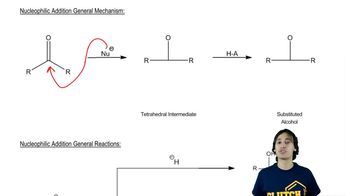
Step 3: Analyze the mechanism of the reaction. The cyanide ion (CN⁻) attacks the carbonyl carbon, breaking the π bond of the C=O group. This results in the formation of a tetrahedral intermediate.
Step 4: Consider the protonation step. After the nucleophilic attack, the negatively charged oxygen atom in the intermediate is typically protonated by a proton source (e.g., water or an acid), leading to the formation of a stable product.
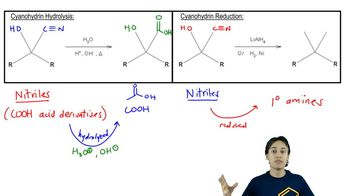
Step 5: Predict the product. The reaction between cyclohexanone and sodium cyanide forms a cyanohydrin, which is characterized by the addition of a hydroxyl group (-OH) and a cyano group (-CN) to the original carbonyl carbon.

Verified video answer for a similar problem:

This video solution was recommended by our tutors as helpful for the problem above.
Video duration:
3m
Was this helpful?

Key Concepts

Here are the essential concepts you must grasp in order to answer the question correctly.

Nucleophilic Addition

Nucleophilic addition is a fundamental reaction mechanism in organic chemistry where a nucleophile attacks an electrophilic carbon atom, typically in a carbonyl group. In the case of cyclohexanone, the carbonyl carbon is susceptible to attack by nucleophiles like cyanide ions. This reaction leads to the formation of a new carbon-carbon bond, resulting in an alcohol or a cyanohydrin depending on the conditions.
Recommended video:
Guided course
08:27
Nucleophilic Addition

Cyanohydrin Formation

Cyanohydrin formation occurs when a carbonyl compound, such as cyclohexanone, reacts with a cyanide ion. The nucleophilic cyanide attacks the electrophilic carbon of the carbonyl, leading to the addition of the cyanide group and the conversion of the carbonyl into a hydroxyl group. This reaction is significant in organic synthesis as cyanohydrins can serve as intermediates for further transformations.
Recommended video:
Guided course
02:36
Nitrile Reduction

Reactivity of Carbonyl Compounds

Carbonyl compounds, including ketones like cyclohexanone, exhibit distinct reactivity due to the polarized carbon-oxygen double bond. The carbon atom is electrophilic, making it a target for nucleophiles. Understanding the reactivity patterns of carbonyl compounds is crucial for predicting the outcomes of reactions, such as the formation of products when they interact with nucleophiles like sodium cyanide.
Recommended video:
Guided course
01:40
Defining meso compounds.