
Textbook Question
Predict the masses and the structures of the most abundant fragments observed in the mass spectra of the following compounds.
(c) 4-methylpentan-2-ol
1451
views

 Verified step by step guidance
 02:19
02:19
 01:44
01:44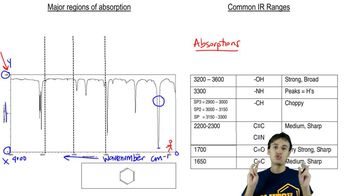 16:04
16:04Predict the masses and the structures of the most abundant fragments observed in the mass spectra of the following compounds.
(c) 4-methylpentan-2-ol
Predict the masses and the structures of the most abundant fragments observed in the mass spectra of the following compounds.
(b) 3-methylhex-2-ene
A common lab experiment is the dehydration of cyclohexanol to cyclohexene.
(a) Explain how you could tell from the IR spectrum whether your product was pure cyclohexene, pure cyclohexanol, or a mixture of cyclohexene and cyclohexanol. Give approximate frequencies for distinctive peaks.
(b) Explain why mass spectrometry might not be a good way to distinguish cyclohexene from cyclohexanol.
A laboratory student added 1-bromobutane to a flask containing dry ether and magnesium turnings. An exothermic reaction resulted, and the ether boiled vigorously for several minutes. Then she added acetone to the reaction mixture and the ether boiled even more vigorously. She added dilute acid to the mixture and separated the layers. She evaporated the ether layer, and distilled a liquid that boiled at 143 °C. GC–MS analysis of the distillate showed one major product with a few minor impurities. The mass spectrum of the major product is shown here.
(a) Draw out the reactions that took place and show the product that was formed.
<IMAGE>
Three common lab experiments are shown. In each case, describe how the IR spectrum of the product would differ from that of the reactant. Give approximate frequencies for distinctive peaks in the IR spectrum of the reactant and also that of the product.
A laboratory student added 1-bromobutane to a flask containing dry ether and magnesium turnings. An exothermic reaction resulted, and the ether boiled vigorously for several minutes. Then she added acetone to the reaction mixture and the ether boiled even more vigorously. She added dilute acid to the mixture and separated the layers. She evaporated the ether layer, and distilled a liquid that boiled at 143 °C. GC–MS analysis of the distillate showed one major product with a few minor impurities. The mass spectrum of the major product is shown here.
(b) Explain why the molecular ion is or is not visible in the mass spectrum, and show what ions are likely to be responsible for the strong peaks at m/z 59 and 101.
<IMAGE>