Ch. 23 - Carbohydrates and Nucleic Acids
Wade - Organic Chemistry 9th Edition
Wade9th EditionOrganic ChemistryISBN: 9780135213728Not the one you use?Change textbook
Chapter 23, Problem 10b

Ribose, the C2 epimer of arabinose, is most stable in its furanose form. Draw D-ribofuranose.

Verified step by step guidance
1
Understand the problem: The question asks for the structure of D-ribofuranose, which is the furanose (five-membered ring) form of D-ribose. Ribose is a monosaccharide with the molecular formula C₅H₁₀O₅, and it is the C2 epimer of arabinose, meaning the configuration at the second carbon is inverted compared to arabinose.
Recall the structure of D-ribose: D-ribose is an aldopentose, meaning it has five carbon atoms, one of which is part of an aldehyde group (-CHO). The remaining carbons are part of hydroxyl (-OH) and hydrogen (-H) groups, arranged in a specific stereochemistry.
Convert D-ribose to its furanose form: In aqueous solution, D-ribose cyclizes to form a furanose ring. This occurs when the hydroxyl group on C4 attacks the aldehyde group on C1, forming a hemiacetal. This reaction creates a five-membered ring structure (furanose).
Determine the stereochemistry: In D-ribofuranose, the stereochemistry of the chiral carbons (C2, C3, and C4) must match that of D-ribose. Specifically, the hydroxyl group on C2 is on the right (down in the Haworth projection), the hydroxyl group on C3 is on the left (up in the Haworth projection), and the hydroxyl group on C4 is on the right (down in the Haworth projection).
Draw the structure: Represent the furanose ring as a five-membered ring with oxygen as one of the vertices. Place the hydroxyl and hydrogen groups on the appropriate carbons based on the stereochemistry described. Ensure that the anomeric carbon (C1) has either an α or β configuration, depending on whether the hydroxyl group is trans or cis to the CH₂OH group on C4.

Verified video answer for a similar problem:

This video solution was recommended by our tutors as helpful for the problem above.
Was this helpful?

Key Concepts

Here are the essential concepts you must grasp in order to answer the question correctly.

Epimer

An epimer is a type of stereoisomer that differs in configuration at only one specific carbon atom. In the case of ribose and arabinose, they are both pentoses but differ at the C2 position. Understanding epimers is crucial for recognizing how small changes in molecular structure can lead to different properties and functions in carbohydrates.
Recommended video:
Guided course
03:42
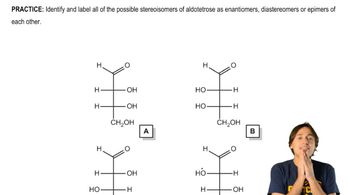
Identifying Types of Stereoisomers

Furanose Form

The furanose form refers to a five-membered ring structure that certain sugars, like ribose, can adopt. This conformation is formed when the carbonyl group reacts with a hydroxyl group on the same molecule, leading to a more stable cyclic structure. Recognizing the furanose form is essential for understanding the stability and reactivity of sugars in biological systems.
Recommended video:
Guided course
06:23
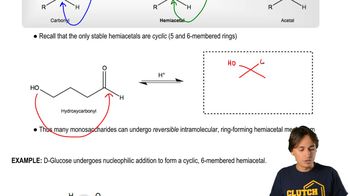
Monosaccharides - Forming Cyclic Hemiacetals

D- and L- Configuration

The D- and L- configuration of sugars is based on the orientation of the hydroxyl group on the chiral carbon farthest from the carbonyl group. In D-sugars, this hydroxyl group is on the right in a Fischer projection, while in L-sugars, it is on the left. This distinction is important for identifying the specific sugar and its biological role, as well as for drawing accurate structural representations.
Recommended video:
Guided course
05:09
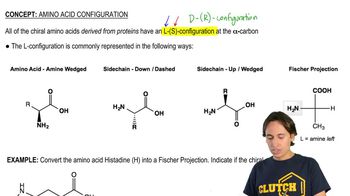
Representations of L-Configuration