Figure 23-2 shows that the degradation of D-glucose gives D-arabinose, an aldopentose. Arabinose is most stable in its furanose form. Draw D-arabinofuranose.
Ch. 23 - Carbohydrates and Nucleic Acids
Chapter 23, Problem 13
Like glucose, galactose mutarotates when it dissolves in water. The specific rotation of α-D-galactopyranose is +150.7°, and that of the β anomer is +52.8°. When either of the pure anomers dissolves in water, the specific rotation gradually changes to +80.2°. Determine the percentages of the two anomers present at equilibrium.
Verified step by step guidance1
Step 1: Understand the concept of mutarotation. Mutarotation is the change in the optical rotation due to the interconversion between α and β anomers of a sugar in aqueous solution until equilibrium is reached. The equilibrium mixture has a specific rotation that is a weighted average of the rotations of the individual anomers.
Step 2: Use the formula for calculating the equilibrium percentages of the two anomers. The specific rotation at equilibrium (denoted as [α]_eq) is given by the weighted average: , where f_α and f_β are the mole fractions of the α and β anomers, respectively, and [α]_α and [α]_β are their specific rotations.
Step 3: Recognize that the mole fractions must add up to 1. Therefore, . This relationship allows you to express one mole fraction in terms of the other, such as .
Step 4: Substitute the known values into the equation. The equilibrium specific rotation is +80.2°, the specific rotation of α-D-galactopyranose is +150.7°, and the specific rotation of β-D-galactopyranose is +52.8°. Replace [α]_eq, [α]_α, and [α]_β with their respective values in the formula: .
Step 5: Solve the equation for f_α (the mole fraction of the α anomer). Once f_α is determined, calculate f_β using . Multiply each mole fraction by 100 to express the percentages of the α and β anomers at equilibrium.

Verified video answer for a similar problem:
This video solution was recommended by our tutors as helpful for the problem above.
Video duration:
5mWas this helpful?
Key Concepts
Here are the essential concepts you must grasp in order to answer the question correctly.
Mutarotation
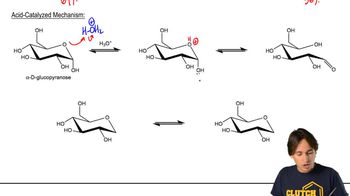
Mutarotation is the change in optical rotation that occurs when an anomer of a sugar dissolves in water and equilibrates between its α and β forms. This process is due to the interconversion of the cyclic forms of the sugar, which alters the specific rotation as the equilibrium is established. Understanding mutarotation is crucial for analyzing the behavior of sugars like glucose and galactose in solution.
Recommended video:
Guided course
Mechanism
Specific Rotation
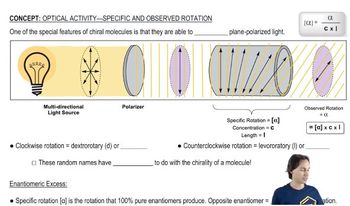
Specific rotation is a property of chiral compounds that quantifies the degree to which they rotate plane-polarized light. It is expressed in degrees and is dependent on the concentration of the solution and the path length of the light. For sugars, the specific rotations of the α and β anomers are distinct, and knowing these values is essential for calculating the equilibrium composition of the mixture.
Recommended video:
Guided course
Specific rotation vs. observed rotation.
Equilibrium Concentration
Equilibrium concentration refers to the stable ratio of reactants and products in a reversible reaction when the rates of the forward and reverse reactions are equal. In the context of mutarotation, it involves determining the final proportions of the α and β anomers of galactose in solution after they have reached a stable state. This concept is fundamental for solving problems related to the distribution of isomers in solution.
Recommended video:
Guided course
Determining Acid/Base Equilibrium
Related Practice
Textbook Question
1034
views
Textbook Question
When D-glucose is reduced with sodium borohydride, optically active glucitol results. When optically active D-galactose is reduced, however, the product is optically inactive. Explain this loss of optical activity.
947
views
Textbook Question
Draw and name the products of bromine water oxidation of
(a) D-mannose
(b) D-galactose
(c) D-fructose
1085
views
Textbook Question
The carbonyl group in D-galactose may be isomerized from C1 to C2 by brief treatment with dilute base (by the enediol rearrangement). The product is the C4 epimer of fructose. Draw the furanose structure of the product.
699
views
Textbook Question
Draw and name the products of nitric acid oxidation of
(a) D-mannose
(b) D-galactose
1754
views
Textbook Question
Ribose, the C2 epimer of arabinose, is most stable in its furanose form. Draw D-ribofuranose.
1482
views