Ch. 19 - Amines
Wade - Organic Chemistry 9th Edition
Wade9th EditionOrganic ChemistryISBN: 9780135213728Not the one you use?Change textbook
Chapter 19, Problem 30f

Show how you would accomplish the following synthetic conversions.
(f) (R)-2-bromobutane → (S)-2-methylbutan-1-amine

Verified step by step guidance
1
Step 1: Analyze the starting material (R)-2-bromobutane and the target product (S)-2-methylbutan-1-amine. Note that the stereochemistry changes from (R) to (S), and the functional group changes from a bromine atom to a primary amine (-CH2NH2).
Step 2: Perform a nucleophilic substitution reaction (SN2) using cyanide ion (CN⁻) as the nucleophile. This will replace the bromine atom with a cyano group (-CN) and invert the stereochemistry, converting (R)-2-bromobutane to (S)-2-methylbutanenitrile.
Step 3: Reduce the nitrile group (-CN) in (S)-2-methylbutanenitrile to a primary amine (-CH2NH2). This can be accomplished using a reducing agent such as lithium aluminum hydride (LiAlH4) followed by hydrolysis.
Step 4: Verify that the stereochemistry remains (S) after the reduction step, as the reduction of the nitrile group does not affect the stereocenter.
Step 5: Confirm the final product is (S)-2-methylbutan-1-amine, ensuring both the functional group transformation and stereochemical inversion are correct.

Verified video answer for a similar problem:

This video solution was recommended by our tutors as helpful for the problem above.
Video duration:
4m
Was this helpful?

Key Concepts

Here are the essential concepts you must grasp in order to answer the question correctly.

Stereochemistry

Stereochemistry is the study of the spatial arrangement of atoms in molecules and how this affects their chemical behavior. In this question, the conversion involves changing the configuration of (R)-2-bromobutane to (S)-2-methylbutan-1-amine, highlighting the importance of understanding chirality and how reactions can lead to the formation of specific stereoisomers.
Recommended video:
1:38
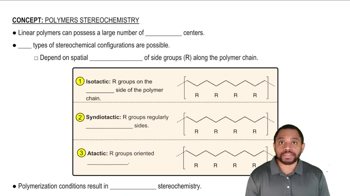
Polymer Stereochemistry Concept 1

Nucleophilic Substitution Reactions

Nucleophilic substitution reactions involve the replacement of a leaving group (in this case, bromine) by a nucleophile (the amine group). This type of reaction is crucial for the conversion of (R)-2-bromobutane to (S)-2-methylbutan-1-amine, as it demonstrates how nucleophiles can attack electrophilic centers in organic molecules, leading to the formation of new compounds.
Recommended video:
Guided course
01:47
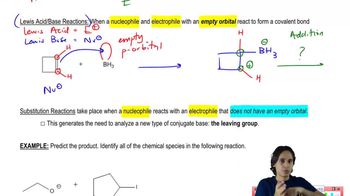
Nucleophiles and Electrophiles can react in Substitution Reactions.

Chirality and Inversion of Configuration

Chirality refers to the property of a molecule that makes it non-superimposable on its mirror image, often due to the presence of a chiral center. In this conversion, the inversion of configuration is significant as the reaction must not only replace the bromine atom but also ensure that the resulting amine has the opposite configuration, transforming (R) to (S) through a specific reaction pathway.
Recommended video:
Guided course
02:14
The Electron Configuration