Ch.8 - Reactions of Alkenes
Wade - Organic Chemistry 9th Edition
Wade9th EditionOrganic ChemistryISBN: 9780135213728Not the one you use?Change textbook
Chapter 8, Problem 8a,b

Predict the major products of the following reactions.
a. 1-methylcyclohexene+ aqueous Hg(OAc)2
b. the product from part (a), treated with NaBH4

Verified step by step guidance
1
Step 1: Analyze the reaction conditions for part (a). The reagents Hg(OAc)2, H2O, and Et2O indicate an oxymercuration-demercuration reaction. This reaction adds water (H-OH) across the double bond of the alkene in a Markovnikov fashion, meaning the hydroxyl group (-OH) will attach to the more substituted carbon of the double bond.
Step 2: Identify the structure of the starting material, 1-methylcyclohexene. The double bond is between the cyclohexane ring and the methyl group. The more substituted carbon in the double bond is the carbon attached to the methyl group.
Step 3: During the oxymercuration step, the intermediate formed involves the addition of Hg(OAc)2 to the double bond, creating a mercurinium ion. Water then attacks the more substituted carbon, leading to the formation of an organomercury intermediate with an -OH group on the more substituted carbon.
Step 4: In part (b), the second step involves treatment with NaBH4 and NaOH. This step is the demercuration process, where the mercury group is replaced by a hydrogen atom, leaving the hydroxyl group intact on the more substituted carbon.
Step 5: The final product is an alcohol where the -OH group is attached to the more substituted carbon of the original double bond, and the hydrogen is added to the less substituted carbon. This follows the Markovnikov rule for addition reactions.

Verified video answer for a similar problem:

This video solution was recommended by our tutors as helpful for the problem above.
Video duration:
8m
Was this helpful?

Key Concepts

Here are the essential concepts you must grasp in order to answer the question correctly.

Oxymercuration-Demercuration

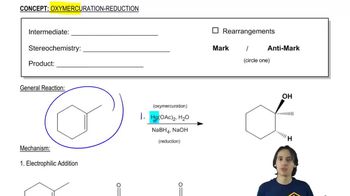
Oxymercuration-demercuration is a two-step reaction used to convert alkenes into alcohols. The first step involves the addition of mercuric acetate (Hg(OAc)2) in the presence of water, which results in the formation of a mercurial intermediate. This step is regioselective, favoring Markovnikov addition, where the more substituted carbon atom receives the mercury atom. The second step involves reduction with sodium borohydride (NaBH4), which replaces the mercury with a hydrogen atom, yielding the final alcohol product.
Recommended video:
Guided course
05:
General properties of oxymercuration-reduction.

Markovnikov's Rule

Markovnikov's Rule states that in the addition of HX to an alkene, the hydrogen atom will attach to the carbon with the greater number of hydrogen atoms already attached, while the halide (or other substituent) will attach to the carbon with fewer hydrogen atoms. This rule helps predict the outcome of reactions involving unsymmetrical alkenes, guiding the formation of the more stable carbocation during the reaction process, which is crucial for understanding the products formed in oxymercuration.
Recommended video:
Guided course
03:54
The 18 and 16 Electron Rule

Regioselectivity

Regioselectivity refers to the preference of a chemical reaction to yield one structural isomer over others when multiple products are possible. In the context of the oxymercuration-demercuration reaction, regioselectivity is important because it determines which carbon atom of the alkene will bond with the incoming nucleophile (water in this case). Understanding regioselectivity is essential for predicting the major product of the reaction, especially when dealing with unsymmetrical alkenes like 1-methylcyclohexene.
Recommended video:
Guided course
05:09
Heck Reaction