Ch.1 - Structure and Bonding
Wade - Organic Chemistry 9th Edition
Wade9th EditionOrganic ChemistryISBN: 9780135213728Not the one you use?Change textbook
Chapter 1, Problem 50a,b

Cyclopropane (C3H6, a three-membered ring) is more reactive than most other cycloalkanes.
a. Draw a Lewis structure for cyclopropane.
b. Compare the bond angles of the carbon atoms in cyclopropane with those in an acyclic (noncyclic) alkane.

Verified step by step guidance
1
To draw the Lewis structure for cyclopropane (C3H6), start by arranging three carbon atoms in a triangular shape to represent the three-membered ring. Each carbon atom forms two single bonds with the adjacent carbon atoms.
Next, add hydrogen atoms. Each carbon atom in cyclopropane should be bonded to two hydrogen atoms to satisfy the tetravalency of carbon, resulting in each carbon having four bonds in total.
Now, compare the bond angles in cyclopropane. In an ideal acyclic alkane, the bond angles around each carbon atom are approximately 109.5 degrees, which is the tetrahedral angle.
In cyclopropane, the bond angles are significantly smaller due to the constraints of the three-membered ring. The bond angles in cyclopropane are approximately 60 degrees, which is much less than the ideal tetrahedral angle.
This deviation from the ideal bond angle introduces angle strain in cyclopropane, making it more reactive than acyclic alkanes or larger cycloalkanes with less angle strain.

Verified video answer for a similar problem:

This video solution was recommended by our tutors as helpful for the problem above.
Video duration:
4m
Was this helpful?

Key Concepts

Here are the essential concepts you must grasp in order to answer the question correctly.

Lewis Structure

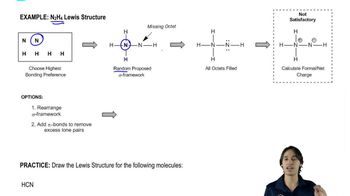
A Lewis structure is a diagrammatic representation of a molecule showing how the valence electrons are arranged among the atoms in the molecule. For cyclopropane, the Lewis structure illustrates the three carbon atoms forming a triangle, each bonded to two hydrogen atoms, highlighting the shared electron pairs and the overall connectivity of the atoms.
Recommended video:
Guided course
04:12
Drawing the Lewis Structure for N2H4.

Bond Angles in Cycloalkanes

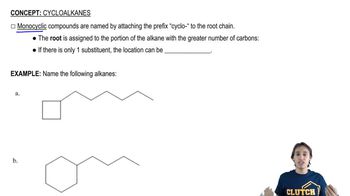
Bond angles in cycloalkanes are determined by the geometric arrangement of the carbon atoms. In cyclopropane, the bond angles are approximately 60 degrees due to the triangular shape, which is significantly smaller than the typical tetrahedral angle of 109.5 degrees found in acyclic alkanes. This deviation from the ideal angle introduces angle strain, contributing to cyclopropane's reactivity.
Recommended video:
Guided course
01:11
How to find the root name for cycloalkanes

Angle Strain

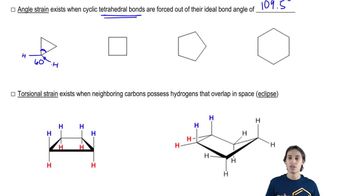
Angle strain occurs when bond angles deviate from their ideal values, causing increased energy and instability in a molecule. In cyclopropane, the 60-degree bond angles are much smaller than the ideal 109.5 degrees, leading to significant angle strain. This strain makes cyclopropane more reactive compared to larger cycloalkanes, which have bond angles closer to the ideal tetrahedral angle.
Recommended video:
Guided course
02:46
What is angle strain?
Related Practice
Textbook Question

For each of the following compounds and ions,

1. Draw a Lewis structure.

2. Show the kinds of orbitals that overlap to form each bond.

3. Give approximate bond angles around each atom except hydrogen.

a. [NH2]

1093
views
Textbook Question

In 1934, Edward A. Doisy of Washington University extracted 3000 lb of hog ovaries to isolate a few milligrams of pure estradiol, a potent female hormone. Doisy burned 5.00 mg of this precious sample in oxygen and found that 14.54 mg of CO2 and 3.97 mg of H2O were generated.

b. The molecular weight of estradiol was later determined to be 272. Determine the molecular formula of estradiol.

1494
views
1
rank
Textbook Question

Cyclopropane (C3H6, a three-membered ring) is more reactive than most other cycloalkanes.

c. Suggest why cyclopropane is so reactive.

1487
views
Textbook Question

For each of the following compounds and ions,

1. Draw a Lewis structure.

2. Show the kinds of orbitals that overlap to form each bond.

3. Give approximate bond angles around each atom except hydrogen.

b. [CH2OH]+

1040
views
Textbook Question

In 1934, Edward A. Doisy of Washington University extracted 3000 lb of hog ovaries to isolate a few milligrams of pure estradiol, a potent female hormone. Doisy burned 5.00 mg of this precious sample in oxygen and found that 14.54 mg of CO2 and 3.97 mg of H2O were generated.

a. Determine the empirical formula of estradiol.

801
views
Textbook Question

If the carbon atom in CH2Cl2 were flat, there would be two stereoisomers. The carbon atom in CH2Cl2 is actually tetrahedral. Make a model of this compound, and determine whether there are any stereoisomers of CH2Cl2

1084
views