
Ch.1 - Structure and Bonding
Wade - Organic Chemistry 9th Edition
Wade9th EditionOrganic ChemistryISBN: 9780135213728Not the one you use?Change textbook
Chapter 1, Problem 49

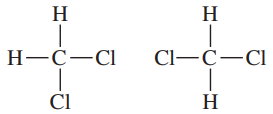
If the carbon atom in CH2Cl2 were flat, there would be two stereoisomers. The carbon atom in CH2Cl2 is actually tetrahedral. Make a model of this compound, and determine whether there are any stereoisomers of CH2Cl2
Structural representations of CH2Cl2 showing two potential stereoisomers with hydrogen and chlorine atoms.

Verified step by step guidance
1
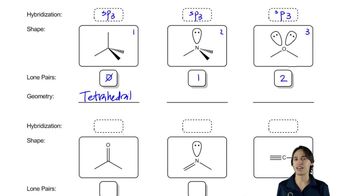
Step 1: Understand the molecular geometry of CH2Cl2. The carbon atom in CH2Cl2 is sp3 hybridized, resulting in a tetrahedral geometry. This means the four substituents (two hydrogens and two chlorines) are arranged around the carbon atom in a three-dimensional tetrahedral shape.
Step 2: Analyze the possibility of stereoisomers. Stereoisomers occur when a molecule has chiral centers or restricted rotation leading to different spatial arrangements. For CH2Cl2, the carbon atom is bonded to two identical hydrogen atoms and two identical chlorine atoms, making it symmetrical.
Step 3: Consider chirality. A molecule is chiral if it has a non-superimposable mirror image. In CH2Cl2, the symmetry of the substituents (two hydrogens and two chlorines) prevents the formation of a chiral center, as the molecule and its mirror image are superimposable.
Step 4: Evaluate the flat geometry scenario. If the carbon atom were flat (planar), the molecule could theoretically have cis and trans isomers due to restricted rotation. However, in reality, the tetrahedral geometry of the carbon atom eliminates this possibility.
Step 5: Conclude the stereoisomer analysis. Since CH2Cl2 has a tetrahedral geometry and lacks chiral centers or restricted rotation, it does not have stereoisomers. The molecule exists as a single form in three-dimensional space.

Verified video answer for a similar problem:

This video solution was recommended by our tutors as helpful for the problem above.
Video duration:
2m
Was this helpful?

Key Concepts

Here are the essential concepts you must grasp in order to answer the question correctly.

Tetrahedral Geometry

In organic chemistry, the tetrahedral geometry refers to the three-dimensional arrangement of atoms around a central carbon atom bonded to four substituents. This geometry arises from the sp3 hybridization of the carbon atom, leading to bond angles of approximately 109.5 degrees. In the case of CH2Cl2, the tetrahedral shape prevents the formation of stereoisomers because the two hydrogen atoms and two chlorine atoms are not arranged in a way that creates distinct spatial configurations.
Recommended video:
Guided course
07:44
Molecular Geometry Explained.

Stereoisomers

Stereoisomers are compounds that have the same molecular formula and connectivity of atoms but differ in the spatial arrangement of their atoms. This can lead to different physical and chemical properties. For a compound to have stereoisomers, it must have restricted rotation around a bond or a chiral center. In CH2Cl2, the presence of two identical hydrogen atoms and two identical chlorine atoms means that it does not have a chiral center, thus no stereoisomers exist.
Recommended video:
Guided course
01:58
Determining when molecules are stereoisomers.

Chirality

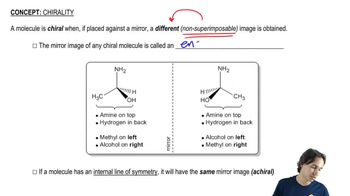
Chirality is a property of a molecule that makes it non-superimposable on its mirror image, often due to the presence of a chiral center, typically a carbon atom bonded to four different substituents. Chirality is crucial in determining the existence of stereoisomers. In the case of CH2Cl2, since the carbon atom is bonded to two identical hydrogen atoms and two identical chlorine atoms, it lacks chirality, confirming that it does not exhibit stereoisomerism.
Recommended video:
Guided course
05:10
What is chirality?
Related Practice
Textbook Question

Compound X, isolated from lanolin (sheep's wool fat), has the pungent aroma of dirty sweatsocks. A careful analysis showed that compound X contains 62.0% carbon and 10.4% hydrogen. No nitrogen or halogen was found.

b. A molecular weight determination showed that compound X has a molecular weight of approximately 117. Find the molecular formula of compound X.

1732
views
Textbook Question

For each of the following compounds and ions,

1. Draw a Lewis structure.

2. Show the kinds of orbitals that overlap to form each bond.

3. Give approximate bond angles around each atom except hydrogen.

a. [NH2]

1093
views
Textbook Question

In 1934, Edward A. Doisy of Washington University extracted 3000 lb of hog ovaries to isolate a few milligrams of pure estradiol, a potent female hormone. Doisy burned 5.00 mg of this precious sample in oxygen and found that 14.54 mg of CO2 and 3.97 mg of H2O were generated.

b. The molecular weight of estradiol was later determined to be 272. Determine the molecular formula of estradiol.

1494
views
1
rank
Textbook Question

Cyclopropane (C3H6, a three-membered ring) is more reactive than most other cycloalkanes.

c. Suggest why cyclopropane is so reactive.

1487
views
Textbook Question

Cyclopropane (C3H6, a three-membered ring) is more reactive than most other cycloalkanes.

a. Draw a Lewis structure for cyclopropane.

b. Compare the bond angles of the carbon atoms in cyclopropane with those in an acyclic (noncyclic) alkane.

950
views
Textbook Question

In 1934, Edward A. Doisy of Washington University extracted 3000 lb of hog ovaries to isolate a few milligrams of pure estradiol, a potent female hormone. Doisy burned 5.00 mg of this precious sample in oxygen and found that 14.54 mg of CO2 and 3.97 mg of H2O were generated.

a. Determine the empirical formula of estradiol.

801
views