Ch.1 - Structure and Bonding
Wade - Organic Chemistry 9th Edition
Wade9th EditionOrganic ChemistryISBN: 9780135213728Not the one you use?Change textbook
Chapter 1, Problem 41e-h

Determine whether the following pairs of structures are actually different compounds or simply resonance forms of the same compounds.
e.
f.
g.
h.

Verified step by step guidance
1
Step 1: Understand the concept of resonance. Resonance structures are different ways of drawing the same molecule, showing the delocalization of electrons. They are not different compounds but different representations of the same compound.
Step 2: Analyze pair (e): CH₂=C-O⁻ and ⁻CH₂-C=O-H. Check if they can be interconverted by moving electrons without breaking any sigma bonds. The first structure has a negative charge on oxygen, while the second has a negative charge on carbon. These are not resonance forms but different compounds.
Step 3: Analyze pair (f): CH₃-C⁺=NH₂ and CH₃-C=NH₂⁺. Check if they can be interconverted by moving electrons. The positive charge is on different atoms in each structure, indicating they are not resonance forms but different compounds.
Step 4: Analyze pair (g): CH₂=CH-CH₂⁺ and ⁺CH₂-CH=CH₂. Check if they can be interconverted by moving electrons. The positive charge can be moved between the carbon atoms through resonance, indicating they are resonance forms of the same compound.
Step 5: Analyze pair (h): CH₂=C=O and H-C≡C-OH. Check if they can be interconverted by moving electrons. The connectivity of atoms is different, indicating they are not resonance forms but different compounds.

Verified video answer for a similar problem:

This video solution was recommended by our tutors as helpful for the problem above.
Video duration:
5m
Was this helpful?

Key Concepts

Here are the essential concepts you must grasp in order to answer the question correctly.

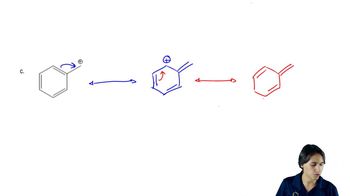
Resonance Structures

Resonance structures are different ways of drawing the same molecule that illustrate the delocalization of electrons. They are not distinct compounds but rather representations that help visualize the electron distribution within a molecule. The actual structure is a hybrid of these forms, which contributes to the stability and reactivity of the compound.
Recommended video:
Guided course
03:04
Drawing Resonance Structures

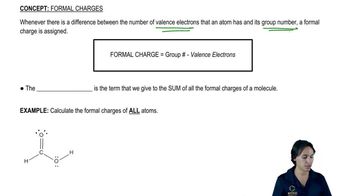
Formal Charge

Formal charge is a theoretical charge assigned to an atom in a molecule, calculated based on the number of valence electrons, the number of non-bonding electrons, and half the number of bonding electrons. It helps in determining the most stable resonance structure, as structures with lower formal charges are generally more favorable. Understanding formal charge is crucial for evaluating the differences between resonance forms.
Recommended video:
Guided course
01:34
Calculating formal and net charge.

Stability of Resonance Forms

The stability of resonance forms is determined by factors such as the arrangement of charges, the presence of complete octets, and the overall energy of the structure. More stable resonance forms contribute more to the resonance hybrid, while less stable forms are less significant. Analyzing the stability of these forms is essential for understanding the behavior and properties of the compound in question.
Recommended video:
Guided course
03:43
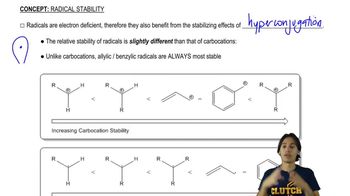
The radical stability trend.