
Ch.1 - Structure and Bonding
Wade - Organic Chemistry 9th Edition
Wade9th EditionOrganic ChemistryISBN: 9780135213728Not the one you use?Change textbook
Chapter 1, Problem 41a-d

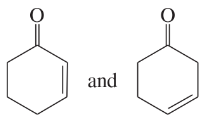
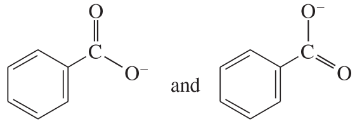
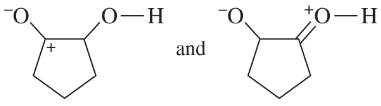
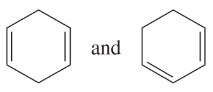
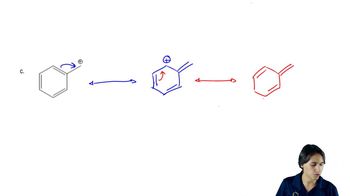
Determine whether the following pairs of structures are actually different compounds or simply resonance forms of the same compounds.
a.
b.
c.
d.

Verified step by step guidance
1
Step 1: Understand the concept of resonance. Resonance structures are different ways of drawing the same molecule, showing the delocalization of electrons. They are not different compounds but different representations of the same compound.
Step 2: Examine the connectivity of atoms in each pair of structures. If the connectivity (the way atoms are bonded to each other) is the same, they might be resonance forms. If the connectivity is different, they are different compounds.
Step 3: Look at the placement of electrons, particularly lone pairs and π-bonds. Resonance structures will have the same arrangement of atoms but differ in the placement of electrons.
Step 4: Check for charge distribution. Resonance structures can have different distributions of charge, but the overall charge of the molecule should remain the same.
Step 5: Consider the hybridization and geometry of the atoms involved. Resonance structures should have the same hybridization and geometry for each atom, as they represent the same molecule.

Verified video answer for a similar problem:

This video solution was recommended by our tutors as helpful for the problem above.
Video duration:
3m
Was this helpful?

Key Concepts

Here are the essential concepts you must grasp in order to answer the question correctly.

Resonance Structures

Resonance structures are different Lewis structures for the same molecule that depict the delocalization of electrons within the molecule. They are used to represent molecules where the electron distribution cannot be described by a single Lewis structure. Resonance structures differ only in the positions of electrons, not in the positions of atoms.
Recommended video:
Guided course
03:04
Drawing Resonance Structures

Structural Isomers

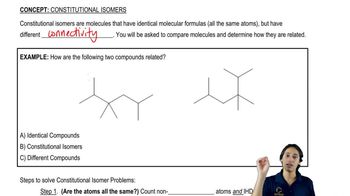
Structural isomers are compounds with the same molecular formula but different connectivity of atoms. Unlike resonance structures, structural isomers have different physical and chemical properties because the atoms are connected in different ways, leading to distinct compounds.
Recommended video:
Guided course
01:10
What is a constitutional isomer?

Electron Delocalization

Electron delocalization refers to the spreading of electron density across several atoms, which is a key feature in resonance. This concept is crucial for understanding how resonance structures stabilize molecules by allowing electrons to be shared over multiple bonds, reducing the overall energy of the molecule.
Recommended video:
Guided course
03:54
The 18 and 16 Electron Rule